Sign In
 Free Newsletter

New day for North Ave.


 Listen to this article
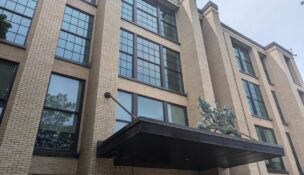
The North Avenue Market today after undergoing extensive renovations as part of a redevelopment project.
A team of local property owners is resurrecting the defunct North Avenue Market, once the city’s biggest, as a 60,000-square foot mixed-use development that is the newest touchstone of the city’s nascent midtown arts district.
Built in 1928 at a cost of nearly $2 million, the market was once home to 254 stalls selling produce, fish and meat, in addition to lunch counters and delis. A six-alarm fire ravaged the property in 1968, and it never fully recovered. In 1970, a large portion of the market, facing 20th Street, was razed to build a low-income housing high-rise that stands today.
Over the years in the space that remained, several businesses that typically operate in low-income neighborhoods, including a check-cashing business and a Family Dollar franchise, leased storefronts in the market.
Now, the market’s rebirth is a result of the efforts of Michael L. Schechter, a prominent property owner in the area, and his equity partner, Carolyn Frenkil, a first-time player in local real estate development, whose husband, a physician with side investments in real estate, purchased the property shortly after the fire.
“The whole thing was gutted by the fire and the water damage,” Frenkil said. “It was really quite horrific.”
The two partners said they have been working to make the new North Avenue Market a reality for the last two years, renovating more than 20,000 square feet of retail space and attracting business owners to lease it.
State records show that the one-acre property, which was acquired by Schechter’s company, Center City Inc., was worth $642,000 in July 2007. The developers declined to comment on the property’s current value but said that their improvements have amounted to between $500,000 and $1 million.
Schechter said some businesses near the market are more suitable than others to remain as the neighborhood becomes more gentrified.
“We’ve got check-cashing but we’ve also got [pizzeria] Joe-Squared,” he said. “We’ve got [music venue] Lo-Fi Social Club, but we’ve also got the North Avenue Motel. … I don’t have anything against North Avenue Motel. I don’t even really know them. I just don’t see it as the future of the neighborhood.”
In a part of the market where a retail clothing operation stood until about a year-and-a-half ago, a new bar called the Wind-Up Space is slated to open May 6. The bar will feature performances of independent music, art shows and film screenings.
The market’s main stall area, which was once home to the Sacred Zion Full Baptist Church, will be converted into an artists’ collective, featuring craftspeople from the Baltimore Glassworks and the Greater Baltimore Cultural Alliance, and a coffee shop and bookstore operated by the Baltimore Chop, Schechter said.
The renovation of the North Avenue Market is in line with the city’s vision for the redevelopment of the Station North Arts and Entertainment District, which covers the area between Penn Station and North Avenue, bounded by Howard Street on the west and Calvert Street on the east.
Near the Maryland Institute College of Art, the University of Baltimore, and the upscale art galleries and restaurants of Mount Vernon, Station North is meant to be the next wave of arts-anchored development to creep up Charles Street.
In the last few years, a handful of arts-related businesses and performance venues, including Load of Fun Studios and Westnorth Studios, have opened along the blighted blocks near Charles Street.
“We’re overcoming the perception of the decline of this neighborhood,” Frenkil said. “So we’re trying to get foot traffic going on North Avenue, people coming to events. You don’t want to build out until you have something built to base it upon. The people on [North Avenue]. they could see beyond the obvious, and we have the same vision. … This is the new Portland.”
Frenkil is an outgoing woman who used to run the state’s office of occupational licensing. Later, she ran a company that did pre-employment drug screening tests for large companies. Standing inside what will soon be the Wind-Up Space bar, she joked, “I gave up drugs for booze.”
She met Schechter, whose real estate holdings include the nearby Charles Theatre, Tapas Teatro and the Metro Gallery, through their common accountant.
“They’re leading the way,” said Michael Deets, chair of the Midtown Community Benefits District. “They’re showing leadership by creating value in the neighborhood. … [They’re] creating an atmosphere where property owners can see that there are positive opportunities that they can use their land-bank properties for.”
David Bielenberg, director of a nonprofit that promotes the Station North Arts and Entertainment District, said there is a real problem of speculators buying properties around the North Avenue corridor and sitting on them for years. He mentioned the stately, art deco Parkway Theatre, at 5 W. North Ave., and several properties owned by Washington-based restaurateur Tony Cheng, as examples.
Cheng, who has purchased at least 10 properties in the Station North area, is trying to attract Asian-owned businesses to establish a small, “Chinatown”-themed retail and entertainment district.
“I’m certainly hopeful that [the market will] be the next stage in the revitalization of North Avenue,” Bielenberg said. “I’m looking forward to not only bringing in artists, but bringing in audiences as well.”
The owner of another stalled rehabilitation property, on the northwest corner of Charles Street and North Avenue, is rumored to have plans to build a jazz club on the site but ran out of money for the renovation, according to Schechter and Bielenberg.
North Avenue Market, its developers say, could be a catalyst for reviving these projects.
“Let’s hope the enthusiasm we have will be contagious, will catch on and will get them going,” Frenkil said.