 Maryland Family Law Maryland family law opinions and commentary
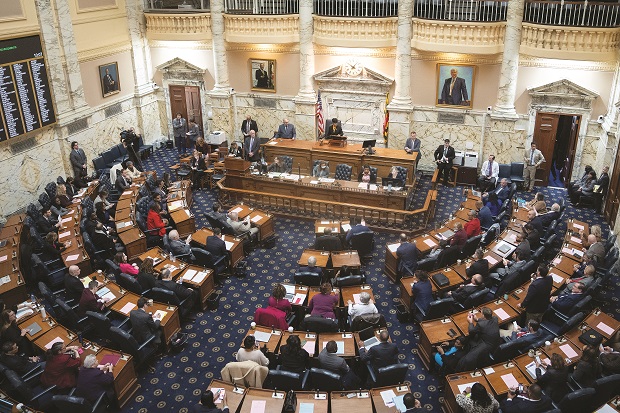
Coming off the heels of the passage of major family law legislation during the 2022 General Assembly session, family law-minded legislators did not pass reforms as sweeping as in 2024. (AP Photo/Bryan Woolston)
For the second year in a row, bills to codify courtroom standards for determining child custody and the qualifications for court-appointed child custody evaluators died this General Assembly session.
But a number of other family law bills made it through both chambers, including several bills relating to children in need of assistance and legislation that established a grant fund for the Victims of Domestic Violence Program.
Coming off the heels of the passage of major family law legislation during the 2022 General Assembly session — with the adoption of legislation that raised the minimum age for marriage and prevented criminal defendants from marrying witnesses to gain their silence, to name a few — family law-minded legislators did not pass reforms as sweeping.
Sen. Chris West, R-Baltimore County and primary sponsor of SB 327, said his bill would have extracted the standards that a judge considers in custody matters for the many individuals who come before the court on a child custody issue pro se.

Attorney Michelle Smith, co-chair of the legislative committee of the MSBA and council member of the MSBA Family Law Section, says she hopes to host discussions before the start of next year’s General Assembly session to reach a possible solution on the custody standards legislation that she described as a “perennial bill.” (Submitted Photo)
The custody standards legislation passed in the House but failed in the Senate, with those opposing the bill believing the presumption in divorce cases should be joint custody of children, West said.
But West said these two issues are separate ones.
“The criteria that the judge ought to take into account when making the decision (of which parent is granted custody of the children) is separate from whether or not there should be a presumption of joint custody,” West said.
West said the bill’s standards are neutral, and that he will reintroduce the bill again next year with the hopes that it will be easier to pass through the Senate.
Also failing to gain full traction this legislative session includes SB 365, which specifies qualifications and training that would be required of individuals in order to be appointed or approved by a court as a custody evaluator.
As co-sponsor of this bill that is a companion bill to a 2022 measure that West introduced that requires judges presiding over child custody cases to undergo certain training, West said the bill’s primary sponsors should “keep the bill as bare bones as possible” and require exactly the same training of the child custody evaluators as is required of judges.
Attorney Michelle Smith, co-chair of the legislative committee of the MSBA and council member of the MSBA Family Law Section, said she hopes to host discussions before the start of next year’s General Assembly session to reach a possible solution on the custody standards legislation that she described as a “perennial bill.”
“It wasn’t a particularly impactful year for family law with the legislation that did pass,” said Smith, who is with Annapolis-based Trainor, Billman, Bennett, Milko & Smith, LLP, of this year’s General Assembly session.
One exception, Smith said, was the passage by both chambers of SB 439, which establishes the Victims of Domestic Violence Program grant fund as a nonlapsing fund in the Governor’s Office of Crime, Prevention, Youth, and Victim Services and authorizes the governor to appropriate $5 million to the fund in the state’s annual budget.
Sen. Sarah K. Elfreth, D-Anne Arundel Coun

“It’s really important to have consistent, dedicated funding to these (domestic violence) programs, especially now,” says Sen. Sarah K. Elfreth, D-Anne Arundel. (The Daily Record/File Photo)
ty and primary sponsor of the bill, said the state funding domestic violence programs has always been critical, and is only more critical post-COVID.
“It’s really important to have consistent, dedicated funding to these programs, especially now,” Elfreth said, noting data shows incidents of reported domestic violence having increased significantly in recent years.
Elfreth said the bill’s passage is a “really powerful signal to the governor” that these programs deserve to be funded at $5 million per year, serving those who answer crisis lines, providing funding for emergency housing, and compensating counselors and social workers.
“We’re asking (counselors and social workers) to support survivors in the toughest of human conditions, and they deserve to be paid well and not feel like their future in working with the domestic violence program is in jeopardy every budget year if we don’t have consistent funding,” Elfreth said.
The bill awaits the Gov. Wes Moore’s approval.
Other family law-related legislation that passed in both chambers include HB 435, which authorizes a court to modify child support if an obligor becomes incarcerated, and the enrolled HB 833 that establishes a presumption that placement with a child’s parent is in the child’s best interest if the parent is receiving certain substance use disorder treatment and the child is receiving proper care.
Looking back on this year’s General Assembly session and what has been accomplished in prior years, West said he thinks Maryland has comprehensive and noncontroversial family law statutes inscribed into law.
“We’re nibbling around the edges here at this point to try to put things in final form to where everybody can agree,” West said. “We have a great body of family law, both in statute and in court decisions. There’s broad consensus over what we need, and in fact we have in place what we need.”
