Sign In
Upcoming Event
 Free Newsletter

Panel OKs eminent domain compromise
Panel OKs eminent domain compromise


 Listen to this article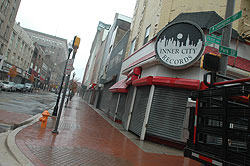
ANNAPOLIS — After two failed attempts to reach a compromise on eminent domain reform, a Senate committee approved a bill Wednesday to increase financial assistance for a business or homeowner whose property is taken.
The Senate Judicial Proceedings Committee unanimously supported Senate Bill 3, which originally made it more difficult for local governments to condemn property for economic development purposes, but was heavily amended to simply increase the caps applied to relocation and re-establishment costs paid to dislocated property owners.
Advocates for reforming the state’s eminent domain laws applauded the vote as a good first step toward providing business and home owners with more protections.
“We’re glad something’s moving. It’s not all that we wanted, but it still provides very meaningful compensation for small business owners who are adversely impacted by condemnation,” said Tom Saquella, president of the Maryland Retailers Association.
Saquella and other small business advocates lobbied this year to require local governments also to compensate displaced businesses for any income lost as a result of the condemnation. Known as “goodwill,” the issue became a sticking point for local government officials, who feared the requirement would make eminent domain cost prohibitive and burdensome.
After a 2005 Supreme Court decision found it is constitutional for governments to use eminent domain for the benefit of economic development projects, the 2006 legislative session saw more than 40 bills addressing eminent domain die because a compromise could not be reached. Proposals ranged from a total ban on using eminent domain in economic development projects to modest compensation increases.
Until yesterday, it appeared there would not be legislative action again this year. But the bill’s sponsor, Sen. James E. DeGrange, D-Anne Arundel, and other advocates decided that increasing the compensation caps would be better than nothing at all.
As amended, the bill would increase from $10,000 to $60,000 the payment a business can receive for re-establishment expenses — such as new signs, moving expenses and searching for a new location. The bill also would increase from $20,000 to $60,000 the amount that can be offered to a business owner wishing to accept a flat fee for all re-establishment expenses. The caps were last adjusted in the 1970s.
Amendments to the bill also removed provisions that would have allowed condemnation for economic development projects only if the local government found there was no feasible way to include the small business in the project.
“I regret that we’re not going to include goodwill, but if this is what happens, it’s a significant step,” said Del. Samuel “Sandy” Rosenberg, D-Baltimore City, who sponsored his own eminent domain legislation that also proposed compensating for business loss.
The Senate amendments should give the bill a better chance to make it through the House, where Environmental Matters Committee Chairwoman Maggie McIntosh, D-Baltimore City, has opposed reimbursement for goodwill.
Noting that Baltimore and other local jurisdictions sometimes use eminent domain as a tool to help complete commercial revitalization projects, she said that requiring goodwill compensation could make those projects too expensive.
“For these shopping areas in Baltimore, it means the difference for a community to go from blighted to vibrant,” McIntosh said.
David Bliden, the executive director of the Maryland Association of Counties, called the Senate bill “a vast improvement over the original bill.”
Local government officials have agreed all along that the compensation caps should be revisited, though Bliden said he hopes other interested parties will remain open to negotiations on the specific numbers. His association proposed placing the caps at $40,000.
“We’re not talking now about different philosophies or new damage elements. We’re talking about defining monetary caps,” Bliden said. “I think if all the interested parties are willing to move on these numbers, I see no reason why we couldn’t work something out this session, and I think that would be in everybody’s interest.”
Of course, not everyone was pleased with the bill.
Sen. Alex X. Mooney, R-Washington and Frederick, voted in favor of the bill but raised concerns that it does not go far enough to protect property owners.
“This is an entirely different bill. This doesn’t even address the issue,” Mooney said before opposing the amendments. “People’s homes are still in complete jeopardy.”
Sen. James Brochin, D-Baltimore County, agreed that the amendments changed the bill’s substance, but told Mooney, “At least we dealt with the compensation, which is the first piece.”
The bill must pass the full Senate before moving to the House.
(Above – A view of the ‘superblock’ in downtown Baltimore, which has been been the subject of eminent domain talks.)