Sign In
 Free Newsletter


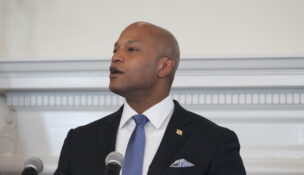
Del. Ben Barnes, who chairs the House Appropriations Committee, said the initial $200 million to $500 million range represents a starting point of sorts. (The Daily Record/Jack Hogan)
House Democrats dig in, advance tax and fee hikes for education, transportation


 Listen to this article
ANNAPOLIS — House Democrats on Wednesday advanced their plan to raise roughly $1.3 billion through tax and fee increases, batting back opposition from Republicans and moving ahead on policies that Senate Democrats and Gov. Wes Moore have said they won’t support.
The House of Delegates is expected to pass its spending and revenue plan on Thursday, paving the way for meetings next week with Senate budget negotiators to iron out differences in approach between the two chambers.
House Democrats have called for the legislature to increase certain taxes and fees — like implementing combined reporting for corporations, adding fees for ridesharing and electric vehicles, and raising toll rates — to account for shortfalls in paying for public education and transportation projects.
While House Republicans and some top Senate Democrats have said they’re concerned about policies like combined reporting driving large companies out of the state, the House’s top budget negotiator said Wednesday that high-performing schools, reliable transportation and a top-notch health care system will be what attract businesses to Maryland and expand the local economy.
“Businesses do not invest in a state that fails to invest in itself,” House Appropriations Committee Chair Ben Barnes said during a floor session.
House Democrats on Wednesday fought back Republican proposals to decrease funding for public defenders’ salary increases and to use the money to instead pay for public education. Republicans also sought to cut funding for abortion services and abortion training for medical professionals, among other measures.
Senate Democrats have centered their more fiscally conservative approach on economic growth, saying tax hikes are unnecessary because of reserves the legislature stockpiled during prior budget years.
Senate President Bill Ferguson said this week that his chamber will be a “hard no” on both combined reporting and on a proposal for online casino gambling, or iGaming, which the House passed last weekend to boost revenue for the Blueprint for Maryland’s Future — a lofty education reform plan that’s driving a structural deficit projected to reach several billion dollars in the coming years.
Ferguson also questioned the extent to which the House’s proposal would restore cuts to transportation projects and services, which stem from a roughly $3.15 billion shortfall the Maryland Department of Transportation is facing over the next six years.
“Everything is a negotiation, but I don’t think we’re at the same place,” Ferguson said to reporters this week. “We want to invest in transportation, we want to invest to make sure that public education is strong, but we have to do it thoughtfully and predictably.”
Lawmakers are awaiting recommendations from the Transportation Revenue and Infrastructure Needs (TRAIN) Commission, established in 2023 to determine how the state will pay for its priority projects and services.
Among the top priorities of the 30-member commission is finding a revenue substitute for the gas tax, which, after a century of being a primary funding source for transportation projects nationwide, is expected to decline significantly with rising fuel efficiency and the surging sales of electric vehicles.
Commission recommendations aren’t expected until next session, though House members say they have the solution.
“The problem is now, we cannot wait a year,” House Environment and Transportation Committee Chair Marc Korman said during a press conference last week.
House Democrats are pushing to increase revenue from vehicle excise taxes, electric vehicle purchases, weight-class registration fees, ridesharing and work zone speeding to restore the transportation cuts from the Moore administration.
The administration’s cuts would affect more than a dozen major road projects, some of which are up for construction funding in the next fiscal year, as well as six major bridge projects and maintenance on another dozen bridges.
“A real solution, from the transportation perspective, includes restoration of those severe cuts,” Barnes said.
The chairman said a “real solution” would also give the Maryland Department of Transportation a financial cushion to avoid debates about tax increases next year, and it would pay for major projects, like the proposed Red Line transit system in Baltimore, to reach their next development phase.
The two chambers are expected to reach some level of consensus in the coming weeks and pass a balanced budget by April 1.