Sign In
 Free Newsletter

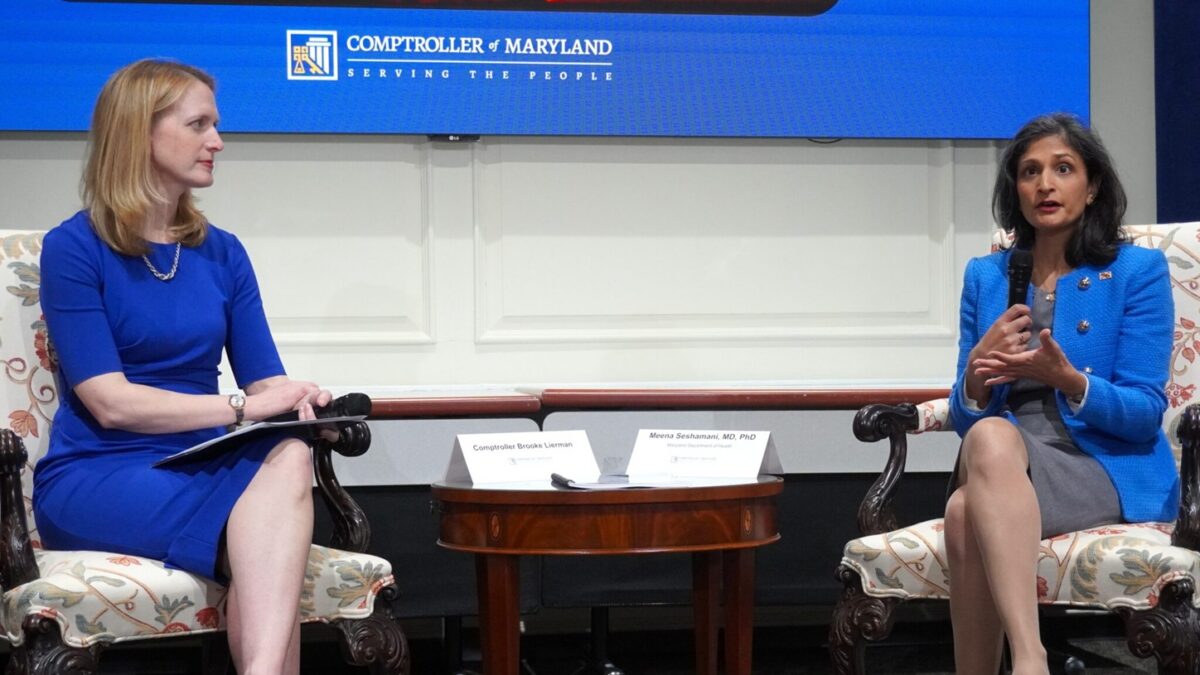
Comptroller Brooke Lierman, left, and Health Secretary Meena Seshamani talk through some of the challenges facing Maryland's healthcare industry. (Photo by Danielle J. Brown/Maryland Matters)
MD comptroller report reveals steep challenges facing healthcare industry
From workforce shortages to looming federal funding cuts, state leaders discuss the challenges, and opportunities, facing the state’s leading job creator


 Listen to this article
Key takeaways:
- Maryland healthcare employs about 427,000 people, report from Comptroller Brooke Lierman‘s office finds
- Registered nurses saw an average of 9,000 unique job positions open each month in 2025
- Federal Medicaid funding cuts could total $2.7 billion
Healthcare and social assistance is the largest industry and leading job creator in Maryland, employing about 427,000 people with 51,000 new jobs added since 2022, but there are strains on the industry, a new report says.
Those include an aging workforce, high vacancy rates in some professions, likely cuts in federal funding at a time when the state’s population is aging and needs more care, among other challenges.
Those are just some of the findings outlined in the “Maryland Industry Analysis: Healthcare and the Economy,” a new economic report from Comptroller Brooke Lierman’s (D) office. Lierman said she wants lawmakers and advocates to use the information in the report to help untangle Maryland’s “unique” and “complex” healthcare system and address issues on affordability, access to care and workforce stability in years to come.
“It really is a challenging time, and this work is so important,” Lierman at an event Wednesday to discuss the report.
“We produce reports like this because we hope they are helpful to our agencies, to our policy makers and to our public to understand the challenges but also the opportunities that are present to us,” she said.
Health Secretary Meena Seshamani joined Lierman for a discussion on the report and how the state can use current and future resources to work on those challenges. Their chat was followed by a panel of state officials, hospital representatives and workforce advocates to further break down the findings and implications for various arms of the healthcare industry.
The 94-page report is the newest addition to an economic analysis series from the Comptroller’s Office over the last year, but it’s the first report focusing on a specific industry in the state.
Many of the findings are grim, but not unexpected, as several of the points raised in the report have been discussed by advocacy groups or smaller data reports over the last few years.
The report says the healthcare industry has been the leading job creator for seven of the past 10 years. The 427,000 people employed in the healthcare sector support 16% of all jobs in Maryland.
“That’s huge,” Lierman said. “The industry accounts for 8% of the state’s GDP [gross domestic product] and 13% of total wages in the state.”
But the report cautions that a growing health industry “does not necessarily signal a healthy economy,” as it also means that there is more utilization of what can be costly healthcare services, leading to increased costs for payers all around.
“We worry about this crowding-out effect … when individuals, businesses, governments spend more on healthcare, they have less to spend elsewhere – perhaps, on housing, on childcare, food, education, etc.,” Lierman said.
The report offers some demographic data about who works in healthcare fields. For example, women make up almost 80% of the healthcare workforce with one notable exception – men make up 58% of Maryland’s physicians. Those figures are aligned with national trends.
Meanwhile, roughly 30% of healthcare workers are immigrants, a higher share than in neighboring states and the United States as a whole, leaving Maryland’s healthcare work force “disproportionally vulnerable to anti-immigration actions.”
There are other challenges. In 2025, registered nurses had the highest number of job openings among healthcare occupations, with an average of 9,000 unique job positions open each month but only an average of 1,800 new registered nurses hired per month.
Despite being one of the only industries continuing to grow in the state and nationally, some fields like behavioral health and primary care have significant staff shortages. And approximately 40% of nurses plan to leave the workforce or retire within the next five years, according to a 2024 survey from the National Council of State Boards of Nursing.
The aging population adds to those troubles, as 65 years and older is the fastest-growing age group in the state over the past decade.
Melony Griffith, president and CEO of the Maryland Hospital Association, including herself in the aging population, emphasized that the increase in older patients is leading to more expensive medical costs.
“We’re sicker, we have more complex needs,” Griffith said. “So having the team in place that can provide that hands-on care – that’s going to be needed. It’s one of the areas we need to focus on.”
Meanwhile, coming changes under H.R. 1, the so-called “One Big Beautiful Bill Act” passed by the Republican-controlled Congress last year, will likely reduce federal Medicaid funding to Maryland by $2.7 billion, representing 20% of the state’s current Medicaid budget, when all the provisions kick in in fiscal 2027.
H.R. 1 will also likely result in loss of Medicaid coverage, due to increased work requirements that the health department estimates 130,000 Marylanders will struggle to keep up with.
The challenges are many, but one of the recurring themes during Wednesday discussion was the importance of preventive care and primary care to keep health care costs down as much as possible. The health department recently announced a Medically Tailored Meals program, for example, so that people with diabetes and heart disease facing food insecurity can access food that works best with their health needs.
“That is a perfect example of where we can use the incredible amount of healthcare dollars that our in our system to actually getting to the root cause of what is making people not healthy,” Seshamani said.
She also noted that Maryland’s new hospital rate-setting model has requirements to boost access to primary care that could help provide more chances to catch ailments earlier, before they can rack up costs.
“If people cannot access the care that they need early on … people get sicker and it becomes even more expensive to treat,” Seshamani said. “What we are all working on is how do we spend that healthcare dollar in a smarter way.”
Danielle J. Brown is a new Maryland resident covering health care and equity for Maryland Matters.
Maryland Matters is part of States Newsroom, a network of news bureaus supported by grants and a coalition of donors as a 501(c)(3) public charity. Maryland Matters maintains editorial independence. Contact Editor Steve Crane for questions: [email protected]. Follow Maryland Matters on Facebook and Twitter.