Sign In
 Free Newsletter

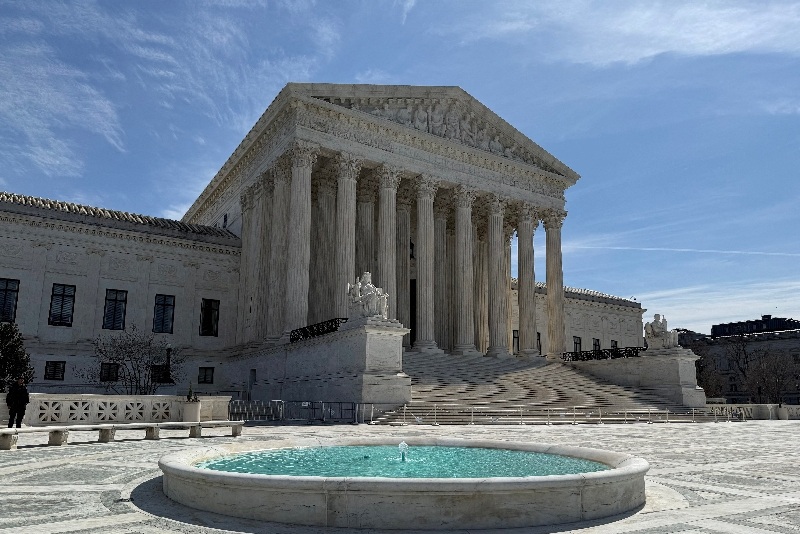
A person stands near the U.S. Supreme Court building in Washington on March 14, 2026. (REUTERS/Will Dunham/File Photo)
Supreme Court rejects MD woman’s attempt to press state, federal cases


 Listen to this article
Key takeaways:
- Supreme Court rules 5-4 against Maryland woman
- Case involves involuntary commitment and forced antipsychotic medication
- Rooker-Feldman doctrine prohibits federal suit before final state judgment
- Justice Amy Coney Barrett dissents, citing expanded doctrine concerns
A divided Supreme Court Thursday said a Maryland woman cannot press a lawsuit against the University of Maryland Medical System while her state court appeal of the same issue is still pending.
The court ruled 5-4 against a woman identified only as T.M., saying a narrow doctrine prohibits “state-court losers” from taking their cases to federal court for review before the state courts have entered a final judgment in the case.
“This case asks whether this rule bars suit when the state court judgment at issue is subject to further review in state appellate proceedings. A straightforward application of the logic and reasoning underlying Rooker-Feldman [doctrine] leads to one conclusion: It does,” Justice Sonia Sotomayor wrote for the majority.
The case, T.M. vs. University of Maryland Medical System, began in March 2023 after T.M. was hospitalized after a psychotic episode. The court said T.M. said she has “a medical condition that ‘causes changes in [her] mental status upon ingesting any amount of gluten’ and can result in ‘episodes of psychosis,’” according to the opinion.
She was taken to the emergency room at Baltimore Washington Medical Center where she and her father sought to have her voluntarily committed. But, over their objections, she was involuntarily committed, and while there her “treating psychiatrist and the medical center sought, and were granted by a clinic review panel, an order authorizing the facility forcibly to inject T. M. with antipsychotic medication.”
Both the involuntary commitment and the order allowing her involuntary medication were upheld by subsequent administrative review panels. She would ultimately remain committed for about three months.
T.M. and her family went to state court seeking her dismissal on several grounds, and they filed a federal due process suit seeking damages and her release.
While those cases were pending, the family and the hospital reached a settlement agreement that allowed for T.M.’s release on several conditions, including continued treatment and the dismissal of legal actions. The settlement was entered as a consent order by the state district court judge, and T.M. was released.
Within 10 days, however, the family filed a new suit in federal court claiming the consent order was obtained under duress and seeking to block its enforcement. She also appealed the consent order to the Appellate Court of Maryland.
About four months later, she asked the Appellate Court to stay her suit there to “’prevent inconsistent rulings’ because both the state appeal and the pending federal lawsuit were ‘based on the same facts and
events,’” court documents said.
The Appellate Court agreed to put the case on hold, but the U.S. District Court dismissed the case. It said it did not have jurisdiction under Rooker-Feldman, which “generally holds that federal courts lack jurisdiction over lawsuits brought by parties who received adverse judgments in state courts and then turn to federal courts seeking ‘review and rejection of ‘ those judgments.”
The 4th U.S. Circuit Court of Appeals upheld the district court, sparking the appeal to the Supreme Court. It agreed to take the case to resolve a split between circuit courts, which have ruled differently on the question.
While plaintiffs can file federal lawsuits that make a collateral attack on an issue to a state suit, only the Supreme Court can consider an appeal of a state court ruling, Sotomayor wrote, and only after the ruling is final at the state level. To do otherwise, the court said, would be creating duplicative work, “anomalous outcomes” and undermine the principles of federalism.
But Justice Amy Coney Barrett, in a dissent, said the Rooker-Feldman rule has turned into “perhaps the primary docket-clearing workhorse for federal courts” looking to dispose of cases. There are other “preclusion and abstention” doctrines in place the prevent federal courts from relitigating settled issues or interfering in ongoing state cases, she wrote.
Barrett, joined by Justices Elena Kagan and Neil Gorsuch and Chief Justice John Roberts, said that rather than restraining the Rooker-Feldman doctrine as it claimed it was doing, the majority expanded it and “has muddied waters that were hardly clear to begin with.”
“Still, the news is not all bad. Although the Court expands Rooker-Feldman beyond Exxon’s line, it repeatedly emphasizes that the doctrine is ‘narrow,’” Barrett wrote. “Courts should not lose sight of that message. In the end, Rooker-Feldman has been given an inch—it should not be allowed to take a mile.”
Requests for comment from attorneys in the case were not immediately returned Thursday. But the University of Maryland Medical System, in a statement late Thursday, welcomed the ruling.
“We believe today’s Supreme Court decision provides important clarity regarding the legal framework governing state court proceedings,” the statement said. “We appreciate the Supreme Court’s careful consideration of this matter … and are pleased that the Supreme Court justices agreed with our position, which affirms the legal principles and longstanding precedent in this case.”
Maryland Matters reporter Mayah Nachman contributed to this report.
Maryland Matters is part of States Newsroom, a network of news bureaus supported by grants and a coalition of donors as a 501(c)(3) public charity. Maryland Matters maintains editorial independence. Contact Editor Steve Crane for questions: [email protected]. Follow Maryland Matters on Facebook and Twitter.