Sign In
Upcoming Event
 Free Newsletter

Collaborative law catches on
Maryland joins the small but growing number of collaborative-law states
Collaborative law catches on
Maryland joins the small but growing number of collaborative-law states


 Listen to this article
Talk more to each other, less to the judge.
That’s the theory behind the collaborative law process, designed to advance settlements of civil cases without trial.
While it shares that goal with most methods of alternative dispute resolution, collaborative law is unique in that the opposing parties hire counsel solely for the purpose of negotiating an out-of-court settlement. If the process fails, the parties must find new lawyers — a strong incentive to work things out.
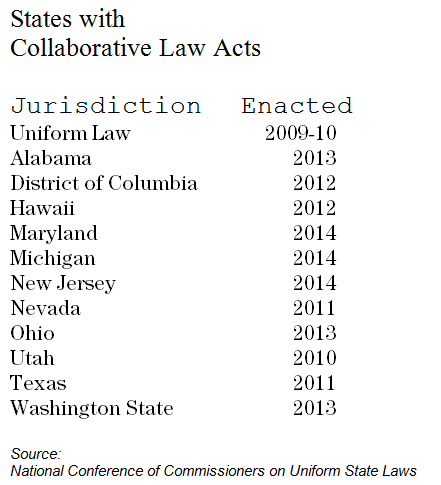
Maryland enacted a collaborative law act this year, making it one of 11 states to do so in the last five years (see box, page 13A). And the Maryland Judiciary’s rules committee has given preliminary approval to standards designed to implement the act, spelling out the attorneys’ responsibility before, during and after the process.
Collaborative law advocates say they hope the momentum drives more interest from lawyers and parties alike.
Unlike some states, in Maryland the process is not limited to family-law disputes. However, advocates see a great opportunity for its use in that field.
Collaboration “allows parties to have control over how they want to disassemble their marriage and prepare for the future,” said attorney Stacey E. Andersen, A Baltimore solo practitioner and president of the Maryland Collaborative Practice Council. “It allows them to achieve a durable agreement.”
Carrot and stick
The collaborative process permits divorcing spouses to speak directly to each other with the assistance of their attorneys. Often a neutral accountant is present to recommend the division of property, as well as a child psychologist, if necessary. No mediator is present and either spouse can call off the process and bring the case to court — but there is a catch.
If the process fails and the case heads to litigation, the spouses must retain new counsel under the law and rule.
The policy behind the need for new attorneys is to encourage the divorcing spouses to remain in the collaborative process, which is generally less acrimonious than litigation in family-law disputes, said attorney Kathleen M. Wobber, the council’s secretary.
“It allows for apology,” said Wobber, of Parler & Wobber LLP in Towson. “There is no place for apology in litigation. In fact, it is discouraged.”
In a collaborative family law case, the parties would agree to full disclosure of assets and a discussion of child custody issues in hope of avoiding the actual and collateral costs of litigation — like putting the fate of their children in a judge’s hands.
But family-law attorney Mary Roby Sanders voiced concern with the expense of a collaborative law process, which involves the retention of experts on many topics, such as an accountant and child psychologist.
Sanders also questioned the need for the collaborative process because most family-law practitioners know each other and strive to settle cases amicably even during the course of litigation.
“We generally have a collegial relationship with our opponents, which is helpful to the clients,” said Sanders, of Turnbull, Nicholson & Sanders P.A. in Towson. “Most attorneys work collaboratively in the family law realm, or we try.”
Attorney Luiz R.S. Simmons, another skeptic, said the inconvenience and expense of finding new counsel if collaboration fails could place an “inordinate” amount of pressure on either or both spouses to remain in a process that might not bring them an adequate resolution.
“Having to, in effect, divorce yourself from the lawyer and start a new relationship is threatening to a lot of people,” said Simmons, a Silver Spring solo practitioner and Democratic state delegate from Montgomery County. “You have to go out in the cold and start with someone new.”
But attorney Craig J. Little, who founded the Maryland Collaborative Law Association Inc., called the criticism reminiscent of concerns lawyers expressed about having family-law disputes resolved through mediation a generation ago, when that was a new alternative.
“Every attorney works from their own frame of reference,” said Little, a Towson solo practitioner. “Mediation was the new kid on the block 15 years ago.”
“It will take time” for collaborative law to be fully embraced, he added, adding he hoped it would not be a long time.
Duty to investigate
Not everyone is a good candidate for collaborative law. In fact, the Rules Committee’s proposal requires attorneys who plan to represent a client in the process to first make a “reasonable effort” to discover whether the client has had a “coercive or violent relationship” with another party. If the investigation reveals such a strain, the lawyer would have to decide if the collaborative process is appropriate.
The preliminary rule also contains an “informed consent” provision requiring lawyers to provide their clients with “information that the attorney reasonably believes is sufficient for the client to make an informed decision about the material benefits and risks” of a collaborative law process. The attorney must also tell the client the process is voluntary and that any party can end it for any reason or no reason at all and resume with the litigation.
The parties would also be able to ask the court to put the litigation on hold during the collaborative process. The rule would require judges to set a specific end-date for the stay, which they could later extend.
Family-law attorney Jac E. Knust said collaboration is not the first word people think of in the often-heated context of divorce, particularly if children are involved.
He said the process can and does disintegrate quickly “when one or both of the parties don’t have a grasp of reality.”
For example, a husband or wife might be so sure they are in the right that they “don’t see any grays in this world; they see everything in black and white,” said Knust, founder of The Collaborative Law Group in Columbia.
“It’s probably not a good process for them,” he added. “They’re going to fight it every step of the way, thinking the judge is going to give them a better deal.”
But the collaborative process is appropriate for divorcing spouses who do not want to cede the final decision to a judge or endure the time and expense of depositions, interrogatories and court hearings, Knust said.
The collaborative process “really puts the onus back on the parents, where it should be, or back on the spouses, if there are no kids, to resolve their own dispute,” Knust said.
Agreements reached through collaboration rather than litigation, he said, are more likely to provide “a lasting peace.”
Editor’s note: This is an edited version of “We can work it out,” which originally appeared in The Daily Record’s Family Law Monthly. For more information about Maryland Family Law Monthly, go to https://thedailyrecord.com/maryland-family-law/
Maryland and the Uniform Collaborative Law Act
The Uniform Collaborative Law Act was promulgated by the Uniform Law Commission in 2009, designed to promote the idea of hiring attorneys for the sole purpose of settling cases out of court. The law “standardizes the most important features of collaborative law practice, remaining mindful of ethical considerations and questions of evidentiary privilege,” the commission says.
The uniform law was amended in 2010 to provide a few other options: a Rules-only alternative that did not require legislation, and a family-law only option. Neither alternative was used in Maryland.
Utah (2010), Nevada and Texas (both 2011) were early adopters of the law. In Maryland, Delegates Jeffrey D. Waldstreicher and Kathleen Dumais, both Montgomery County Democrats, first introduced a collaborative law measure to the General Assembly in 2012. That bill, HB 477, was withdrawn after receiving an unfavorable report by the Judiciary Committee.
The two tried again this year, with a third co-sponsor (Del. Eric Luedtke, also a Montgomery County Democrat) and a cross-filed measure in the Senate, SB 805, sponsored by Sen. Jamin B. ‘Jamie” Raskin and a host of co-sponsors.
The Senate measure actually cleared first, passing at the end of March. The bill then won approval in committee, the House and the Senate (again) in a matter of days, gaining final approval on April 7. The law took effect Oct. 1.
Maryland was one of three states to enact a version of the law in 2014, bringing the total to 11.