Sign In
 Free Newsletter


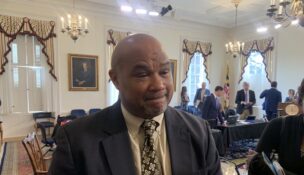
Sen. Arthur Ellis protests Senate leadership's decision to not bring a bill to redraw Maryland's congressional districts to the floor on Feb. 5, 2026. (Hannah Gaskill/The Daily Record)
Is MD redistricting still on table after SCOTUS decision? One senator is still pushing.


 Listen to this article
Key takeaways:
- Sen. Arthur Ellis calls for a special session on Maryland redistricting.
- U.S. Supreme Court allows Louisiana to redraw its districts.
- Maryland House Speaker Joseline Peña-Melnyk supports redrawing Maryland’s map.
- Senate President Bill Ferguson opposes midcycle redistricting.
State Sen. Arthur Ellis is attempting to reignite the conversation around redrawing Maryland’s congressional map following the U.S. Supreme Court decision that weakened the Voting Rights Act of 1965.
Ellis, D-Charles County, held a news conference in Annapolis on Tuesday morning calling for the General Assembly to convene a special legislative session to review the state’s congressional and legislative maps.
“The urgency [of] this issue is underscored by actions already underway in other states,” a news release from Ellis’ office reads. “Jurisdictions such as Louisiana, Florida, and South Carolina are actively adjusting their election timelines, including modifying primary dates.”
For all intents and purposes, redistricting is extremely unlikely to take place in Maryland this election cycle. But will the U.S. Supreme Court opinion allowing Louisiana to redraw its map instigate other states to try the same before the November midterm election?
“I think given where we are in the calendar and how … many states are already past their deadlines for filing … I think it’s unlikely you’re going to see many other states beyond Louisiana in this cycle,” said Flavio Hickel Jr., an assistant professor of political science at Washington College.
Todd Eberly, a professor of political science and coordinator of public policy studies at St. Mary’s College of Maryland, said he believes “states are going to try as best they can” to move new maps before November but, like Hickel, noted that success could be challenging this late in electoral process.
“What I expect is we’re going to see another huge round of midcycle redistricting, but it will take place after the midterm elections,” he said.
In late April, the U.S. Supreme Court issued a 6-3 opinion in the case Louisiana v. Callais deeming that the state’s majority-minority district is unconstitutionally gerrymandered. Reporting from SCOTUSblog on Monday stated that the court granted a request to immediately finalize its opinion to allow Louisiana to redraw its congressional districts ahead of the 2026 midterm election.
Maryland’s push to redraw its map largely fizzled out with the close of the 2026 legislative session.
In November, Gov. Wes Moore, a Democrat, convened the Governor’s Redistricting Advisory Commission to solicit Marylanders’ interest in redrawing the state’s congressional map midcycle after a handful of states — starting with Texas — enacted new maps of their own.
“We know that this is a priority,” Moore said in December. “That being able to defend our Democracy and have fair and competitive maps, that that is something that is a priority of the people of Maryland.”
Last July, the U.S. Department of Justice sent a letter to Texas Gov. Greg Abbott and Attorney General Ken Paxton, both Republicans, alleging that the state had several majority-minority congressional districts. Texas then redrew its map, adding five more Republican districts.
North Carolina, Utah, Missouri and Ohio followed suit.
In response, California voters approved a state referendum to enact a redrawn map, adding five Democratic districts. It will go into effect until the map is reconfigured by the California Citizens Redistricting Commission after the 2030 census.
Hickel said that prior to the push on behalf of President Donald Trump’s administration to have Republican-led states redraw their maps, midcycle redistricting was rare. The last instance he could recall was in 1996, when then-Gov. George W. Bush, a Republican, challenged Texas’ majority-minority districts after the 1990 census.
Midcycle redistricting was “widely seen by most Americans until now as a blatantly partisan process,” Hickel said. “Politicians are choosing their voters rather than the other way around.”
Maryland’s attempt at midcycle redistricting had legs until it reached the state Senate.
During the 2026 legislative session, House Speaker Joseline Peña-Melnyk, D-Anne Arundel and Prince George’s, supported the push from Moore to redraw the state’s congressional map in a manner that would have likely eliminated Maryland’s lone Republican-held congressional district.
“Everyone knows where the House stands on this issue,” Peña-Melnyk said in a Monday statement in response to Ellis’ call for a special section. “With the Supreme Court’s gutting of the Voting Rights Act, the urgency is only greater, and the House stands ready to act to protect voters and strengthen our democracy.”
The House passed legislation in early February that would have put that map into effect on a vote of 99-37. But that bill was stalled in the Senate, leading Ellis to protest by not registering his name during Senate roll calls as to not give the chamber a quorum.
The House also amended redistricting language into a hard-fought bill that would have allowed Maryland voters to determine whether the state should hold special primary and general elections to fill vacancies in the General Assembly. The amendment rendered the bill dead in the Senate.
Senate President Bill Ferguson, D-Baltimore City, has been staunchly against redrawing Maryland’s congressional map midcycle, noting that the push to pass the bill was up against the state’s campaign filing deadline and that both the new and current maps would likely be challenged in court.
Maryland’s current congressional map came to be after a map approved by the legislature during a special session in December 2021 was challenged in the state’s highest court.
In 2022, former Maryland Supreme Court Judge Lynne A. Battaglia struck that map down, ruling that it violated the Maryland Constitution. She called it “a product of extreme gerrymandering.”
The General Assembly redrew the map by the end of the 2022 legislative session, leading all contesting parties to withdraw their legal claims.
Maryland’s current 7-1 map has never been reviewed by the courts. Ferguson has expressed concerns that approving a new map could lead to the loss of more than one democratically controlled district via a court-drawn map.
Every member of the Maryland General Assembly is up for reelection in November. Ferguson’s Democratic primary challenger, Bobby LaPin, has criticized the incumbent for not forging ahead with a new map. LaPin delivered a petition with nearly 7,000 signatures to Ferguson’s office in February, demanding that he bring the bill to redraw the map to the floor for a vote.
According to the senate president’s office, a review of the petition indicated that at least half of the signers had out-of-state zip codes.
Asked if Ferguson’s stance against redistricting could hurt his reelection effort, Hickel said that it could, but the professor doesn’t see it as the “most salient issue among voters.”
Although a redistricting domino effect is unlikely to happen before the midterms, Hickel said there is a good chance that states will continue to redraw their maps midcycle after the election is over and that Democrats who had previously aligned themselves with grassroots efforts to ban midcycle redistricting will choose to “fight fire with fire” rather than being snuffed out.
“The challenge that Democrats have now is, Republicans have really shown, beginning in Texas … that the guardrails are off,” he said. “Democrats right now feel like if they continue to hold the moral high ground, they’re going to lose. They’re going to be wiped out.”
Eberly said the country is likely to “see how bad this could become before we see legislation having a chance to stop it.”
However, he also said that the decision in Louisiana v. Callais could prove useful to blue states — including Maryland — because they are no longer required to draw majority-minority districts that favor Republicans.
“In Maryland, the desire to create majority-minority districts has hindered their ability to make the” first congressional district “no longer a Republican district,” Eberly said. “This ruling takes the legal onus off of them to do that.”