Sign In
 Free Newsletter

Hogan, Democrats step up war of words on crime legislation


 Listen to this article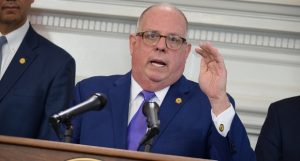
ANNAPOLIS — Republican Gov. Larry Hogan Thursday called on the Democratic-controlled legislature to quickly pass a package of bills he said will address violent crime in Baltimore and proposed making them emergency legislation, a change that is likely to leave Democratic lawmakers unmoved in their opposition.
A frustrated Hogan traded words with Senate President Bill Ferguson and Senate Judicial Proceedings Chairman Will Smith over the lack of legislative attention to his crime package designed to ease violent crime in Baltimore.
Hogan stopped short of proposing alternatives beyond a demand for passage of his bills, and he defended comments a day earlier in which he called for Smith to step aside as chairman of his committee.
“We don’t want to hear any more excuses,” said Hogan. “There can’t be any more delays.”
The governor told reporters Thursday he will ask the legislature to treat his bills as emergency legislation. The change would allow Hogan to immediately sign and put into effect his proposals if they are passed by lawmakers.
The change is somewhat meaningless as Democrats expressed no interest in moving his bills as currently drafted.
Hogan in the two weeks since his State of the State address has become more vocal in public events and on social media. He has called on the legislature to pass his crime package, chiding them for instead focusing on what he sees as less important bills, such as one banning the release of balloons.

Democratic lawmakers, including Smith, said Hogan’s bills bring back draconian punishments that disproportionately imprison minorities while not dealing with the root causes of criminal activity.
“While some of the draconian policies of the past have done effective things in locking people up for generations, we now find ourselves in a position where violent crime in Baltimore city and throughout the state is worse than ever,” said Smith. “Oh, and by the way, we’ve destroyed and decimated a generation of Marylanders, most of whom are black and brown.”
Legislation on Hogan’s agenda includes tougher mandatory minimums for violent offenders who use firearms in the commission of a crime as well as tough penalties for the use of weapons with obliterated serial numbers. The governor also wants tougher sentences for witness intimidation as well as the ability to track sentences handed out by judges.
“While I respect the governor’s position, I don’t think it’s the right thing to go back to those same oppressive law enforcement policies that have landed us in the position we’re in now,” said Sen. Jill Carter, D-Baltimore and a member of the Senate Judicial Proceedings Committee. “And if we’re serious about dealing with crime in Baltimore and other places I think a starting place would have been to consult with the six senators that represent Baltimore city.”
Democrats have their own package, which includes a witness intimidation bill that, like Hogan’s, allows for broader use of statements from witnesses who are unavailable to testify. The legislature’s bill dispenses with stiffer penalties.
Democratic lawmakers earlier this year also proposed stiffer penalties for failing to report lost or stolen firearms as well as a statewide crime coordinating council and four to six regional councils to help police departments coordinate crime-fighting efforts.
Hogan called the proposals “phony bills” and “do-nothing pieces of legislation masquerading as crime bills.”
One Republican lawmaker backed the governor in calling for a sense of urgency in enacting legislation.
“When we play politics with law enforcement, people die, they get raped,” said Sen. Robert Cassilly, R-Harford and a member of the Senate Judicial Proceedings Committee. “We do need to ramp up our effort and put (the governor’s crime bills) first, certainly above the balloon bills.”
Hogan also scolded Democrats, including Baltimore Mayor Bernard C. “Jack” Young, for characterizing the $4 billion Kirwan Commission education recommendations as “life or death.”
“But I’m sorry, no, that is not the top priority of Marylanders,” said Hogan, listing a number of polls he said showed support for his initiatives. “That is not a crisis and it is not a matter of life and death. The actual and the only life and death crisis is the people shot and killed every single day on the streets of our largest city.”
Resignation demands
Hogan ramped up his pressure Wednesday when he told The Baltimore Sun that Smith, chairman of the Senate Judicial Proceedings Committee, should step aside as chairman after public proclamations that he would not allow Hogan’s bills out of committee.
Ferguson, the Senate leader, spoke in defense of his chairman before the opening of the Senate session Thursday.

“From the very outset, I think we’ve tried to set the tone that this session is all about trying to solve problems and not pointing fingers. In the comments, the governor went over the line in suggesting (Smith) should resign because the bills aren’t moving fast enough,” said Ferguson before criticizing Hogan’s Department of Parole and Probation.
Ferguson said Hogan’s comments were “totally inappropriate” when nearly a third of the people under the supervision of parole and probation “were either victims or perpetrators of the most violent crimes in the state.”
“To suggest that when an agency could start solving the problem today, that’s unacceptable,” said Ferguson. “That’s not how we will be addressed in the Senate.”
Both Ferguson and Smith invited Hogan to come and testify on the crime issue.
“If this is such a priority and if he has data to support for implementing new mandatory minimums, then please come down to this committee and give it to us,” said Smith. Give it to us and then we can wrestle with it and have an intellectually honest conversation.”
Former Gov. Martin O’Malley, testified on a handful of times during his two terms on some of the bills that were his biggest priorities including increases in the minimum wage and the repeal of the death penalty. Hogan, in his first five years in office, has yet to appear personally before a committee on any of his proposals.
“The governor usually doesn’t go down and talk before the legislature,” said Hogan before telling reporters he believed Ferguson and Smith wanted him to appear to speak during hearings on legislative crime legislation he called “two phony bills.”
“You can send him a copy of the testimony I just gave you,” Hogan told reporters, referring to his news conference.