Sign In
 Free Newsletter

Access to education, HBCU funding among higher ed priorities in 2021


Between unexpected closures, shaky reopenings, salary cuts and more, Maryland universities have taken the force of the coronavirus pandemic head-on.
As schools head into the spring semester, and the Maryland General Assembly heads into its 2021 session, the legislature’s priorities for higher education are varied — and aren’t all strictly COVID-19-related.
Legislators are highly concerned about ending a 14-year-long legal battle alleging that Maryland has academically and financially prioritized its historically white institutions over its historically Black colleges and universities.
Other systemic issues facing Maryland’s university students — such as food insecurity, cuts to scholarships and collective bargaining for student workers — are also in the spotlight, having been exacerbated by the pandemic.
HBCUs
Legislators will seek to reintroduce a bill, originally introduced last session, that would end an ongoing lawsuit between the Coalition for Equity and Excellence in Higher Education, a group representing alumni of Maryland’s HBCUs, and the state.
The lawsuit alleges that the HBCUs — Bowie State University, Coppin State University, Morgan State University, and the University of Maryland, Eastern Shore — have been underfunded, and that historically white institutions have been allowed to replicate programs at HBCUs, siphoning students from those programs.
A bill, which passed through the General Assembly with nearly unanimous bipartisan support in the 2020 session, but was later vetoed by Gov. Larry Hogan, would have ended the lawsuit by distributing $577 million to Maryland HBCUs over the course of 10 years.
Regardless of the bill’s surprising death last session, the legislative solution is still seen as the correct path to ending the lawsuit. Language in the original bill stated that Maryland had to reach a final settlement with the coalition by Dec. 1, so legislators plan to reintroduce the bill this session, changing that language, rather than override the governor’s veto.
The bill will be essentially the same, aside from that timeline, said Del. Darryl Barnes, D-Prince George’s and chair of the Legislative Black Caucus. The plan is to reintroduce it very early in the session, so that if it is vetoed again, that veto can be overridden in the same session.
“It’s something that the Legislative Black Caucus supports wholeheartedly and something that we have been fighting for for years,” Barnes said. “Our HBCUs are not receiving the same level of funding as our white institutions and our flagship school, so for them to be able to receive this additional funding, it helps. It’s not a solvent, but it’s moving in the right direction.”
Accessibility
With the COVID-19 pandemic causing many Marylanders to lose their sources of income, many college students have also lost the means to pay for their education. That is why measures to make universities more financially accessible continue to be high priority, said Sen. Mary Washington, D-Baltimore city, who sits on the Education, Health and Environmental Affairs Committee.

“These (measures) are all consistent with our COVID priorities. We know that more people are housing insecure because of COVID. We know that students don’t have access to the supports that they’ve received in the past,” she said.
Washington said several bills may be introduced this session that would make applying to and affording college easier for low-income students. A universal Free Application for Federal Student Aid bill, which already exists in some states, would require all high school students to fill out a FAFSA application, increasing the likelihood that students who need financial aid would receive it.
Washington, who co-chairs the Joint Committee on Ending Homelessness, will also look to amend a bill she first sponsored several years ago that waives tuition to Maryland’s two- and four-year colleges and universities for unaccompanied homeless youths. This year, she hopes to remove the stipulation that the youths must be “unaccompanied,” a requirement that does not exist in similar laws in other states, Washington said.
She also expects bills to be introduced that address food insecurity for college students — something that she views as another major barrier barring students from completing their education. These measures could establish food banks on campuses or allow students to donate unused food credits.
“Our policy needs to be developed on (food insecurity) more,” Washington said.
Legislators also hope to reallocate money towards scholarship funding. At the onset of the pandemic, the state cut funding to the Community College Promise Scholarship, a program that offers free community college to Maryland high school graduates, due to the low number of students who took advantage of the program the previous fall.
Sen. Paul Pinsky, D-Prince George’s, who has advocated for the program for years, will be working this session to reinstate that funding and to ramp up the program’s publicity — though he noted that legislation may not be necessary to do so.
“We clearly need to get back to a point that any person who qualifies (can) receive that money and go to community college for free and not have significant student debt when they graduate,” Pinsky said.
Collective bargaining
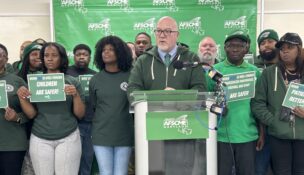
For student employees at graduate schools across Maryland, the pandemic has been a particularly strenuous time. Not only are they paid low stipends, but they also are not guaranteed paid time off if they contract the virus — and due to a ban on collective bargaining for student employees established 20 years ago, they can’t fight for sick leave, either.
That’s why removing the ban — something advocates have been working for since it was implemented almost two decades ago — is arguably more significant than ever, said Will Howell, a former University of Maryland, College Park, graduate student employee who fought for student employees’ rights during his time there.
In 2017, a bill was struck down in the House of Delegates that would have allowed all student workers to collectively bargain, with the feedback that the bill would have a better chance if undergraduate workers were not included. The bill has been introduced every year since, with that adjustment, but continues to fail.
It will come back again this session, in a bill has been prefiled by Sen. Ben Kramer, D-Montgomery.
“Graduate employees need that clarity now, far more than in the past,” Howell said. “It’s literally, for some of them, a life-or-death question.”
Del. Maggie McIntosh, D-Baltimore city and chair of the House Appropriations Committee, anticipates additional labor-related bills, including one that would allow collective bargaining to happen on a university systemwide scale, rather than campus-by-campus. She also anticipates legislation being introduced that would support collective bargaining for community college employees.
“We have a lot of bills coming in on collective bargaining this year, and we have to, I think, take a look at where we are and where we’re going with collective bargaining in higher education generally,” McIntosh said. “I think that’s going to be a major discussion point in this session.”