Sign In
 Free Newsletter

New Johns Hopkins institute aims to make Baltimore an AI hub


 Listen to this article
Johns Hopkins University has launched an ambitious endeavor that the school’s leaders say will make Baltimore a hub of the booming artificial intelligence industry.

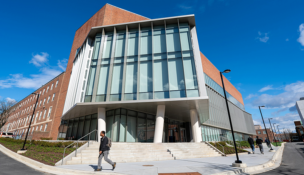
The new Data Science and Translation Institute, announced several months ago and planned for the western edge of the Homewood Campus, is expected to be “the leading academic hub for data science and artificial intelligence – a resource that will bring world-class experts to the Baltimore region and drive game-changing innovations,” said Rama Chellappa, interim co-director of the planned institute and a Bloomberg Distinguished Professor at the school.
“We expect the institute to greatly impact research, innovation, the student experience and our regional economy.”
Chellappa noted that the federal government recently designated Baltimore as a “Tech Hub,” and that the new institute would boost the city’s growth in that role, “creating long-term jobs, attracting top talent and spurring the growth of new companies that will compete in one of the world’s most promising fields.”
Christy Wyskiel, senior advisor to the school’s president for innovation and entrepreneurship and executive director of Johns Hopkins Technology Ventures, elaborated on that benefit. She noted that academic institutions are often at the heart of urban tech-based economies, including in Silicon Valley and Boston, and in emerging tech hubs such as Austin, Pittsburgh, Portland and Seattle.
“Creating a successful hub for AI and data science in Baltimore could have powerful economic ripple effects in Baltimore and Maryland,” she said. She noted that Gov. Wes Moore’s proposed budget includes $20 million for the project’s infrastructure.
The institute will fuel an already burgeoning local industry, Wyskiel added, noting that more than 1,000 new jobs have been added to Baltimore’s tech ecosystem in recent years directly because of Hopkins startups.
“A world-class data science and AI institute could catapult this type of economic growth in Baltimore,” she said. “Our vision is that researchers, entrepreneurs, investors and companies will look to Baltimore as the place to develop and launch products and companies based on data science/AI technology.”

The new institute is a natural fit for Hopkins, according to the institute’s other interim co-director, K. T. Ramesh. The school “has the opportunity to bring together its strengths, in engineering, medicine public health, national security and the humanities, and dramatically advance our mission,” he said. “Our vision is the transformative improvement of the human condition by integrating data science and AI into every field of human endeavor.”
The institute is still in the formative state, Ramesh said, adding that the first steps are creating a home for the institute and hiring faculty and researchers.
That home, he said, will be a custom-built, 500,000-sauare-foot pair of buildings and include “cutting-edge computational resources and advanced technologies.”
Over the next five years, he said, the school plans to hire some 110 new faculty members to be part of the institute.
Hopkins University President Ron Daniels said the new institute will be perfect fit for his school.
“Data and artificial intelligence are shaping new horizons of academic research and critical inquiry with profound implications for fields and disciplines across nearly every facet of Johns Hopkins,” he said in a statement. The planned institute, he added, “will harness our university’s innate ethos of interdisciplinary collaboration and build upon our demonstrated capacity to deliver impact research at the forefront of this critical age of technology.”
Others outside of Hopkins are equally enthusiastic about the planned institute’s impact on the area.
“The new Hopkins Data Science and AI institute will be a foundational piece for the greater Baltimore region’s tech economy,” said Pothik Chatterjee, chief economic officer for the Greater Baltimore Committee, in an email response to questions. “The institute can jump start a new chapter in the development of our Baltimore Tech Hub at one of our anchor institutions, building on our federal designation awarded last year.”
Chatterjee said data science and AI represent the “new frontier of technology and discovery resulting in new health-care treatments, clinical trials and diagnostics that can improve health outcomes for our Baltimore population.
“By creating an academic hub at the proposed scale, we can expect to see a significant ripple effect throughout the region as investors, corporations, entrepreneurs look to do business in Maryland,” he added. “The institute’s focus on AI and data science will be enormously symbiotic with many fields, including biotechnology, giving Baltimore and Maryland the chance to carve out a distinct economic zone for national leadership.”