Sign In
 Free Newsletter


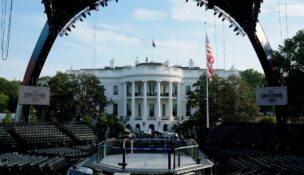
Pimlico racetrack nearly closed in 2019, when, weeks before the Preakness Stakes, the deterioration of its grandstands made them unusable. (Jay Cannon/Capital News Service)
Lawmakers question cost, community benefits of Maryland’s Pimlico plans


 Listen to this article
ANNAPOLIS — State lawmakers on Tuesday questioned how exactly Maryland will pay for the future of its thoroughbred horse racing industry and to what extent the Baltimore communities surrounding Pimlico Race Course will benefit from hundreds of millions of dollars in facility upgrades.
Under an agreement between the state and The Stronach Group, the Canadian company that owns Pimlico Race Course and operates the Preakness Stakes, the state government would assume ownership of the track and, beginning in 2027, run the annual race through a new 501(c)(4) not-for-profit authority.
The new operator will be known as the Maryland Jockey Club, continuing the name of the current Preakness Stakes operator, owned by The Stronach Group. The Maryland Jockey Club was first established in Annapolis before the Revolutionary War and is believed to be the country’s oldest sporting organization.
The state would pay $1 to acquire the track and then $3 million per year, plus 2% of money wagered, for the rights to operate the Preakness Stakes, said Greg Cross, a Venable LLP attorney who led negotiations with The Stronach Group on the state’s behalf.
The agreement is contingent on approval from the state legislature and the powerful Board of Public Works, comprising the governor, comptroller and treasurer.
Exactly how and how much the state would pay for the track’s day-to-day operating costs isn’t yet clear to at least some top Democrats.
RELATED: Pimlico to be transferred to state ownership; $400M in bonds sought for upgrades
“There’s still a long road ahead,” Senate President Bill Ferguson, a Baltimore city Democrat, said to reporters Tuesday. “There are going to be a lot more conversations needed because I think there is some apprehension within our membership. … They’re feeling a level of exhaustion around this issue, and I can sympathize with them.”
Ferguson said state Democrats want Maryland’s horse racing industry to continue, but they won’t cut a blank check to ensure its viability.
A prior 10-year plan to sustain a changing industry has run its course, and efforts to bolster the industry have been underfunded and fallen short, state officials have said.
In 2020, the COVID-19 pandemic and the various economic hurdles it created complicated a $375 million plan that lawmakers had approved for improving the tracks.
State negotiators are now asking lawmakers for $400 million in bonds, up $25 million from the prior proposal. The higher bond ceiling accounts for interest costs and wouldn’t add money to this year’s budget, though Ferguson said there’s been “consternation” among lawmakers about the higher amount.
The proposal requires state investment in workforce housing in and around the Pimlico facility, and state negotiators have said the plan would bring year-round economic activity to a race track facility that goes mostly unused outside roughly two-week Preakness period.
Cross said the state would also invest $10 million for workforce housing by the facility.
State Sen. Jill Carter, a Democrat whose district includes Pimlico and the communities surrounding it, said she and other state representatives from the area planned to call for more investment in neighborhoods near the race course that have been “deprived for a very long time.
“Our entire delegation is (sic) interested, primarily, as this moves forward, that our communities move forward, that our neighborhoods and people move forward,” Carter said in an interview.
Democratic Del. Dalya Attar, who has lived within five minutes of Pimlico her entire life and has represented the district since 2019, said upgrades at the race track must include the broader community.
Carter, Attar and Dels. Samuel “Sandy” Rosenberg and Malcolm Ruff have pushed for the proposal to include state investments in “workforce housing, commercial revitalization, workforce development, affordable housing, homeownership and home preservation, and community beautification” for the neighborhoods around the track.
Under the proposal, the Preakness Stakes will leave Baltimore in 2026 while Pimlico receives upgrades, potentially including a hotel adjoining the racetrack, a 1,000-seat venue for non-racing events, a parking garage to alleviate congestion and a multi-purpose field to host festivals and events.
The Preakness Stakes is still scheduled to be at Pimlico in 2024, 2025 and then 2027 and beyond. It’s expected to be at Laurel Park in Anne Arundel County in 2026, and the state is expected to have rent-free access to the Laurel track for three years while Pimlico is under construction.
State negotiators determined that the state couldn’t afford to revamp both Pimlico and Laurel Park while ensuring the viability of the industry.
Under the agreement, The Stronach Group would retain ownership of Laurel Park and is expected to eventually cease operating races there, potentially putting the land up for development.
Lawmakers have until April 8 to iron out specifics and decide whether to approve the new plan. They’ve have generally agreed with state officials on ensuring thoroughbred horse racing remains viable in the state, especially with the storied history of the Preakness Stakes, one of three races comprising the Triple Crown.
“It’s (been) a feature of Maryland for almost the last 150 years,” Ferguson said. “It’s kind of hard to imagine a Maryland without the Preakness.”