Sign In
 Free Newsletter


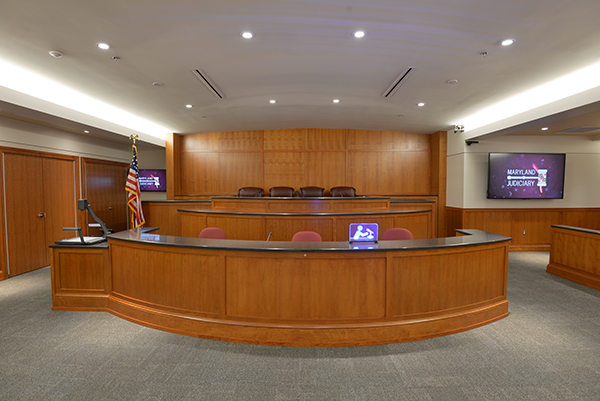
The Maryland Supreme Court heard arguments in a case that could make it easier for police to stop people for using their phones while driving. (Depositphotos)
MD Supreme Court weighs how much proof cops need for texting-while-driving stops


 Listen to this article
Key Takeaways:
- Maryland Supreme Court reviewed a case on stopping drivers for phone use.
- Police stopped Michael Stone after seeing him touch a mounted phone.
- The case involves alleged drug possession discovered during the stop.
- Justices questioned whether mere phone contact is enough for reasonable suspicion.
The Maryland Supreme Court on Friday heard arguments in a case that could make it easier for police to stop people for using their phones while driving.
The justices are tasked with deciding whether two Hagerstown police officers had reasonable suspicion to stop Michael Eugene Stone for texting while driving because they saw him touch his phone.
Maryland law prohibits texting and reading texts while driving, but it allows drivers to make calls or use a GPS app.
Stone was driving after 9 p.m. one night in 2023 when he reached for his phone, which was mounted on the windshield or dashboard. The officers only saw him using his right hand and did not say that he removed the phone from the mount. One of them later testified that “it appeared like he was typing a message or placing a phone call while he was driving the vehicle.”
They stopped him and asked to search his car and body, and he consented. They found fentanyl, cocaine, marijuana, drug paraphernalia and brass knuckles. Stone was later convicted of unlawful possession of a controlled dangerous substance and unlawful possession of a controlled dangerous substance with the intent to distribute.
Stone filed a pretrial motion to suppress evidence, arguing the stop violated his Fourth Amendment right against unreasonable searches and seizures. A Washington County Circuit Court judge rejected the motion and allowed the case to move forward, saying the officers had “reasonable articulable suspicion” because texting and making a call look the same.
The Appellate Court of Maryland, in a 2-1 decision, reversed the lower court.
“Pressing a cellphone screen while driving is, in our view, innocuous behavior unless additional information indicates criminal activity,” Judge Melanie Shaw wrote for the majority. “The officers here did not articulate any additional observations or indications of criminal activity.”
Senior Judge Glenn Harrell Jr., who was specially assigned to the case, dissented, writing that the majority risked unduly burdening law enforcement.
Friday’s arguments were held at Easton High School in Talbot County before a full audience of students, teachers and others.
Jillian Chieppor, of the Maryland Attorney General’s Office, argued officers are allowed to make a stop when a driver’s conduct is ambiguous and could be illegal.
“The purpose of those kinds of stops are to dispel ambiguity about whether somebody is acting in a way that is lawful or unlawful — and so that’s exactly what the officers did in this case,” Chieppor said.
“They were presented with an ambiguity — that Mr. Stone was manipulating his phone in a manner that was consistent with, as one possibility, illegal conduct — and when they conducted that traffic stop they took steps to dispel that liability.”
Douglas Nivens II, of the Maryland Office of the Public Defender, said officers need to be able to articulate what they saw in more detail, including how the driver was holding the phone and how long they were using it.
“The placement of the phone — where the phone is in relation to the driver — is a fact that matters,” he said. A brief one-hand tap on a dashboard-mounted phone, he said, is “qualitatively different” from “a situation where a person is maybe driving with one hand on the wheel and the phone is up to their face.”
“One touch being grounds for a traffic stop is a bridge too far,” Nivens said.
Several justices appeared skeptical that officers should be able to stop drivers for simply touching their phones.
“It seems like if we accept the state’s position, any time somebody touches a cell phone device that would constitute reasonable suspicion,” Justice Brynja Booth said.
“There’s no other corroborating fact that I can divine from this record that indicates that he was doing anything illegal,” Justice Peter Killough added. “And the conduct that he was accused of doing, I would say, is at least equally if not more consistent with legal use of a cell phone.”
Chief Justice Matthew Fader asked, “Doesn’t the state’s position in this case risk taking something that describes completely innocent activity — engaged in by a large number of Maryland citizens every single day — and make that the basis for a seizure?”