Sign In
Upcoming Event
 Free Newsletter

Board approves $147M contract for new MD Supreme Court building

The new building will replace the Robert C. Murphy Courts of Appeal Building, which opened in 1972. (Rendering provided by the Maryland Department of General Services)
Board approves $147M contract for new MD Supreme Court building


 Listen to this article
Maryland’s top court can expect a new home in Annapolis, thanks to the Maryland Board of Public Works‘ approval of a multimillion-dollar contract on Wednesday.
Gov. Wes Moore, Comptroller Brooke Lierman and state Treasurer Dereck Davis, all Democrats, confirmed a $146,981,015 construction contract to Coakley & Williams Construction LLC to build the new, six-story, 217,000 square foot Maryland Supreme Courthouse on a vacant parcel of land along Rowe Boulevard in downtown Annapolis.
“Our current courthouse is inadequate to support the mission of the Maryland Judiciary, and has been for some time,” said Maryland Supreme Court Chief Justice Matthew Fader. “This new courthouse … will appropriately represent Maryland’s commitment to the rule of law and the equal justice under law, and will be a fitting home for our state’s two appellate courts and the important work we do to serve the people of Maryland.”
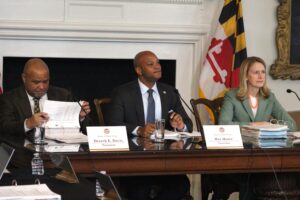
According to Moore, the building will include office spaces, classrooms, courtrooms, judges’ chambers, a law library and “a new Maryland Legal History Museum.” The property will be built with historic architecture elements from the 1903 state Supreme Court building.
The building will be erected over the course of three years, starting in 2026. Maryland Department of General Services Secretary Atif Chaudhry said that the building will be the only state Supreme Court set for construction at the time.
“It takes years to plan, program and design a building of this magnitude,” said Chaudhry. ”This is really a once-in-a-generation investment in the long-term stability of our state’s storied judicial system.”
Fader said that the Maryland Supreme Court has had “three homes” since 1776: first on the second floor of the Maryland State House; then in an adjacent building that used to encompass what is now Lawyer’s Mall and the Department of Legislative Services building; followed by its current location “nine-tenths of a mile down the road” along Rowe Boulevard, which was established in 1972.
Fader said the new building will house certain committees and boards that the Judiciary supervises, follow a “consumer friendly” design, and reflect the gravity and significance of what happens inside.
“And it is my hope that the heat will work in the winter — and only the winter — that less water will fall from the ceilings, that the power will be more reliable and we will have significantly less mold,” he added.