Sign In
 Free Newsletter

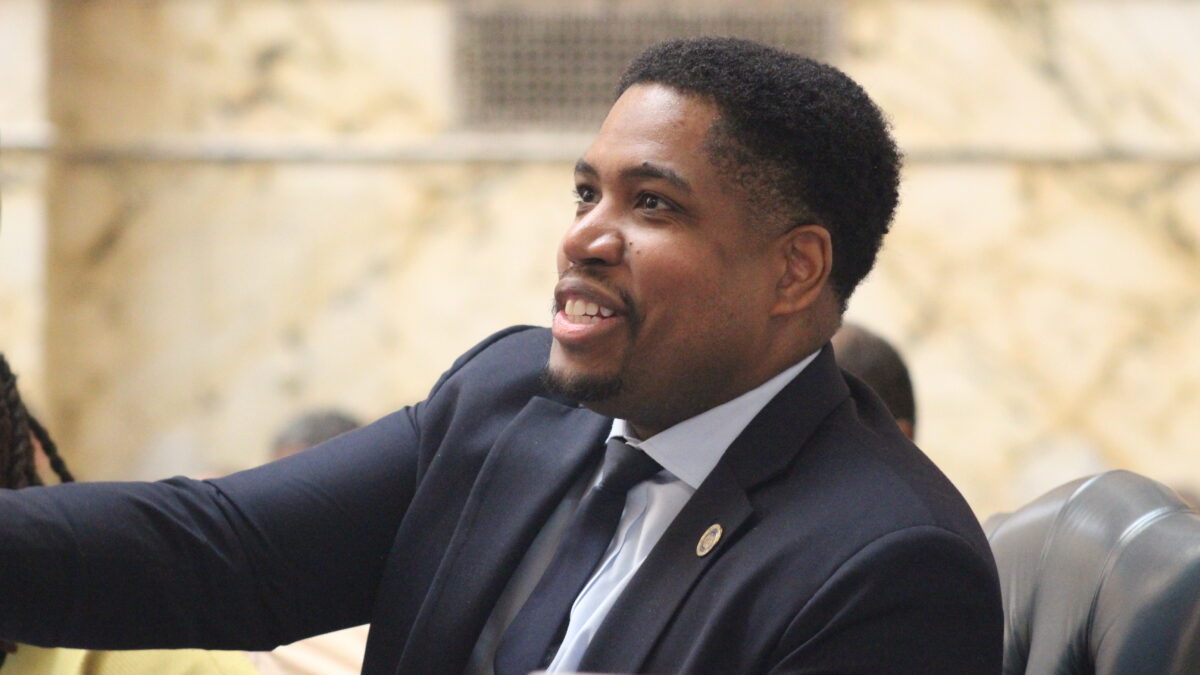
Del. Marlon Amprey's legislation to make rap lyrics inadmissible in court passes out of the House chamber on April 7, 2026. (Hannah Gaskill/The Daily Record.
Rap lyrics inadmissible in criminal court under MD bill: ‘That’s how I roll’


 Listen to this article
Key takeaways:
- The Maryland House of Delegates passed the Protecting Artists’ Creative Expression Act on Tuesday.
- The bill prohibits rap lyrics and creative works from being used as evidence in criminal or juvenile trials unless intent is literal and facts align.
- The law codifies the 2020 Maryland Supreme Court ruling in Montague versus Maryland.
- The Maryland State’s Attorneys’ Association opposed the bill, while Baltimore City State’s Attorney Ivan Bates supported it.
The Maryland House of Delegates passed legislation Tuesday to prevent rap lyrics and other works of creative expression from being admissible in criminal or juvenile court proceedings.
“What this bill basically does is codify what we’ve already done in Maryland in our Supreme Court,” Del. N. Scott Phillips, D-Baltimore County, said on the House floor before the bill’s final approval.
Sponsored in the House by Del. Marlon Amprey, D-Baltimore City, and in the Senate by Sen. Charles Sydnor III, D-Baltimore County, the Protecting Artists’ Creative Expression Act would still allow artistic works to be admitted as evidence if the court finds, by a preponderance of the evidence, that the defendant’s intent was for the expression to be literal. If the expression is derivative, the court must determine that the intent was to adopt the literal meaning as their own.
Creative expression could also be admissible in these cases if it refers to the direct facts or is relevant to a disputed issue of fact.
Under the bill, creative expression includes forms, sounds, words, movements or symbols in the genres of music, dance, performance art, visual art, poetry, literature and film eligible for federal copyright protection.
Amprey’s version of the bill was approved in the House on Tuesday morning. Sydnor’s should receive final approval from the chamber in the coming days.
According to Phillips, the legislation seeks to codify the standard set under the 2020 state Supreme Court case Montague versus Maryland, which determined that rap lyrics aren’t admissible as evidence in criminal trials unless they closely resemble factual and temporal connections to the alleged offense.
Questioning the bill’s limits, House Minority Whip Jesse Pippy, R-Frederick, posed a hypothetical scenario on the floor Tuesday morning as though he were a musician.
“So if I have a song that’s like, ‘I shot him; I hid the gun behind the shed; I did it on a Wednesday; that’s how I roll,’ … could those statements still be used against a rapper hypothetically if that rapper was charged with let’s say attempted murder in court?” he asked.
Phillips — who admired what he described as Pippy’s musical “skills” — responded, “It depends.”
“If the probative value is appropriate, if the lyrics are very on point with actually what took place and you present that to the judge, the judge would have to consider that,” said Phillips.
Pressing further, Pippy asked when the bill would not apply to works of artistic expression. Phillips said that following preliminary review, statements that are not in line with the charge at the heart of the case would be inadmissible.
“Is the content literal or using artistic license? The facts have to match the allegation,” said Phillips. “Is there a fact pattern connecting the art to a specific allegation? And the areas of dispute — is there a fact being disputed, or is it already stipulated by the defense? And if so, then that wouldn’t be presented” to a jury.
The Maryland State’s Attorneys’ Association opposed the bill, alleging in written testimony that it would risk “making threats, intimidation, and witness tampering more difficult to admit when they are cloaked in so-called ‘creative expression’ or metaphor.”
However, Baltimore City State’s Attorney Ivan Bates, a Democrat, provided testimony in its favor. He called it “an important and overdue step” to ensure that creative expression and other protected forms of artistic speech are “not misused in criminal or juvenile proceedings.”
“Any evidence used to prove or disprove any essential fact in a criminal trial must be evaluated for relevance,” wrote Bates. “Permitting courts to admit creative work with dubious relevance to any particular fact is tantamount to allowing a creative work to become character evidence; thereby risking transforming artistic expression into a proxy for character evidence, reinforcing harmful stereotypes and free expression, especially for young people and artists of color.”