Sign In
 Free Newsletter

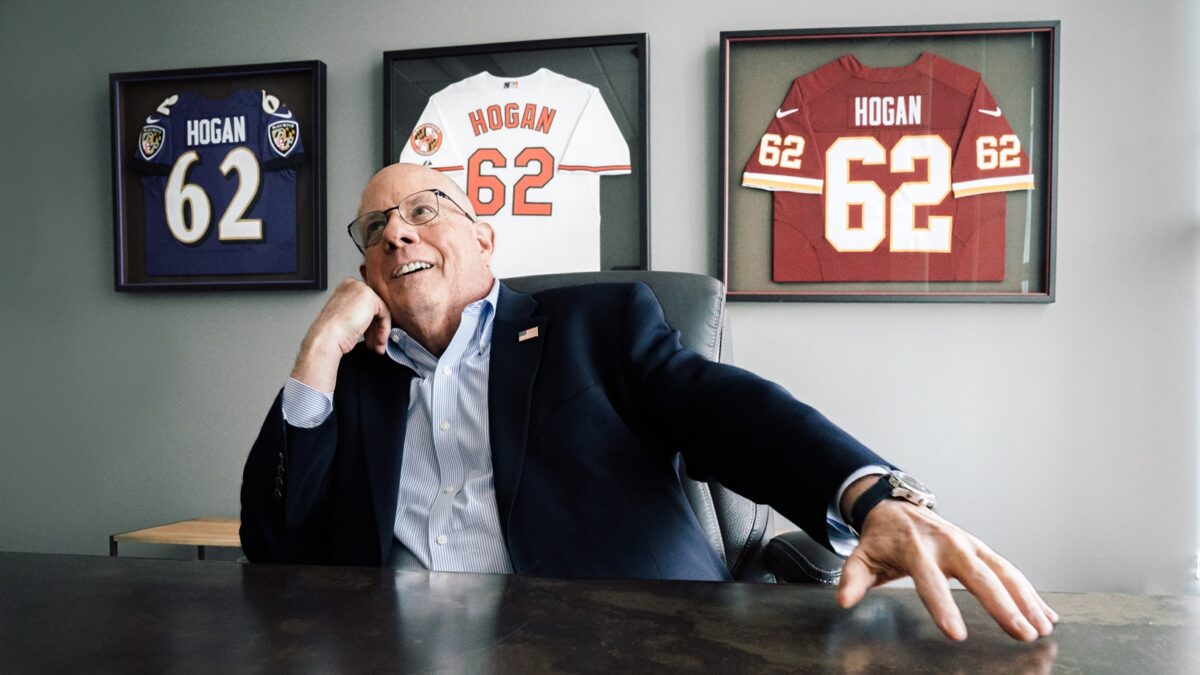
Former Maryland Gov. Larry Hogan poses for a photo in his Annapolis office with jerseys of local sports teams hanging behind him on May 14, 2026. (Maxine Wallace/The Washington Post)
‘Somewhat jaded’ Larry Hogan promises no more campaigns, pivots to teaching


 Listen to this article
Key takeaways:
- Larry Hogan announces Hogan Institute at Washington College
- Hogan vows never to run for office again
- Hogan lost 2024 Senate race to Angela Alsobrooks by almost 12 percentage points
- “Never Trump” movement seen as fractured and diminished
At the height of his political influence, Maryland’s former Republican governor Larry Hogan was courted as a presidential candidate to offer an antidote to Donald Trump’s takeover of the GOP.
But the brand that made him a popular blue state governor never made a splash outside the “Never Trump” world. Now Hogan is done trying to reshape his party as a candidate.
Instead, in what he calls his “Zen” era, Hogan is announcing Sunday the launch of the nonpartisan Hogan Institute at a small liberal arts college on the Eastern Shore. Vowing to never run for office again, Hogan is instead focused on teaching leadership skills to Washington College undergraduates who he hopes can fix the “broken” two-party system that he’s leaving behind.
“It can be the storefront of the Hogan philosophy, even if it’s a little storefront,” Hogan, 69, said in a wide-ranging interview about the Republican Party, his first since announcing earlier this year he wouldn’t run for governor again.
In political retirement, Hogan wants to shape a generation of ethical leaders that can reach the disaffected center of the electorate and rescue the country from polarized politics. “They’re the only ones that have a chance to,” he said.
His permanent exit from the political stage highlights another setback for the withered Never Trump movement, the loose coalition of anti-Trump Republican strategists, activists and politicians that failed to detach their party from the president.

Hogan has acknowledged his predictions of an anti-Trump backlash opening the door for moderates like him didn’t bear out. Republican voters stuck with Trump and his 2024 presidential comeback bid despite a slew of conservative challengers.
Hogan said he really thought Republicans were “eventually going to get back to sanity. And we haven’t.”
Many onetime Never Trump leaders now believe a post-Trump future for the GOP will look nothing like its pre-Trump conservative roots.
“It’s not like there’s this band of people who are going to reconstitute it, like ‘Return of the Jedi,’ ” said Republican strategist Mike Madrid, a co-founder of the Lincoln Project, a Never Trump organization. Some of the most enthusiastic supporters of groups like the Lincoln Project are liberals, and some Never Trumper Republicans have become Democrats or independents.
“Very few of the Never Trumpers call themselves Republicans any more, or are fighting for conservatism any more, and that’s very telling,” Madrid said.
Hogan served two terms as governor in a deep blue state that picks Democratic presidential candidates by a 25-point margin or more. He left office with record-high approval ratings, but could not parlay that into a future on the national stage. Hogan was too Republican for Democrats, not Republican enough for Trump supporters.
“I‘m somewhat jaded,” Hogan said.
Hogan sees this year’s midterms as a pivotal moment to shake the president’s grip on his party.
“There are some people that have been afraid of speaking out or standing up because they were afraid of being primaried or attacked on social media,” he said. “But when they start losing seats, I’m hoping that maybe there’ll be some more political courage that pops up.”
Others in the Never Trump movement view Hogan’s optimism as clinging to a battle that has been lost by anti-Trump Republicans.
“That group, definitely now in year 10 has fractured,” said Tim Miller, a former Republican strategist who hosts the self-described “flagship podcast” of the Never Trump movement. “It’s not that we’re mad at each other. There’s different views about what the future should look like.”
Miller finds it a “fool’s errand” to convince a group of voters who nominated Trump three times to agree with moderates.
“With love to Larry, sometimes you’ve got let go of things you love because they change,” Miller said. “I mourned the loss of Larry Hogan-style Republicans five years ago, so the scab has been healed over.”
Other Republicans who emerged as prominent critics of Trump have left the political stage, including former senators Mitt Romney of Utah and Jeff Flake of Arizona, and rivals in the 2024 presidential primary such as Nikki Haley and Chris Christie.
Some centrist Republicans are still trying to salvage what they valued about the party, such as former senator Lamar Alexander, who wrote in his new book about charting a post-Trump future.

Hogan rose to national prominence during the pandemic as the rare Republican to contradict Trump’s narrative about the coronavirus, accusing the president of spreading misinformation and downplaying the severity of the virus. He was courted for presidential bids by moderates in both 2020 and 2024. He abandoned his presidential ambitions before the 2024 election, calling it a “kamikaze mission” to try to dislodge Trump’s hold on the party.
He instead sought an open Senate seat in 2024, arguing he could moderate a Republican majority in the Senate. He lost by nearly 12 percentage points to Democrat Angela Alsobrooks. But he focuses on another metric: he ran nearly 9 points better than Trump. Now he doesn’t long for life in the Senate, hounded by reporters to comment on the latest Trump controversy and casting the lone vote against presidential appointments.
“It was the best thing that could have happened to me,” Hogan says now. “It would have been a very miserable existence.”
He seriously considered but ultimately rejected a bid for a third term as governor by challenging Gov. Wes Moore, a rising star in the Democratic Party. In an op-ed announcing his decision, Hogan said he was done being a candidate and would not seek elective office again.
In the interview, Hogan likened such a bid to a two-time Super Bowl champ returning to the field and possibly leaving with an injury rather than another trophy.
He turned down offers to be a cable news talking head, he said, because he didn’t want to be “the token Republican” either defending the party or denigrating the president all day.
Instead, he’s joining company boards, working at his real estate company, spending time with his grandchildren and building his institute rather than running for any office again.
Hogan plans to announce his new center during a commencement speech Sunday at Washington College, the small liberal arts college on the Eastern Shore that will host it and promote some of his objectives, such as open primaries and a national prohibition on gerrymandering.
In another era, Madrid said, a figure with cross-party appeal like Hogan would found a think tank to promote his brand of conservatism, not a bipartisan leadership institute. “It’s saying: My legacy is not the work that I did, it is the leadership that I showed.”
Hogan said he was drawn to the symbolism of launching the institute during the 250th anniversary of the country’s founding, and doing it at the first college chartered after the signing of the Declaration of Independence.
“You don’t have to be the most experienced. You don’t have to be the most polished. You don’t have to have everything figured out. You just have to be willing to step forward when it matters,” Hogan planned to say in his speech, saying his institute will teach “the skills of ethical leadership at a moment in time when our nation desperately needs it.”
Erin Cox is a national politics reporter. She joined The Washington Post in 2018 as a staff writer on the Metro desk. Send her secure tips via signal @erincox.30