Sign In
 Free Newsletter


Maryland Federal Public Defender Jim Wyda stands outside U.S. District Court in Baltimore on May 21, 2026. (Ian Round/The Daily Record)
MD federal public defender set to retire: ‘I’ve loved it’


 Listen to this article
Key takeaways:
- Jim Wyda is retiring this year from leading Maryland federal public defender office
- Wyda represented high-profile defendants including Marilyn Mosby and John Muhammad
- Wyda helped build the Federal Capital Trial Project for death penalty defense
- Four former Wyda staffers appointed as federal judges in Maryland
After nearly three decades leading Maryland’s federal public defender’s office — a soon-to-end tenure that has seen him become a national leader in death penalty defense and sentencing reform — Jim Wyda still does his share of routine work.
He has represented some of Maryland’s highest-profile defendants of the 21st century — including former Baltimore City State’s Attorney Marilyn Mosby, “D.C. Sniper” John Muhammad and NSA whistleblower Thomas Drake — but he doesn’t only handle the cases that attract attention.
About once a month, he serves as the on-call duty attorney for people who have been accused of a crime in federal court and can’t afford counsel. Public defenders, along with private attorneys who serve as court-appointed defense lawyers, represent about 90% of all criminal defendants in federal court.
“Jim does this quietly and routinely,” Maryland U.S. District Judge Deborah Boardman, who served as first assistant federal defender under Wyda for four years, said in an interview. “It’s rare.”
When there’s a new arrest, the defender on duty goes to the U.S. Marshals Service’s lockup to meet the client, who might be going through withdrawal or having a mental health crisis. Wyda described that first meeting as “profound.”
“Our clients are typically scared, whether they’re admitting or showing it or not, but you’re the first person there trying to help them navigate what has probably been a pretty frightening process,” said Wyda, who grew up in Southeast Baltimore, near what is now the Johns Hopkins Bayview Medical Center.
“It’s a powerful relationship,” he said. “I take great satisfaction in being able to do that work. It’s sort of a privilege to meet clients on what’s probably a pretty awful day for them and try to help them through it.”
Wyda, 66, intends to retire in November after what will be 28 years leading the office. In April, Katherine Tang Newberger, the No. 2 in the office for nearly seven years, was named his successor.
Wyda has already led the office for more than half of its existence; if he finishes his seventh four-year term in November, he will be the second-longest-serving federal defender in the history of the U.S. Court of Appeals for the Fourth Circuit, which covers five states.
Wyda’s colleagues said he’s nurtured the office into one of Maryland’s premier criminal defense law firms, describing him as a talent magnet who helped to shape Maryland’s federal court.
“A lot of lawyers that are great litigators get promoted to run offices, but they’re not necessarily good leaders,” said Kristina Leslie, who used to work for Wyda and now leads the Federal Capital Trial Project, a part of the federal defender organization that Wyda helped build. “He is such a clear exception to that.”
Capital defense and sentence reductions
Outside a clerkship after graduating from the Yale University School of Law, Wyda has only ever worked as a public defender.
He started in the state defender system in Baltimore City, where he represented clients facing the death penalty. He was eventually recruited to the federal defender’s office by James K. Bredar, who led the office for six years in the 1990s and is now a senior federal judge.
Bredar said one of his former law professors told him to hire Wyda, whom he had also taught. About four years later, in 1998, the Fourth Circuit appointed Wyda, who was then 39, to run the office.
Since then, he’s played a key role in centralizing and developing the defender program’s representation of people facing the death penalty.
When the federal government reinstated the death penalty in the late 1980s, the federal defender program had next to no capital expertise. Wyda was responsible for growing the Federal Capital Trial Project, a central office that trains lawyers on capital defense and handles out-of-district cases alongside local defenders. He had defended capital cases in Baltimore City and said some districts had no lawyers with capital experience.
“The standard of care in our federal capital work across the nation has risen dramatically,” Wyda said.
He also takes pride in the fact that hundreds of his office’s clients have had their sentences reduced under the 2018 First Step Act. Maryland has led the nation in such sentence reductions, Wyda said.
“There’s no district in the nation that does it better,” he said. “It was important to bring these people home who had no hope.”
‘Zealous’ and ‘tenacious’
Wyda’s chief professional adversary, Maryland U.S. Attorney Kelly Hayes, did not respond to an interview request, but two of her predecessors did.
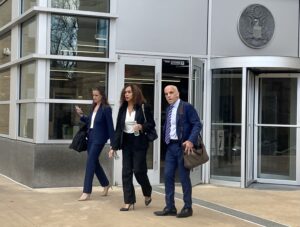
Erek Barron worked both with and against him. Before former President Joe Biden appointed Barron to serve as Maryland U.S. attorney, he was a court-appointed private defense attorney on the Criminal Justice Act panel. Barron said Wyda held high standards for the panel and made sure its lawyers were prepared and working in coordination with his office. When Barron became the state’s top federal prosecutor, he said, Wyda was “tenacious.”
“We probably had as good a relationship as any pair in those roles,” Barron said, adding that before he was appointed U.S. attorney, he and Wyda were in a coronavirus-pandemic-era book club.
Rod Rosenstein, a Republican who served as Maryland U.S. attorney for 12 years, then as deputy attorney general during the first Trump administration, said that despite “professional disagreements,” he “always appreciated the high standards Wyda set for the public defender’s office and the zealous advocacy his office provided for criminal defendants.”
‘A magnet for tip-top talent’
Bredar was one of many who said Wyda has a knack for finding talented lawyers and convincing them to work for him, though they could make more money in the private sector.
“The most important thing he’s done is build this formidable institution that the federal defender’s office in Maryland now is,” Bredar said. “He became a magnet for tip-top talent.”
Evidence of Wyda’s recruiting power can be seen on the bench. Four of his former staffers — Boardman, Paula Xinis, Brendan Hurson and Douglas Miller — have been appointed federal judges. (Miller is a magistrate judge.) With Bredar, that makes five federal judges in Maryland who served as defenders.
“There’s nothing like it in the country,” Wyda said of the number of former defenders on the Maryland U.S. District Court. “My greatest accomplishment is the extraordinary people who work here. … Giants work here.”
As for what’s next, he’s not sure. For now, all he knows is that he wants to keep teaching at the University of Maryland Carey School of Law.
“I’ve loved it,” he said. “I love this work. I love being a public defender, and I’ve felt like I’ve been good at this job.”