Sign In
 Free Newsletter

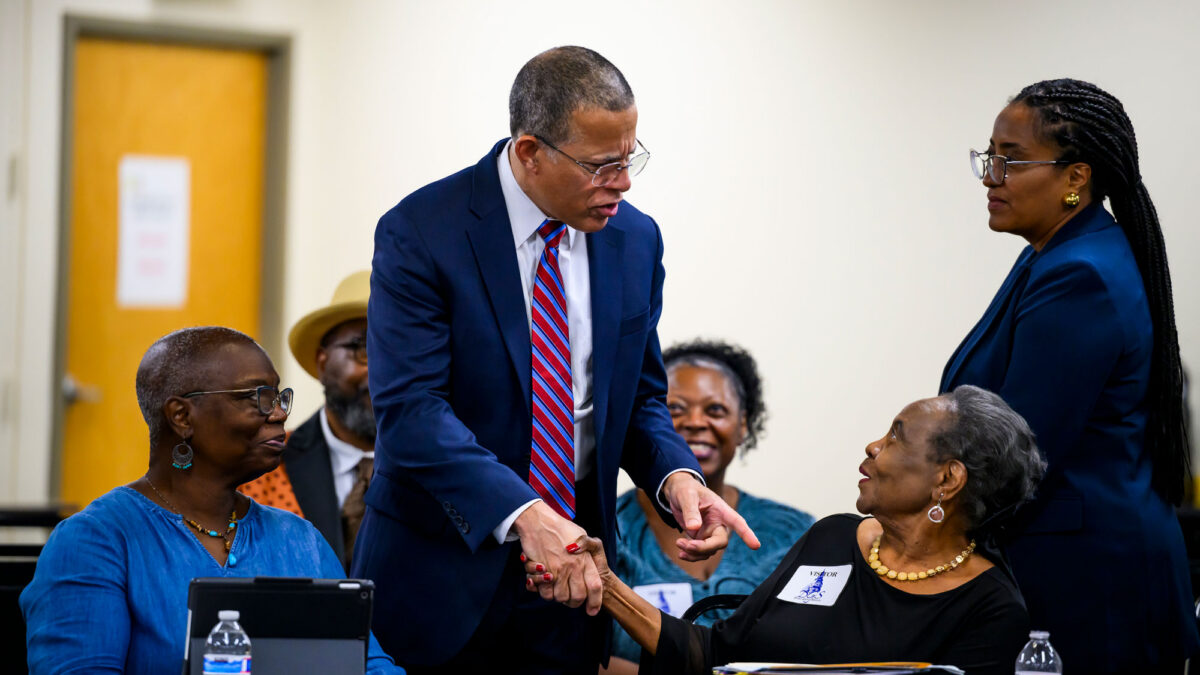
Maryland Attorney General Anthony Brown will chair the commission, which is composed of two dozen voting members and another 10 nonvoting advisory members. (Pete Kiehart/For The Washington Post)
At least 230 Black boys died in jail. Their families want answers — and justice.


Phyllis Hammond knew she needed to act the moment she emerged from her walk through the woods. She climbed into her car, tears streaming, and said a prayer.
God use me, in whatever and however way possible, to bring justice.
A week earlier, Hammond, 69, had received a letter from a genealogist with an unsettling revelation.
Her uncle, Amos Hammond, had died in 1921 at the age of 18 at the House of Reformation and Instruction for Colored Children, a segregated juvenile jail in Maryland with a documented history of abuse and neglect. He was among hundreds of Black boys and teens the state buried across the road from the facility in a forest in Prince George’s County.
Hammond had never heard of an uncle named Amos. But the more she learned, the more she realized Amos was family. This spring she visited the graves, marked by crumbling cinder blocks with no names, and left resolved: “I’m going to be that voice those boys didn’t have.”
Hammond began that work last week, when she was recognized by Maryland Attorney General Anthony G. Brown as a voting member of the state’s newly formed Commission on the House of Reformation and Instruction for Colored Children – an investigative body created by lawmakers earlier this year to unearth buried truths the state ignored for more than a century.
“We are determined to be the voice and to take a role in major decision-making throughout this entire process,” Hammond said Aug. 4 at the first commission meeting. “We are firm and committed in our belief that no decision should be made about our children without full engagement and participation with the families.”
Hammond articulated her priorities: To ensure the commission is independent, unflinching and centered on the wishes of the boys’ living relatives as they weigh whether to exhume the remains, identify them and determine the children’s true manner of death.
The commission will be chaired by Brown, the first Black attorney general in state history, and is composed of two dozen voting members and another 10 nonvoting advisory members, all with interest or expertise in forensic anthropology, archaeology, state history, juvenile justice policy and civil rights law. Members include Sen. Will Smith (D-Montgomery) and Del. Jeffrie E. Long Jr. (D-Calvert), who sponsored the commission legislation, and Prince George’s County Executive Aisha Braveboy.
In addition to Hammond, two other living relatives will serve on the commission: Dorothy Givens, 83, representing her uncle Fred Ames Jr., and Linda F. Gorham, on behalf of her cousin Richard Saunders.
The Washington Post first reported on the abandoned and overgrown graves a year ago, after former leaders of the Maryland Department of Juvenile Services made their existence public. A Post investigation found that at least 230 children died at the House of Reformation between 1870 and 1939, the most comprehensive public accounting to date based on state records, newspaper archives and death certificates.
Black Caucus lawmakers visited the site last August, and its members later championed a law signed by Gov. Wes Moore (D) that allocates $1 million for the commission’s initial budget. The African American Heritage Preservation Program awarded another $200,000 in grant funding.
“This is the state of Maryland, all of us, finally doing what should have been done long ago,” Brown said at the meeting, explaining that the body is expected to submit a preliminary report on its work by the end of 2027 and a final report in December 2029. He told members that the House of Reformation commission may be the most significant investigative body that Maryland has created in the past decade, especially as the Trump administration works to strip recognition of the legacy of racism from the nation’s history.
“We’re meeting at a time when many in our federal leadership are turning away from acknowledging the history that made this country what it is,” Brown said. “That makes what we’re doing here more important, not less. The state of Maryland is choosing to look clearly at a painful chapter of its own history, not to perform accountability, but to actually pursue it.”
The year since the House of Reformation gravesite’s public rediscovery has been both revelatory and fraught, a navigation of tensions over institutional racism, state power and the people impacted by both. Those tensions were made clear at the Aug. 4 afternoon meeting, where the families reminded commission members that for them, this process is personal.
“We are mourning,” said Gorham, a licensed psychologist. “I know we talked about remains and records, but just know that … we have souls that need to be tended to.”
Running parallel to the commission’s efforts is the Forgotten Children Initiative at Georgetown University – a first-of-its-kind research effort founded by youth justice advocate and former DJS deputy secretary Marc Schindler that is working to identify similar abandoned cemeteries nationwide. He and former DJS secretary Vincent Schiraldi oversaw the state’s earliest efforts in 2024 to uncover the House of Reformation’s history, and Schindler wanted to continue the work after he left the government.
To date, the Forgotten Children Initiative’s lead genealogist, Malissa Ruffner, has contacted 73 potential living relatives for 24 of the boys. Family members for about a dozen of the boys have responded.
Ruffner’s previous genealogical work includes helping to identify the living descendants of the 272 enslaved people who were sold in 1838 by Georgetown’s Jesuit founders. She said that she has been able to find some family members for the House of Reformation children within a few hours and others have taken days – a process that includes sifting through decades of birth and death certificates, state records, newspaper archives, census information and obituaries.
The families identified so far have already developed an intense bond, forged by shared grief and righteous rage. In June, they visited the abandoned cemetery in the woods to hold a funeral – the kind of dignified ceremony the boys did not receive a century ago.
So far, the families have met privately with Brown. They were not in attendance at a May ceremony at the Cheltenham juvenile detention facility where the House of Reformation once stood. That gathering, held by current DJS leaders, state lawmakers and the governor, served as a history lesson for the broader community and ended with the unveiling of a road marker that acknowledges the institution’s segregated past.
“Loving your country does not mean lying about its history,” Moore said that day. “Loving your country does not mean pretending like the awful and dark and bad spots did not happen. It means being able to embrace everything, flaws and all, and say that every day is an opportunity for us to be better.”
Moore said he was “committed” to honoring the boys, including locating the grave of each one in the woods.
That work will likely take years and a great deal more money than the $1.2 million currently allocated, the attorney general said at Tuesday’s meeting. The commission will rely on the expertise of forensic anthropologists and archaeologists who have overseen similar investigations, including Erin Kimmerle, who led a years-long excavation project at the Dozier School for Boys in Florida, a reform facility where officials buried dozens of children who died in state custody.
Kimmerle, an advisory commission member, told the group that they should approach this process with the sensitivity of a homicide investigation.
“For them, the past is the present,” she said of the families. “Historic justice and modern justice are interwoven.”
Gorham emphasized that point.
“It doesn’t matter that Richard, my cousin, died when he was 15 in 1935. I still feel it,” she said. “There’s a really deep thing that’s happening here. If you’re serving, I want you to feel it.”
For Hammond, among the commission’s most important missions is using their power to ensure no child detained in state custody is ever treated the way her uncle Amos was. To crystalize that conviction, she read the room a poem she wrote after visiting the abandoned cemetery for the first time.
“If these woods could talk, I wonder what they would say?” she read. “If these woods could talk, do you think they could share each of these boys’ tragic lives and deaths while entrusted in the hands of the juvenile system? If these woods could talk, could they share the pain and the scars that they endured across their fragile bodies?”
“If these woods could talk,” she continued, “I wonder if these woods would have raised their voices loud and clear against the lawlessness of what they’d seen, heard and became a part of.”
“If only these woods could talk,” she said, “maybe many lives could have been saved.”
Katie Mettler reports for The Washington Post.