Sign In
 Free Newsletter

Baltimore ready to help the ailing Senator, but only without Kiefaber


 Listen to this article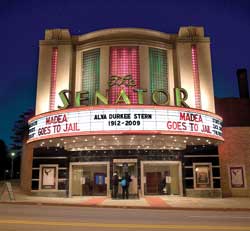
The Senator Theatre, which has been a part of the Kiefaber family since it opened in North Baltimore in 1939, is more than $1.4 million in debt.
Since the day it opened in 1939, the Senator Theatre in North Baltimore has been a retail anchor for Belvedere Square and a part of the Kiefaber family.
With the Senator now more than $1.4 million in debt and on the brink of foreclosure yet again, the city wants in on saving the financially troubled theater — but only if owner Tom Kiefaber is out.
“He has been given funding on more than one occasion from the city,” said Kimberly Clark, executive vice president of the Baltimore Development Corp. The city loaned the Senator $40,000 in 1997, and in 1999 loans of $180,000 from the BDC and $300,000 from the state were made.
“He says he has learned from his mistakes and he’ll make it work, and he’s never made it work,” Clark continued. “It’s beyond fixing with him at the helm.”
Recent years haven’t been kind to the theater as its debt has increased while staying with a failing single-screen business model that loses out to more popular movie megaplexes. Kiefaber has not been able to make a mortgage payment to First Mariner Bank since September, his loan is now in default and the clock is ticking on the life of the business he took over from his family nearly 20 years ago.
Although Kiefaber declined to respond directly, he said he felt the city’s approach was somewhat of a knee-jerk reaction.
“This is a weird, hard business to understand from the outside,” he said. “There’s a saying in my family that everyone is an expert on two things: whatever it is they do and the motion picture business.”
In as little as two months, the theater that has built memories for many Baltimoreans stands to close its doors, the striking Art Deco marquee will go dark and the building will be sold at auction. It’s a worst-case scenario that community members and city officials are working to avoid — just not together.
|
Click to see a full size version of the slideshow |
A month ago, Baltimore City officials extended an offer to Kiefaber to pay $320,000 toward his $920,000 debt with First Mariner in exchange for him turning over the theater to a nonprofit. Because the city had already guaranteed $600,000 of that bank loan in 2003, the deal would essentially turn over the theater and two adjacent properties to the city and release Kiefaber’s home from the mortgage. The nonprofit (one was not named at the time by the city) would then assume the Senator’s debt, which also includes roughly $500,000 in loans from city and state agencies.
Catherine Evans, president of the Belvedere Improvement Association and a longtime collaborator with Kiefaber on the theater’s many community and charity fundraiser events, said a phenomenon called “crucifying the zealot” in historic theater circles tends to happen when venues like the Senator meet their end.
“Tom is getting the blame where no one else could have been able to do it better,” she said. “He’s the reason [the Senator] is even still here.”
But it’s often been by the skin of his teeth. In 1993 and 2000, public support helped Kiefaber, who also owns the two-screen Rotunda Cinematheque in Hampden, stave off foreclosure.
Then in February 2007, First Mariner filed a foreclosure action on the
$1.2 million it lent the theater in 2003. Kiefaber again avoided closing in an 11th-hour effort that entailed raising nearly $105,000 in donations and obtaining a bridge loan to cover the theater’s $109,828.64 debt to First Mariner.
But with the financial industry spiraling downward from the recession — First Mariner reported a $9 million fourth-quarter loss this month — staving off another loan crisis is not a viable option. Kiefaber, who was only able to make a partial payment in September toward his $9,300 obligation to the bank, said he understands its position.
“Those folks have always been straightforward — if you have a commercial loan, you need to keep it current,” he said.
Kiefaber said this week he was encouraged by the city’s offer, but had qualms about the approach and how it would affect his approximately 20 employees and the Senator’s business relationship with film distributors.
“If we’re closed for any amount of time, it could permanently damage those relationships,” he said.
Since the offer was made in January, the city has formed a steering committee charged with assessing the Senator’s financial situation and researching how a nonprofit could take over and bring it out of debt without being further subsidized by the city. Made up of about 10 officials and volunteers, it is headed up by Ellen Janes, community development regional manager for the Federal Reserve Bank of Richmond, which has jurisdiction in Maryland.
At this stage, the committee is not seeking community input, said councilman and committee member Bill Henry, who represents the district in which the Senator is located.
“None of us know anything about actually running [a theater], so we’re saying let’s not focus on that right now,” Henry said. “Right now we just need to make sure we save the real estate so someone can have a crack at it.”
Henry said the committee’s idea is that the city turns over control of the theater to a nonprofit that would likely operate the building as a cultural entertainment venue. While the committee says its biggest fear is that the theater would have to close, shutting down for a month to upgrade the building is acceptable.
“With my councilperson hat on or off, I love the theater and would hate to lose it as a landmark,” said Henry, who grew up going to the Senator. “But at the end of the day, my responsibility to my district is to save the Senator Theatre — not to maintain everything as it is.”
Meanwhile, Belvedere community members have formed a nonprofit group — the Senator Community Trust — with a similar goal: to take over operation of the theater and open it up to arts and educational events such as live music, stand-up comedy nights, lectures, school fieldtrips and movie premiere nights.
Beginning this week, the theater is hosting elementary school groups to watch an interactive program designed to improve testing skills. Also this month, a three-day benefit concert attended by about 1,000 people was held at the theater and featured different music genres each night. Sean Brescia, who helped produce the concert, said he and Kiefaber are testing the theater out with a variety of events in the next month to see how it holds up as a multipurpose venue.
“There’s a misnomer that this is a Band-Aid solution to fixing the problem,” said Brescia, president of Clearpath Management in Annapolis. “We are keeping the doors open and we are demonstrating there’s a real, viable model to what the Senator can be.”
Kiefaber would not serve on the board of the Senator Community Trust, which is receiving pro bono help from a local attorney, but Evans said she still imagined him in an advisory role with significant input about the theater’s movie events.
Board members notified city officials of the nonprofit’s status this week.
“Our hope is that we are recognized by the city as an entity for this transition,” Evans said.
Ideally, Brescia said, the trust could work out a temporary refinancing of its loan with First Mariner, then as a nonprofit immediately begin fundraising with the help of the city and state to take it off of the bank’s books.
“The idea is to get everybody off the hook,” he said. “While we’d like the city and state involved, they need to be off the hook for the long term and we can’t burden our taxpayers.”
Susan McCarter, former executive director for the League of Historic American Theaters and now a Johns Hopkins University professor, said that most historic theaters that have survived have done so as a nonprofit. But the successful ones have been a marriage between community and government ideals.
“If you involve a community in some way in maintaining the theater, it has a chance of being healthy,” she said. “I think the problem arises when people who don’t have a local stake in it are making the decisions.”
The Silver Theatre in Silver Spring, which stood vacant for about 15 years, is such an example where funding and community desire met at the right time.
“We were fortunate … that local governments saw that these were important amenities in communities and worth investing in,” said Ray Barry, deputy director and CEO of the now AFI Silver Theatre and Cultural Center. “This made Montgomery County a more attractive place to bring your business and live — Discovery [Communications] relocating its world headquarters here was immediate endorsement of that situation.”
The 2003 opening of the theater marked the first phase in a $321 million, 28-acre mixed-use downtown revitalization project in Silver Spring funded by the county, state and private developers — a far cry, however, from the scope of Belvedere Square and the available funding in strained city and state budgets. And while Barry and others spent many nights presenting plans to community groups, he said there was no debate about what the film institute would do with the Silver Theatre space.
“It’s really a great situation when all the parts sort of come together,” Barry said.
In the late 1990s, another effort to revive a 1930s theater in Pikesville failed due to a lack of local funds. After standing dormant for a decade, a local group tried to buy the Pikes Theatre to turn it into a nonprofit performing arts center but could not raise funds to match a state grant.
Since being sold to a developer and reopening as a restaurant in 2003 as part of a Pikesville revitalization, the establishment has changed ownership three times from an Italian eatery to a kosher deli to an American diner.
“The last thing I’d want to see for the Senator is that a developer snatches it up and turns it into condos,” said Ruth Goldstein, a lifelong Pikesville resident involved in the effort to keep the Pikes Theatre in the arts. “The take-home lesson [from the Pikes] is you need to have a business community that’s going to take a leadership role in shaping the future of the space.”
As far as the Senator Theatre is concerned, there’s no lack of community and business interest; just one of time and agreement between two groups that believe they have the property’s best interests at heart.
“There is definitely a disconnect with the city’s way of trying to figure out a solution to this problem and our thinking,” said Brescia. “It’s a good indicator of intent that they established this task force — now we’re looking to bridge the gap between the community’s idea and what the city’s exploring.”
McCarter said it would be ill-advised for the city to let that gap continue, noting that Kiefaber’s history and experience marketing the theater are valuable assets.
“It would be a real mistake to separate Tom from [the transition],” she said. “The guy’s a brilliant marketer — it would be too bad to waste that talent and it would be a good idea not to completely sever that relationship.”