Sign In
Upcoming Event
 Free Newsletter

Hospital association wants to spread pain of assessment
Hospital association wants to spread pain of assessment


 Listen to this article
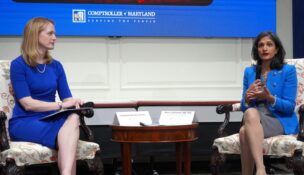
The Maryland Hospital Association is urging the state to spread a hospital tax evenly among providers and the self-insured to avoid hitting its members too hard, a position highlighted last week during a Medicaid briefing at the group’s headquarters in Elkridge.
“As the House and Senate leadership try to close the historic gap in the state budget, we want to be very clear: Spending is due to Medicaid enrollment,” said Carmela Coyle, president and CEO. “As they look to a hospital tax as a solution, we need to look to spreading it to the broadest base possible and not have the 46 community hospitals in the state shoulder that burden.”
Also known as hospital rate assessment, the tax is a state law that authorizes the collection of revenue from hospital providers.
The association’s leadership highlighted the tax as part of a 39-page study of health care costs. Coyle kicked off the meeting by explaining what it all means.
“So, how about hospital assessment — does that make sense?” she said, amid a couple of chuckles and confused faces. “It really is a strange creature.
“I once saw a headline [about this issue] that read, ‘Hospitals would get a pay raise,’ and I thought, ‘Oh my goodness.’ When the state raises rates, we don’t get to keep that money,” she said. “When there is a hospital assessment, we have to write a check back to the state.”
The General Assembly is debating a 2.5-percent hospital assessment as part of HB 72, the Budget Reconciliation and Financing Act of 2011. The fee would be imposed on net patient revenue for Medicaid operations, according to its fiscal and policy note on the Maryland General Assembly website. Assessment costs, the note says, must be shared “equitably” among hospitals and purchasers of hospital services.
If the budget passes both chambers, the Health Services Cost Review Commission will implement the hospital fee.
As Medicaid spending grows in Maryland, it becomes a bigger share of the state’s budget, the association’s study showed. The group projects drastic growth of Maryland Medicaid enrollees from 2008 to 2012, including a 30,000 beneficiary jump in 2009. The association expects the numbers to near 1 million by 2012.
Hospital assessment fits into the budget equation by raising revenue through Medicaid. Maryland’s Medicaid system is funded on a 50-50 basis. For every dollar the state spends on Medicaid, it receives a dollar from the federal government. And closing the budget gap by raising the assessment keeps federal dollars flowing in, Coyle said.
Maryland is the only state where a commission sets hospital rates. Coyle said that means that hospitals could only recover a new assessment if the commission allows the facility to charge higher rates. Otherwise, the hospital would have to find other means to cover the assessment.
The General Assembly predicts the new fee would raise $370 million, making it the largest amount the state has ever put on the table for hospital rate assessment, Coyle said.
Jim Reiter, MHA senior vice president of communications, said hospitals should carry a portion of the load.
“We have 93,000 employees,” said Reiter. “Hospitals are one of the largest employers in the state. We will be sharing our burden of the cost of this and will be paying our share as any other employer would. This would not just be water off of our backs.”
But Simon Powell, a budget analyst for the Department of Legislative Services, said an “equal” spread of the assessment exists in theory alone.
“The hospital association favors the tax being spread to ‘the broadest base possible’ because they have a vested interest in making sure they pay as little as possible,” Powell said. “So, from their perspective, it is the best option.”
Historically, there has been a 70-30 percent split, Powell said, with those with insurance paying the most. The real question, he said, is how this will play out in the future.
“Will there be a similar split or will the tax be allocated differently?” Powell said. “We won’t know until after session. That’s the big debate.”