Sign In
 Free Newsletter

In first-ever testimony, Baltimore County father asserts innocence in 1998 ‘shaken baby’ case


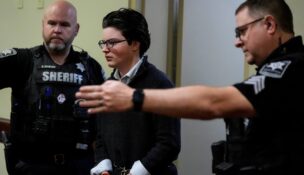
Clarence Jones took the witness stand and spoke directly to the judge in a clear, quiet voice.
“My son died tragically because of his health problems,” Jones said. “I would never hurt my child.”
It was the first time Jones, 59, testified in the nearly 25 years since the death of his infant son, Collin.
Jones spent 18 years in prison for murder based on police and prosecutors’ claim that he violently shook his 9-week-old son on Aug. 25, 1998.
He won a writ of actual innocence in 2021 after his lawyers mustered a slate of experts who said the once-accepted theory of “shaken baby syndrome” is based on flawed science that has come under increased scrutiny in the decades since Jones’ conviction.
Now, Jones is seeking compensation from the state. He testified last week at a two-day hearing before administrative law Judge Edward J. Kelley, who will decide whether Jones qualifies for more than $1.6 million under a Maryland law that grants exonerees payment for the time they spent in prison.
For the first time, Jones spoke under oath about Collin’s death and the time they spent together before the baby’s final hospitalization.
“Every day it was Collin and me,” Jones said, recalling carrying Collin into his home gym and letting the baby touch the equipment with his tiny hands.
Collin was born on Father’s Day in 1998, and Jones considered him a gift.
“I was so proud of him,” Jones said.
But Collin also had serious health problems. He was hospitalized for several days after a difficult delivery and again about a month later, when he began spitting up blood. Doctors treated Collin for pneumonia and told Jones and his then-wife to bring Collin back for treatment if he had trouble breathing.
On Aug. 25, 1998, according to Jones, Collin woke from a late afternoon nap spitting up and choking on baby formula he’d eaten earlier. Collin went limp and his breathing became strained.
Jones rushed Collin to Sinai Hospital in Baltimore.
“I was scared,” Jones testified. “I knew something was wrong and I had to react real quick.”
Collin lost consciousness and never woke up again. Doctors at the hospital quickly contacted police — the baby had a “triad” of symptoms, including bleeding in his eyes and around his brain, that at the time were considered to be guaranteed signs of child abuse.
Six days later, when doctors removed Collin from life support, Baltimore County police officers arrested Jones for murder. At a bench trial in 1999, prosecutors presented nearly unrebutted testimony from experts who said it was clear that Collin had died of shaken baby syndrome. Jones was convicted of murder and sentenced to 30 years in prison.
Jones testified last week about his time in prison and how the experience changed him.
“I had to watch my back day and night,” he said. “You’re in fear every day of your life. Nobody should go through that.”
Jones always maintained his innocence, even though it could have hurt his chances of winning parole. Even so, he went home on parole in 2017, after 18 years in prison.
He continued pursuing a writ of actual innocence after his release. Some medical and biomechanical experts now say that the certainty once assigned to the “triad” of shaken baby symptoms was misplaced, and that a variety of medical problems can mimic the signs that a child was abused.
Maryland’s Court of Special Appeals granted Jones a writ of actual innocence in 2021, concluding that the competing medical opinions might have led to a different outcome at Jones’ trial in 1999.
At last week’s hearing, Jones’ lawyers from Brown, Goldstein & Levy argued that Collin died of sepsis, not shaking, and that Collin’s symptoms were attributable to a long-running infection that overwhelmed his body’s ability to respond.
“The tragedy of this case, your honor, is they (doctors) just ignore the sepsis,” said Kobie Flowers, one of Jones’ lawyers. “They reverse engineer that there must have been an assault.”
Flowers called the case an “American tragedy” — Collin Jones lost his life and Clarence Jones lost his freedom.
“Clarence Jones is an innocent man,” Flowers said. “Clarence Jones should be compensated as such.”
Jones testified that he is still “lost” even more than five years after leaving prison. He was released without a driver’s license, social security card or the ability to use a smartphone. He struggles to find work because employers often won’t hire him when his background check comes back.
He wants to marry his fiancée, Peggy Williams, but has held off because he doesn’t feel financially stable enough. His relationships with his adult children are damaged by the years he spent in prison.
“They destroyed me,” Jones said of his conviction. “I have to mask this every day of my life.”
The Baltimore County State’s Attorney’s Office is contesting Jones’ request for compensation and asserted at last week’s hearing that Jones is in fact guilty of murdering Collin.
But the county’s legal argument also falls on technical grounds. Under the Walter Lomax Act, a 2021 law that standardized the way exonerees are compensated for wrongful convictions in Maryland, the person seeking money must show that their charges were either dismissed or that they were found not guilty on retrial.
Neither happened in Jones’ case. After Maryland’s Court of Special Appeals granted Jones a writ of actual innocence, the trial judge who first handled the request agreed to set aside Jones’ guilty verdict instead of allowing prosecutors to retry him, reasoning that Jones had already completed his prison sentence.
“The state was never given the opportunity to retry or dismiss the charges,” Deputy State’s Attorney John P. Cox said in court.
Kelley asked for additional briefing on the issue and will hear final arguments from both sides on May 9 at the Office of Administrative Hearings in Hunt Valley.
The judge will decide whether Jones is eligible for compensation within 90 days of the hearing in May.