Sign In
 Free Newsletter

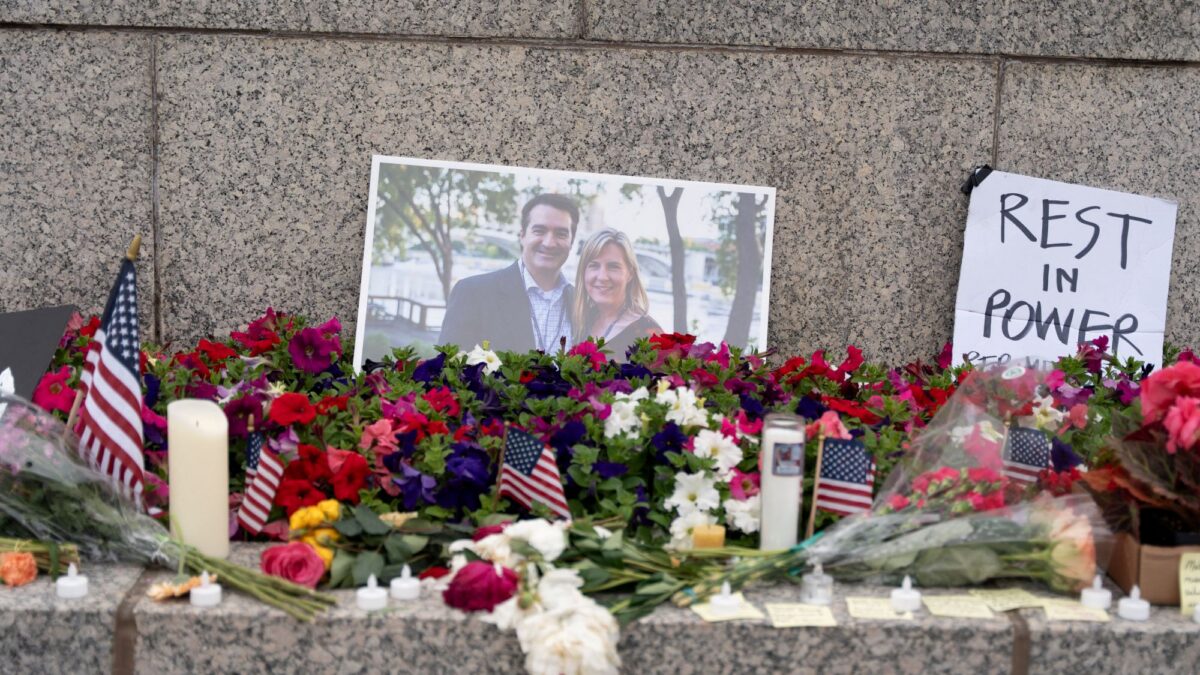
A memorial sits outside the Minnesota State Capitol in honor of murdered Democratic state assemblywoman Melissa Hortman and her husband Mark, in St. Paul, Minnesota, June 15, 2025. A 57-year-old named Vance Luther Boelter is suspected in the double murder, which, according to Minnesota Governor Tim Walz, is thought to be a politically targeted assassination. (REUTERS/Tim Evans)
Minn. man pleads guilty to charges in lawmaker shooting case


MINNEAPOLIS – The man accused of assassinating a former speaker of the Minnesota House and her husband last year in what authorities have described as an act of targeted political violence pleaded guilty Thursday after federal prosecutors said they would not seek the death penalty against him.
Vance Boelter, 58, of Green Isle, Minnesota, told a federal judge he fatally shot state Rep. Melissa Hortman (D) and her husband, Mark, during an early-morning rampage last June in which he disguised himself as a police officer and sought to target other lawmakers. Boelter also admitted to shooting State Sen. John A. Hoffman (D) and his wife, Yvette, during the attacks. They survived but sustained critical injuries and watched Thursday’s hearing from the courtroom gallery.
As part of a deal struck with prosecutors, Boelter pleaded guilty to six counts including stalking, murder and discharging a firearm in a crime of violence and agreed to serve a sentence of two life terms plus 40 years.
The agreement does not resolve state charges Boelter is also facing for his crimes. U.S. District Judge John Tunheim said he hoped to schedule a formal sentencing hearing for Boelter before the end of July to expedite pending proceedings in the state case.
Boelter’s appearance in court Thursday occurred nearly a year after his brazen rampage cut short the life of Hortman, a promising Democratic lawmaker, her husband and left a trail of devastation across Minnesota that stoked concern about rising rates of politically motivated violence in the United States.
He showed little emotion as a prosecutor read the details of his crimes. Shackled at the ankles and dressed in orange prison garb, Boelter simply responded “yes” as the judge asked whether the government had accurately described what he did.
Boelter acknowledged he wore body armor, a silicone mask and a wig as he arrived at the Hortmans’ home in the early hours of June 14, posing as an officer investigating reports of shots being fired in the area.
Mark Hortman opened the door, prosecutors said, and demanded to see a badge or identification. Boelter responded by pulling a handgun and repeatedly shooting Melissa Hortman, at one point firing at point-blank range.
Prosecutors’ description of that moment drew audible sobs from the courtroom gallery.
In a statement afterward, the Hortman family said “there is no justice for Mark and Melissa Hortman.”
“There is not justice when our family and our state will never truly heal,” it read.
An attorney for Boelter did not immediately return requests for comment Thursday.
The shootings occurred amid a spate of other high-profile incidents of politically motivated violence across the United States.
Months before the attacks, an arsonist set fire to the residence of Pennsylvania Gov. Josh Shapiro (D), later telling police he was motivated by “hatred” toward the governor. Three months after the Minnesota slayings, conservative commentator Charlie Kirk was fatally shot during an event on a college campus in Utah. And earlier this year, law enforcement said, an armed man stormed the White House correspondents’ dinner in Washington, attempting to harm Trump administration officials who were in attendance.
But even against that backdrop, the attacks in which Boelter has been charged stood out both for the number of intended targets and the meticulous planning authorities say led up to them.
Prosecutors said Thursday that Boelter stalked his intended victims over weeks, keeping a handwritten notebook with the names of lawmakers’ family members and researching their addresses online.
He first targeted the Hoffmans, approaching their home in disguise and ordering the senator and his family to raise their hands under the guise he was committing a robbery. Boelter acknowledged Thursday firing several shots at the couple before escaping in a vehicle disguised as a police SUV.
Prosecutors said Boelter then traveled to the homes of at least two other state lawmakers. Neither was at their residence.
He eventually arrived at the home of the Hortmans in Brooklyn Park, Minnesota. There, after killing Melissa Hortman, Boelter was interrupted by local police conducting a welfare check as he fatally shot her husband, law enforcement officials have said.
Boelter managed to escape, leading to a 48-hour manhunt before authorities captured him near his home, about 50 miles outside Minneapolis.
Investigators have since said Boelter confessed to the attacks in a rambling, delusion-filled letter addressed to FBI Director Kash Patel in which he claimed he had been acting on secret orders from Minnesota Gov. Tim Walz (D).
In the letter, he maintained he had been secretly trained by the U.S. military and that Walz had ordered him to kill the state’s two Democratic U.S. senators, Amy Klobuchar and Tina Smith. Boelter said he did not want to participate and did so only because his family had been threatened and that his victims were somehow part of that alleged plot, prosecutors have said.
Friends have described Boelter as an avidly evangelical Christian and occasional preacher who spent most of his career in the food industry while dreaming of launching a security business. In court Thursday, he told Tunheim in addition to Minnesota, he’d lived in Wisconsin, Oklahoma and Texas, and had traveled internationally to the Middle East, Eastern Europe and Africa.
He said he has five children, drawing a brief “That’s impressive” from the judge.
The Justice Department‘s decision not to pursue the death penalty against Boelter comes as the Trump administration has pushed to expand the use of capital punishment in federal crimes. But recent developments in another high-profile murder case had prompted some doubt about whether prosecutors would be able to sustain a capital conviction against Boelter.
A federal judge in Manhattan recently scuttled the Justice Department’s plan to pursue death penalty charges against Luigi Mangione, who is accused of gunning down UnitedHealthcare CEO Brian Thompson in 2024 outside a New York hotel.
To secure a capital conviction, prosecutors would have had to prove that Thompson’s killing occurred during the commission of another violent crime. The judge in that case ruled that stalking does not qualify as a crime of violence.
Boelter was facing the same combination of stalking and murder charges in the deaths of the Hortmans.
Daniel Rosen, the top federal prosecutor in Minnesota, defended the deal his office struck with Boelter to take the death penalty off the table in exchange for his guilty plea.
“When you have a defendant that is prepared to plead guilty, take consecutive life terms, to ensure that he never sees freedom again in his entire life,” he told reporters at a news conference following Thursday’s court hearing. “That was an opportunity that we just could not, that we could just not pass up.”
Reporting by Sheilan Regan and Jeremy Roebuck, who reported from Washington.