Sign In
 Free Newsletter


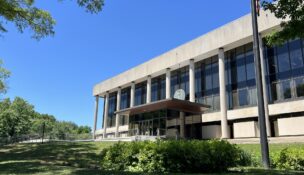
The 4th U.S. Circuit Court of Appeals is shown in 2017. (U.S. General Services Administration file photo)
Baltimore man’s claim police framed him can proceed, 4th Circuit rules


 Listen to this article
A Baltimore man deemed wrongfully convicted of murder after serving three decades in prison can sue the Baltimore police officers he claims framed him, the U.S. Court of Appeals for the 4th Circuit ruled Monday.
In a published opinion written by Judge Stephanie D. Thacker, a panel of 4th Circuit judges found that a federal judge inappropriately applied collateral estoppel, a legal doctrine that prevents the relitigating of issues, to prohibit Gary Washington from litigating his claims that the Baltimore Police Department and its officers coerced a 12-year-old and sole eyewitness into providing false testimony against him.
Thacker and the panel of judges, in reversing in part and affirming in part the district court’s ruling, also permitted Washington’s claims of due process violations and malicious prosecution, among others, to proceed.
“Applying collateral estoppel in this case would impose an unfair and inequitable result that is inconsistent with the doctrine,” the 4th Circuit wrote. “Precluding Appellant from litigating his colorable claims for relief would bar him from taking even a single bite of the apple regarding Appellees’ alleged misconduct.”
Washington, released from prison in 2018 after serving 31 years of incarceration for a 1986 murder that occurred outside his home, claims the Baltimore police officers and department violated his civil rights by coercing a 12-year-old witness into naming Washington as the shooter in the murder.
According to the opinion, the witness, Otis Robinson, retracted his testimony incriminating Washington when he became an adult, claiming he had only testified against Washington because he was a “victim of Baltimore City Police Dep[artment].” Robinson said the Baltimore police had threatened to take him away from his mother “forever.”
The 4th Circuit found Robinson’s original testimony did not provide probable cause to arrest and prosecute Washington, and that therefore Washington’s civil claims against the Baltimore police officers that rely on Robinson’s recantation may proceed.
“We are pleased with the Fourth Circuit ruling, and Mr. Washington welcomes the opportunity to prove his claims at trial,” said Renee Spence, counsel for Washington and partner at the Chicago-based firm Loevy & Loevy, in an email Tuesday.
The 4th Circuit also reversed the district court’s dismissal of Washington’s intentional infliction of emotional distress claim.
“As it stands today, the State of Maryland has declared Appellant to be an innocent man. Thus, if Appellant’s theory of the case is true, and he was incarcerated for 31 years pursuant to Appellees’ coercive attainment of fabricated testimony, his incarceration would certainly qualify as distress ‘so severe that no reasonable man could be expected to endure it,’” the 4th Circuit wrote.
The Baltimore City Law Department, who represented the Baltimore police officers named in the case, said the city “is reviewing the decision and will reserve comment for the appropriate judicial forum.”