Sign In
 Free Newsletter

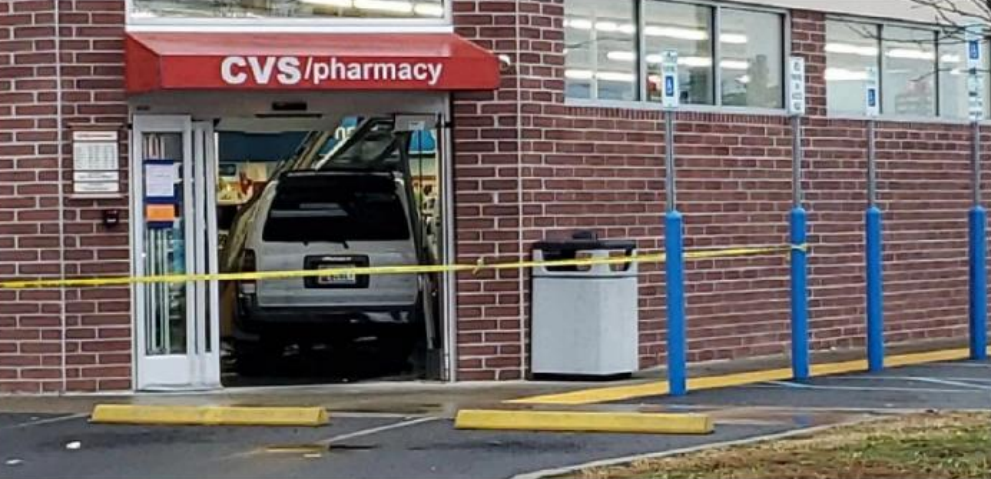
Ashley Moore was "catastrophically injured" when an SUV crashed into the front entrance of a Salisbury CVS in December 2019. (Photo taken by the Wicomico County Police Department and included in the case record)
Salisbury CVS crash case must be tried, MD court rules


 Listen to this article
Key takeaways:
- Maryland Appellate Court reverses dismissal in CVS crash case
- Ashley Moore suffered catastrophic injuries in 2019 crash in Salisbury
- Her lawyer calls ruling important for customer safety
The Appellate Court of Maryland last week ordered a trial in a personal injury case arising from a car crashing into the entrance of a CVS Pharmacy in Salisbury.
On Friday, the court reversed a decision by the Wicomico County Circuit Court, which had dismissed the lawsuit in favor of CVS.
The appellate court ruled that the crash might have been foreseeable, despite the lack of crashes at this location. It ruled that there were genuine disputes of fact regarding the extent of CVS’ control over its Maryland subsidiary and the subsidiary’s responsibility for the design of the store’s parking lot.
Ashley Moore, a freshman at Salisbury University, was on her way out of the store one day in December 2019 when an SUV crashed through the entryway. The driver, Maria Belfort, was pulling into a parking spot in front of the entrance and failed to hit the brakes. The parking spot had a “wheel stop,” a roughly 6-inch-tall concrete barrier, but it didn’t stop the vehicle.
Moore was knocked unconscious and suffered “catastrophic injuries,” including numerous fractures that required surgeries, and alleged permanent physical and emotional injuries.
“Maryland CVS was not entitled to summary judgment merely because the parking space had a wheel stop — something which, by all accounts, would not impede a moving vehicle,” Appellate Judge Kevin Arthur wrote. “Maryland CVS was not entitled to summary judgment merely because there were no prior vehicle crashes at the same store or at certain nearby CVS stores.”
Arthur was joined by Appellate Judge Melanie Shaw and Senior Judge Timothy Meredith, who was specially assigned.
Casey Brinks, a partner at Tydings & Rosenberg in Baltimore who represented CVS and Maryland CVS, declined to comment.
Moore’s lawyer, Allen Honick, of Furman Honick Law in Owings Mills, described the decision as “an important step for customer safety in Maryland.”
“The Appellate Court made clear that businesses cannot ignore foreseeable dangers at their storefronts and then claim they needed a prior tragedy at the same exact location before acting. Ms. Moore deserves her day in court, and we look forward to presenting her case to a jury.”
The opinion was reported, meaning it can be cited as precedent. The courts may only report “opinions that are of substantial interest,” according to the Maryland Judiciary’s website.
“Irrespective of what happens in Ashley Moore’s case, this is now good law and puts storefront owners on notice,” Honick said.
Moore sued Belfort, CVS and Maryland CVS, alleging her injuries were caused by the driver’s negligence and the company’s design of the parking lot, with only wheel stops but not bollards in front of the entrance.
CVS argued that it did not have reasonable notice of the possibility of storefront crashes because none had happened at this store for at least five years before this accident and that the installation of a wheel stop was enough to avoid liability.
Moore argued that the company knew about the risk because there had been several crashes at CVS stores in the 12-store district that included the Salisbury location — not to mention the more than 100 similar crashes nationwide from 2011 to the time of the accident in 2019.
Wicomico Circuit Judge S. James Sarbanes granted summary judgment to CVS.
Arthur wrote that CVS argued for a too-narrow reading of a Maryland Appellate Court case from 1979.
“In our assessment, it is unreasonable to interpret (precedent) to mean that any barrier of any kind, no matter how ineffective, automatically precludes liability against a store proprietor for storefront vehicle accidents,” Arthur wrote.
“(It) would be an error to interpret (the case) to mean that store proprietors have no obligation to take protective measures against encroaching vehicles unless and until they receive reports of incidents at their stores or stores under their control.”