Sign In
 Free Newsletter


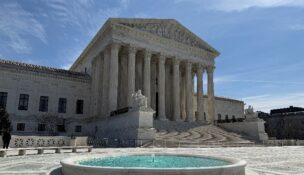
SGK Contracting replaced the roof at the Elijah E. Cummings Courthouse, part of the Baltimore City Circuit Court. (The Daily Record/Ian Round)
Officers, ICE agents must identify themselves, show IDs when entering Baltimore court facilities


 Listen to this article
All law enforcement officers entering certain court facilities in Baltimore City — including immigration agents — will have to identify themselves and state the purpose of their visit under an administrative order issued Monday by Baltimore City Circuit Court Chief Judge Audrey Carrión.
The order, dated June 30, applies to the Clarence M. Mitchell Jr. Courthouse, the Elijah E. Cummings Courthouse and the Juvenile Justice Center, and comes days after an incident in which a local correctional officer reportedly invited Immigration and Customs Enforcement to come and detain a person who was there for an appointment.
Carrión’s order states that officers must report to the Baltimore City Sheriff’s Office to identify themselves. They are required to be in uniform or to “prominently display above the waist” their badge or agency ID.
“It is crucial that Court management and the Baltimore City Sheriff’s Office are aware of any law enforcement activity taking place (in these courts),” the order states.
It does not apply to U.S. District Court or Baltimore City District Court facilities.
Nick Cavey, a spokesman for the Maryland Judiciary, stated in an email that the order “was issued to emphasize and reaffirm the preexisting protocols of the Circuit Court for Baltimore City.”
The Baltimore Banner first reported on the ICE enforcement action at the Mitchell Courthouse and Carrión’s administrative order.
The Baltimore City Sheriff’s Office is investigating the employee of the Maryland Department of Public Safety and Correctional Services who allegedly tipped off ICE about the individual’s court date, the Banner reported. BCSO did not immediately respond to a request for comment.
Guha Krishnamurthi, a professor at the University of Maryland School of Law, said in an email, “I certainly think it makes sense and is within the court’s power and discretion to require people who come to the courthouse to state their business.”
“Additionally,” he wrote, “it seems like good practice — it can help avoid serious concerns about access to justice and frustration of the court’s own business — if people are being apprehended at the courthouse, they might not come to their required hearings, and the like.”