Sign In
 Free Newsletter


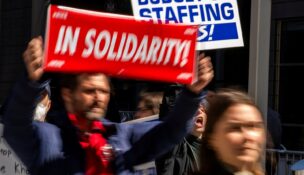
AFSCME Maryland Council 3 President Patrick Moran speaks at a rally outside the District Court for Baltimore County on June 11, 2024. (Jack Hogan/The Daily Record)
State employee union argues against budget cuts: ‘Our members are more than just line items’


 Listen to this article
Unionized state employees testified before the Senate Budget and Taxation Committee Tuesday, arguing that the state’s continued staffing issues are due to a lack of investment in its workers.
“Our members are more than just line items,” said Denise Gilmore, the legislative and political director for the Maryland chapter of the American Federation of State, County and Municipal Employees. “They are on the frontlines every day, and they are ensuring that Maryland runs.”
During a personnel budget briefing for the Department of Budget and Management, the Department of Legislative Services recommended that the agency not move forward with the proposed $63.8 million for salary step increases for state employees in the fiscal year 2027 budget.
“I just want to underscore how expensive it is not to invest in personnel,” Gilmore said to the lawmakers.
Members of AFSCME testified that they save the state money through their labor, sometimes up to three-quarters-of-a-million dollars, according to Lisa Thomas.
Thomas is a maintenance supervisor at Maryland Correctional Training Center. She said that, last year, she repaired a steam line in the road by herself for $60,000. Contractors had quoted that it would cost the state $250,000. She also fixed doors at Patuxent Institute for $111,000.
Contractors said it would cost $360,000.
“… [T]hat’s just my one position,” Thomas said. “There are stories like mine in skilled trade positions all over the state.”
Gilmore commended the Department of Public Safety and Correctional Services for “still having in-house maintenance,” noting that not every agency does.
“Where Lisa is saving DPSCS money, we’re seeing another agency, for instance, moving away from in-house maintenance … spending that money, instead, on contractors,” she said.
Jake Weissman, the secretary of the Department of Budget and Management, said his agency “respectfully disagrees” with the Department of Legislative Services’ recommendation.
“… [T]his issue has emerged as a long-standing issue of inequity that exists in our state government and which this administration is determined to address,” he testified, noting that the department plans to address the salary step increases through a “phased” approach.
Beyond their push for more-competitive salaries, members of the union testified that under-staffing remains an issue.
Vacancy data submitted to the Department of Legislative Services in January suggests there are approximately 4,360 open positions among executive agencies.
Under-staffing agencies has cost the state money — $350 million for 6.7 million hours of overtime in fiscal year 2025, Gilmore said.
It’s also dangerous.
Tony Sines, who represents AFSCME’s Western Maryland correctional officers, said that at North Branch Correctional Institution, a supermax prison in Cresaptown, officers there are being “mandated seven or eight weeks straight without a day off,” and are sometimes asked to work “multiple” double shifts.
North Branch Correctional Institution is authorized by the Department of Budget and Management to have 315 positions. According to Sines, there are currently 151 vacancies.
“We have a real hiring and retention issue. The only solutions right now require investment,” he said, calling for a combination of salary increases, a stabilization plan for staffing crises, temporary hiring and retention incentives.
Sines recalled multiple incidents where correctional officers in his area have been attacked, including an instance where two were “stabbed in the neck and throat area” requiring lifeflights to Morgantown, West Virginia, and a case where another officer was stabbed in the face with a pen to the point that she had to receive care in Pittsburgh, Pennsylvania.
“Something has to give,” said Sines. “We can’t go on like this.”
Gilmore pointed to position cuts and the limited hiring freeze that Gov. Wes Moore, a Democrat, implemented last summer, noting that vital services state employees conduct “still have to happen, they just get contracted out.”
The hiring freeze is not being implemented at agencies with 24-hour care facilities, like the Department of Public Safety and Correctional Services and the Department of Health.
Weissman said the freeze will continue into the 2027 fiscal year.
But the panel also argued that employee retention is also a problem.
Wynton Johnson , the vice president of the Maryland Department of Transportation unit for the union, has worked at the State Highway Administration for more than 20 years as a facility maintenance tech.
Johnson said that, five years ago, he noticed a lot of empty positions.
“There are three reasons why people are leaving,” he said, noting that the employees he represents feel undervalued, contracted workers are being hired to cut down the number of positions, and that the wage gap is widening between state and county employees.
“When I first started, being a state employee was a gateway to the middle class,” he said. “Now, we’re allowing it to become a stepping stone to a better job at county levels.”