Sign In
 Free Newsletter

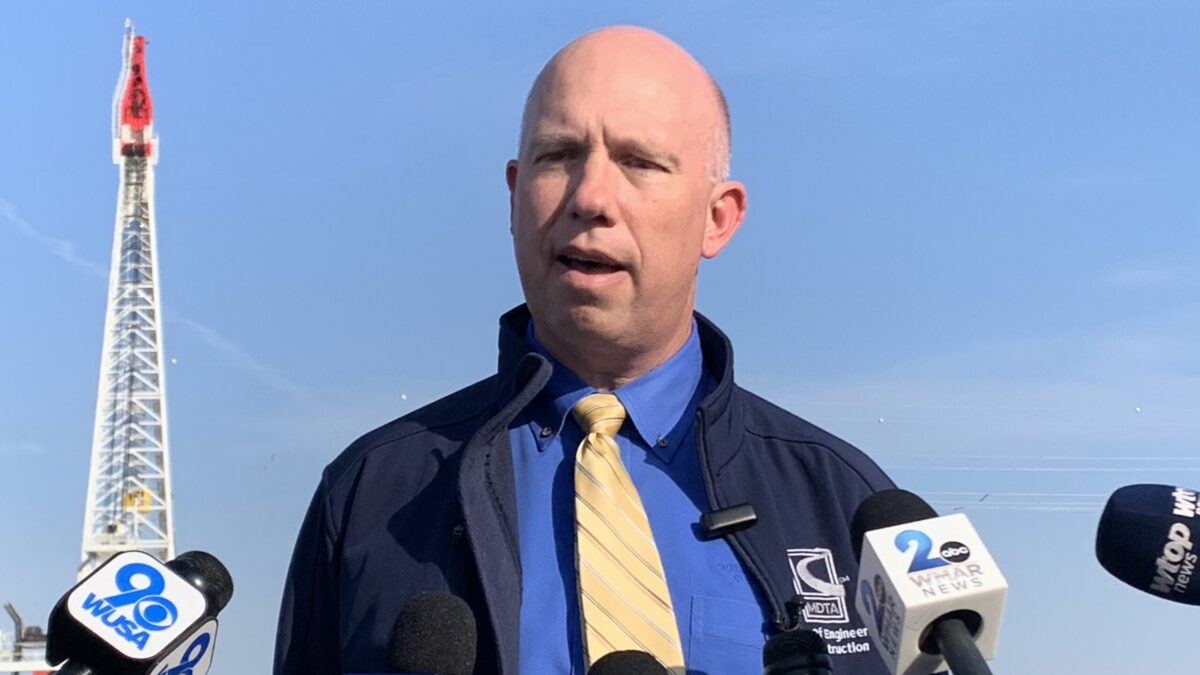
James Harkness, chief engineer at the Maryland Transportation Authority, speaks to reporters about progress on the Francis Scott Key Bridge rebuild, two years after the original bridge collapsed from a ship strike. (Dan Belson/The Daily Record)
MD to seek 4 contracts for Key Bridge rebuild


After exiting its contract with Kiewit Infrastructure, the Maryland Department of Transportation is seeking four separate procurement contracts in its mission to rebuild Baltimore‘s Francis Scott Key Bridge.
“I want to be crystal clear that Kiewit was not fired, and the work that Kiewit was under contract to do will continue through the end of the year,” Kathryn Thomson, secretary of the Maryland Department of Transportation, said during a briefing of the state’s House Appropriations and Environment and Transportation committees Tuesday. “We have been pleased with the quality of the work and the price for that portion of the work and have no concerns about that.”
In late April, the state announced it was pursuing an off-ramp clause in its contract with Kiewit, which has executed the design of the new Key Bridge after the fatal collapse in March 2024. The contract between Kiewit and the state required Maryland to allow the infrastructure company to have the first bid on the construction phase of the bridge.
Thompson said that after several weeks of negotiating “in good faith,” the state decided to pursue a different construction route. Bruce Gartner, executive director of the Maryland Transportation Authority, declined to provide details regarding the price of the contract with Kiewit, citing the confidential negotiation process.
Rather than awarding one company a contract to construct the bridge, the rebuild project has been split into four separate parts: continued demolition and miscellaneous marine work, the south land approach, the north land approach, and the main span and marine approaches.
Advertisements for bids will be issued for the demolition contract and main span and marine approaches over the summer, the south land approach this fall, and the north land approach in winter 2027.
Kiewit will continue the rest of the Phase 1 rollout, which is expected to be completed by the end of the year.
The new procurements were developed in partnership with the Federal Highway Administration, Gartner said.
James Harkness, the chief engineer at the Maryland Transportation Authority, said breaking the work into four procurements will “allow us to stagger” by allowing certain projects with readily available materials to be taken on first.
“It also allows contractors to look at multiple bid packages if they so choose,” he said.
Asked why the state initially pursued one large contract instead of multiple procurements — which typically come in at a lower price point — Thomson said, “It was based on what we needed at the time to move quickly and to get into the water to do demolition and to begin design.”
“This off-ramping is not uncommon in large, complex infrastructure projects,” she said.
Gartner said the state had to release a cost estimate without having a design.
“Nobody has experienced this kind of, like, emergency program project at this scale, and that was the best path forward at the time,” he said. “That was the best opportunity we had to get the project moving as quickly as we did.”
The project is still anticipated to cost around $5 billion. Gartner said that the Department of Transportation is still hoping to have the project completed by the end of 2030.
This story has been updated.