Sign In
 Free Newsletter

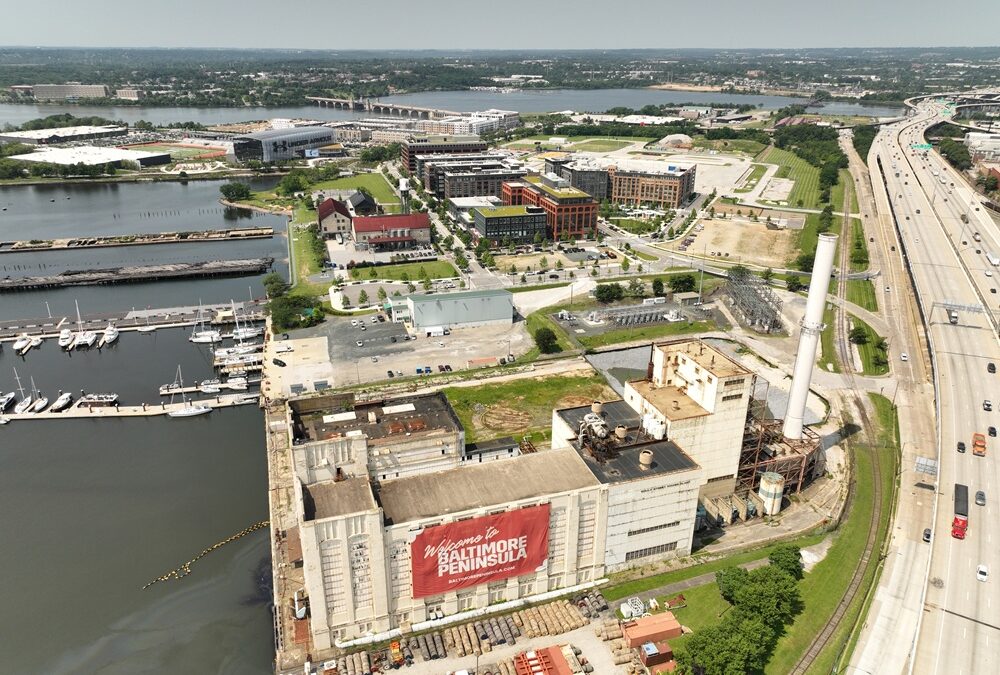
The mixed-use Baltimore Peninsula development in the southern part of the city. (Courtesy of Baltimore Peninsula Partnership)
Baltimore Peninsula: Was Kevin Plank ‘overly optimistic’?


 Listen to this article
Key takeaways:
- Developer Kevin Plank exited new development at Baltimore Peninsula to focus on Under Armour.
- Less than 10% of the 235-acre Baltimore Peninsula site is currently in use.
- Leasing office space has been difficult due to market conditions and negative publicity, including viral YouTube videos.
- Residential development is progressing steadily with 28 Walker’s townhomes and apartments nearing completion.
Depending on who you’re listening to and what you call it, the Baltimore Peninsula mixed-use campus was founded about a decade ago.
Initially branded under long-time name of Port Covington, the area was renamed a few years later Cyber Town USA in an effort to attract tenants to an innovation campus.
In late 2022, it became Baltimore Peninsula, which today ― again, depending on the participants and the tangent ― hasn’t lived up to the predicted traction due to an overly enthusiastic marketing plan, a pandemic, a flat commercial real estate market and maybe a couple of viral YouTube videos that detailed its lack of energy.
However, others call this ongoing saga simply a typical, large, mixed-use project, the type that can be slow to develop but could eventually meet its hype.
The project was planned to include 14 million square feet on 2.5 miles of restored waterfront at what was once a rail and industrial hub in a somewhat-detached property adjacent to Interstate 95. However, less than a 10th of the 235 acres available for the project is in use.
In December, Kevin Plank’s Sagamore Ventures pulled out of future development so he could focus on revitalizing the company he founded, key Baltimore Peninsula tenant Under Armour. This departure has left stakeholders split on whether the complex can still realize his vision.
Evolving issues
As it stands, “Leasing office space has been the biggest challenge,” said Terri Harrington, who is now managing principal of Baltimore-based Harrington Commercial Real Estate Services but served as a broker during the early days of the project, “though there are some wins, like CFG Bank, PwC and Saint Ayers Gross.
“Many Downtown tenants are contemplating moves to Harbor East, Harbor Point and Baltimore Peninsula,” Harrington said, adding, “It’s harder to get bigger leases today. They tend to come in smaller blocks, so brokers and owners are working harder, and have to be more nimble to get deals done.”
Not helping at Baltimore Peninsula “is negative PR like the YouTube videos, which everyone seems to have seen,” she said, “and recent news about yet another asset manager. That hurts continuity.”
Posted by construction and development account Building Tales, the video series on “Baltimore’s Billion Dollar Ghost Town” collectively received millions of views since posted in 2025.
Harrington added that connectivity is another key to future leasing, “as ingress and egress issues are still being worked out. The success of the project is ultimately having ease of access to South Baltimore,” she said. “It would be easy with a water taxi, but bicyclists and walkers have to navigate on and off ramps to a major interstate when headed toward Federal Hill.”
Energy needed
The access issue is of particular note to planners like Cecily Bedwell, a principal with Baltimore-based Design Collective. “How to exit I-95 below the overpass seems to be a question, and the entry isn’t aesthetically pleasing or welcoming,” she said.
Bedwell was part of a group that toured the area last year, when a city liaison said 97% of retail was leased and occupied. “But it didn’t look that way,” Bedwell said.
Her impression was that “the streets were well-designed,” she said, “but the community lacked energy. They need programming to attract more events, thus more people. Given the distance from the southern neighborhoods of the city and the lack of access, there isn’t a reason to go there if you’re downtown at a ballgame, a concert or another event.”
Bedwell said holding events at the stadium behind the Under Armour headquarters or the current open space should be a goal. “However, you don’t want to take the energy from Downtown and the Inner Harbor, which need to be energized, too.”
Be like Nike?
Richard Clinch, director of the University of Baltimore‘s Jacob France Institute, was involved with then-Port Covington early on, writing economic development projections for Weller Development Partners (the developer of much of the project), which Plank brought on board. Clinch offered a macro version of what he thinks has transpired to date.
“The YouTube video offers an honest depiction, but it lacks enough context,” he said. “Under Armour changed South Baltimore for the better when it grew to a few hundred employees at Tide Point, and development there has struggled since.”
That’s about when Plank left the Tide Point area for a bigger project: Port Covington.
“Plank saw how Nike changed Portland,” he said. “Was this overly optimistic? Yes. Was it pie in the sky? No. And young professionals were moving into cities at that point. Look at the Navy Yard, in Washington, for instance. That area was bad news in 1994, but now look at how successful it’s become.
“Thus, Plank presented us with Port Covington,” Clinch said, “which was Baltimore/not Baltimore,” due to its somewhat isolated/not isolated lay on the land.
But then Under Armour hit the wall. “It’s lost 75% of its valuation in the past decade and didn’t become Nike,” he said. “Then COVID-19 happened a few years in; add to the equation that Maryland is not doing well.”
Although the city’s employment growth rate was up 3% over eight years and projected to grow another 4% in the next few years, it was losing citizens.
“So during Baltimore Peninsula’s existence,” said Clinch, “the city has been in decline.”
Looking up
Despite the challenges, some of those involved see the issues experienced at Baltimore Peninsula as somewhat normal. Among them is Mark Sapperstein, CEO of 28 Walker Development, which is building 394 townhomes/condos and 420 apartments on the 25-acre Locke Insulators site in the area.
He said 28 Walker’s homes are about two-thirds done, approximately 150 occupied. The average townhome and/or condominium is selling for north of $700,000, according to Sapperstein.
He feels like the overall project “is going to work out fine. It’s just taking longer to gain momentum. As for the retail, remember that you need density for it to be successful, so that has been slow.”
“However, residential is needed, has been well-received and will continue to be,” said Sapperstein. “We’re even seeing a flux of people moving here from Montgomery County because the price point is a bit lower here, plus we offer the convenience of I-95.”
CEO of CFG Bank Jack Dwyer concurred, complimenting Plank “for his vision. ”
“He built buildings here on spec, which usually doesn’t happen anymore. It’s like a campus, and we’re the first large tenant.”
Dwyer said he’d been talking with Plank about moving to the campus from Bare Hills, in Baltimore County, in its early years; then COVID-19 hit. “But I was fascinated by this new product, as I am by David Bramble’s plan to attract residential projects to the Inner Harbor. That’s important since much of the business community has moved and is moving to Harbor East, Harbor Point and Baltimore Peninsula. They’re the new frontiers.”
In 2024, the bank leased about 100,000 square feet at Baltimore Peninsula for its headquarters.
But Dwyer knows it can take time to build an identity, too.
“I’d guess that 80% of the people in Baltimore,” he said, “still don’t know where Baltimore Peninsula is.”
‘Solid 2025′
But those who do come to the area, Dwyer said, come away impressed.
“Once people see the campus, they’re in awe of it,” he said. “I think its progress is about right, considering that the world was shut down for about two years. We’re probably about where we need to be.”
While noting that, “We all wish it was farther along, but Harbor East didn’t happen overnight, either. And the only open space left for another building is the old Baltimore Sun printing plant site, and I think, in time, someone else with vision will come in with an appropriate project.”
Harrington is feeling a similar vibe.
“The good news is that there’s some upside, and I think the project will stabilize not too far down the road, spurred in part by the move back to the office,” she said. “In terms of Class A office space, it’s still one of the most lucrative submarkets in the city, especially since it abuts Route 95 and is close to South Baltimore, Federal Hill, the Inner Harbor and Locust Point.
“Baltimore Peninsula had a solid 2025 to build on, so once some of the PR challenges die down and people see who’s moved in,” she said, “those tenants will beget more tenants.”
This story has been updated.