Sign In
 Free Newsletter

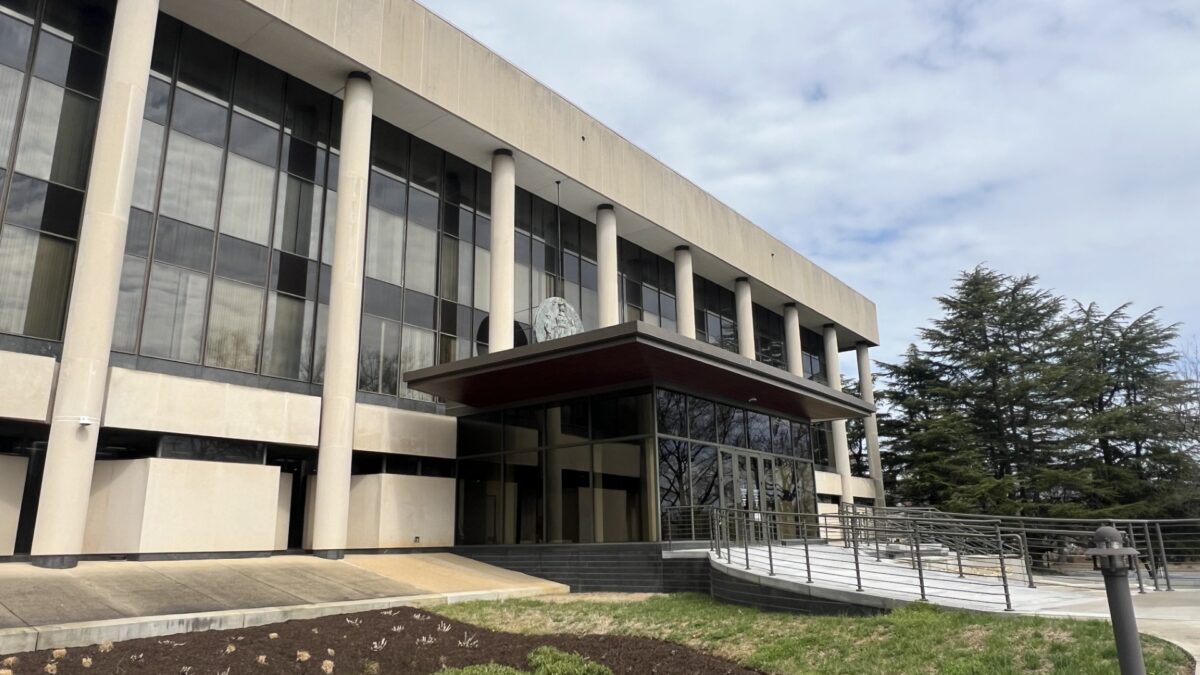
The Robert C. Murphy Courts of Appeal Building, which houses Maryland's two appellate courts, is seen on March 30. (Ian Round/The Daily Record)
MD Appellate Court dismisses charges after state fails to provide speedy trial


Key takeaways:
- Maryland Appellate Court dismissed charges against John William Smith Jr.
- State violated Interstate Agreement on Detainers by missing 180-day trial deadline
- Trial delayed without good cause or record of extension in open court
- Smith sentenced to 20 years before appellate dismissal of convictions
The Maryland Appellate Court this month dismissed criminal charges against a man after the state failed to provide him with a speedy trial.
The Appellate Court ruled that the state violated the Interstate Agreement on Detainers and dismissed third-degree sexual offense convictions in Washington County against John William Smith Jr., who is currently incarcerated in Pennsylvania for child pornography and corruption of a minor.
In an opinion published April 6, the court found that the state failed to try Smith within 180 days of his request for a trial as the agreement requires. An extension beyond that deadline, the court ruled, was not granted “for good cause shown in open court.” The Washington County Circuit Court should have granted his motion to dismiss the case after the state missed the deadline, the court found.
“In this case we have no record as to why the court found cause to go beyond the 180-day window,” Appellate Judge Stephen Kehoe wrote. “It was incumbent on the State to make sure that there was a record. Defense counsel had no obligation to save the other parties from themselves.”
Kehoe was joined by Appellate Judge Michael Reed and Senior Judge James Eyler, who was specially assigned. The Maryland Office of the Attorney General, which represented the state on appeal, declined to comment. The Maryland Office of the Public Defender, which represented Smith, did not respond to a request for comment.
The Interstate Agreement on Detainers is a compact between almost every state, the federal government and Washington, D.C., applying to incarcerated people who are charged with crimes in other states.
Smith in March 2024 requested a prompt trial under the IAD, and the court and prosecutors acknowledged receipt of that request in April. A trial was eventually scheduled to begin October 15 — the last possible day under the law.
Prosecutors and Smith’s lawyers met in August, but did not keep a record of the meeting. The trial was then delayed by about two weeks. On Oct. 16, Smith filed a motion to dismiss, and the court denied the motion without a hearing eight days later. He was found guilty of two counts and sentenced to 20 years, with 10 years suspended, on top of the sentence he is serving in Pennsylvania.
The state argued that Smith consented to the postponement through counsel, and that the scheduling conference counted as a proceeding in “open court,” even though a transcript wasn’t prepared. It argued that the defendant had the obligation to attempt to create a record of the proceeding.
Kehoe wrote that the court was “completely unpersuaded” by the state’s attempt to shift the burden to the defendant.
“Plainly, the continuance in this case did not occur in ‘open court,’” Kehoe wrote. He wrote that there was “nothing in the record to indicate a waiver by defense counsel.”
Kehoe cited the Maryland Appellate Court’s 2024 opinion in State v. Meadows, where it found that a defendant has “one, and only one burden,” which is to ask the prison official who has custody over him to prepare and send forms to the jurisdiction that has filed new charges. After that, the responsibility to guarantee a prompt trial is “solely” the state’s.
“A defense lawyer has no obligation to remind the State of its duty to bring the defendant to trial within the statutory deadline,” Appellate Judge Kevin Arthur wrote in that case. “In fact, one could argue that a defense lawyer has a professional obligation not to remind the State of that duty.”