Sign In
Upcoming Event
 Free Newsletter

‘Beltway sniper’ bid to be resentenced sooner in MD rejected by appeals court
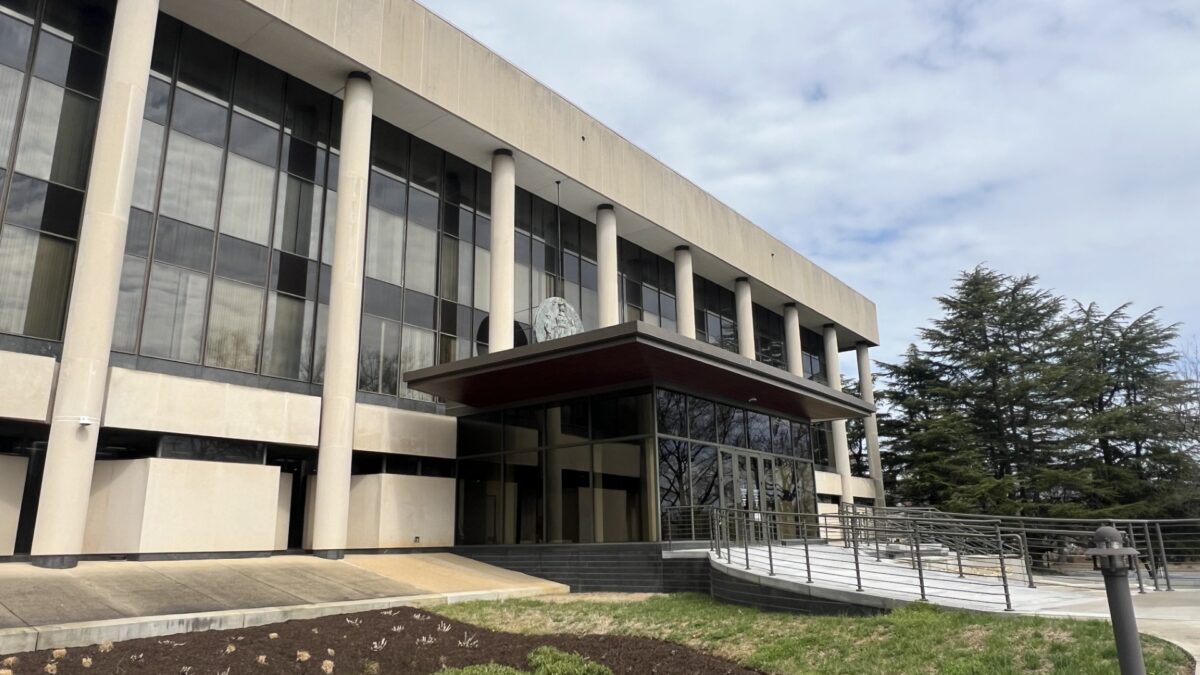
The Robert C. Murphy Courts of Appeal Building, which houses Maryland's two appellate courts, is seen on March 30. (Ian Round/The Daily Record)
‘Beltway sniper’ bid to be resentenced sooner in MD rejected by appeals court


 Listen to this article
A three-judge panel rejected an appeal by the man serving several life terms for the 2002 “Beltway sniper” killings, finding that a snag in Lee Boyd Malvo‘s endeavor to be resentenced in Maryland is not ready for review.
The ruling by the Appellate Court of Maryland was a blow for Malvo, who was 17 at the time of the killing spree and is serving a total of 10 consecutive life sentences — four in Virginia, to be followed by six in Maryland.
The Maryland Supreme Court ruled in 2022 that Malvo, now 41, must be resentenced, though those proceedings were rendered impracticable due to complications with transferring him from Virginia to Maryland, resulting in a Montgomery County judge ruling that the hearing would take place once his sentences in Virginia are complete. Malvo was last denied parole in Virginia in 2022.
Maryland’s intermediate appeals court ruled last Friday that Montgomery Circuit Judge Sharon V. Burrell’s order was not appealable because it is not a final judgment, and the collateral order doctrine does not apply.
Burrell had ruled that because Malvo refused to have his resentencing hearing held virtually and the state could not force Virginia to transfer him to Maryland, his resentencing could not be held. Malvo had also filed a motion to vacate his guilty pleas due to the delay in his resentencing.
“There are only two options. Have a … sentencing hearing in which (Malvo) appears remotely or wait until he has finished his sentence in Virginia,” Burrell said in 2024.
Malvo’s attorney, Michael Beach of Brennan McKenna & Lawlor, Chtd., did not return a request for comment Thursday. At oral arguments, he argued that the state supreme court’s 4-3 order to resentence Malvo was without exception.
“The Maryland Supreme Court is not in the habit of issuing advisory opinions or suggestions,” he said. He argued that Burrell’s order could be reviewed under the collateral order doctrine, which allows the immediate appeal of certain interlocutory orders.
“They didn’t say, ‘He ought to be resentenced if it’s possible.’ They didn’t say, ‘Maybe he should be resentenced if there’s some way to you can get him back from Virginia,'” Beach said.
Malvo and accomplice John Allen Muhammad were arrested following a string of shootings that killed 10 people and wounded three others in the Washington, D.C., area over a three-week span in October 2002, following another set of preliminary shootings that killed and wounded several other people.
Muhammad, who was decades older than Malvo and accused of manipulating the teen to serve as his partner in the shootings, was sentenced to death and executed in Virginia in 2009.
A Virginia jury convicted Malvo of murder but spared him of the death penalty, and he became eligible for parole in 2020 after the state’s then-governor, Ralph Northam, signed legislation allowing prisoners serving life sentences for crimes committed as juveniles to be eligible for parole after 20 years of incarceration.
In Maryland, he pleaded guilty in 2006 to six counts of first-degree murder. There was no formal plea agreement, though Malvo’s attorneys argued that a memorandum saying the parties were “free to allocute” the sentence was violated by Burrell’s order because Malvo would be unable to allocute for a lesser sentence.
He remains incarcerated in the Keen Mountain Correctional Center in Southwest Virginia. Officials there had told Maryland officials that they were “not interested in entering into an executive agreement” to transfer Malvo to Maryland for resentencing, according to the appellate court’s opinion — then-Gov. Glenn Youngkin’s spokespeople said at the time that Malvo would not be transferred due to his “violent criminal history.”