Sign In
 Free Newsletter

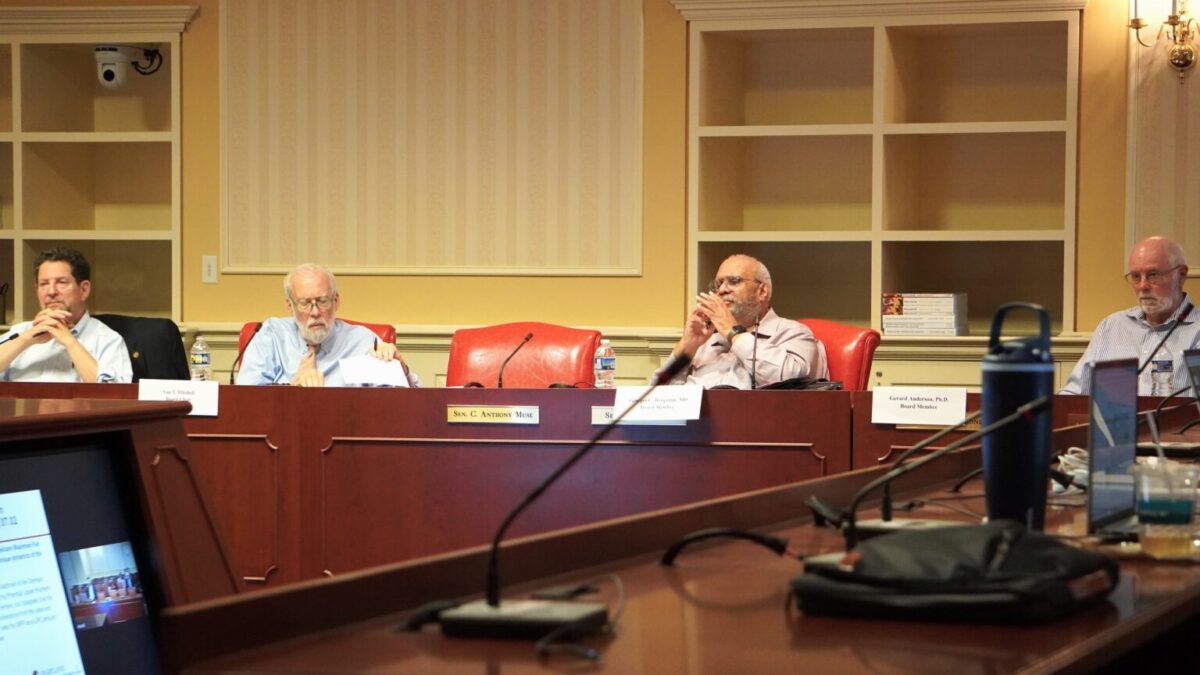
Members of the Prescription Drug Affordability Board approve a plan May 18, 2026, to limit how much state and local governments can spend on Ozempic. (Photo by Danielle J. Brown/Maryland Matters)
MD board votes to cap how much governments spend on Ozempic
With two drugs selected for upper payment limits, an expansion for the board’s authority to cover all Marylanders is on the horizon


 Listen to this article
Key takeaways:
- Maryland Prescription Drug Affordability Board approves payment limit on Ozempic
- Limit could save state and local governments about $5.8 million annually
- Board explores subscription model for GLP-1 medications like semaglutide
- Chair Van T. Mitchell announces plan to step down after six years
State officials determined that Ozempic, a popular diabetes treatment and weight-loss drug, is unaffordable for Marylanders and voted Monday to limit how much state and local governments will pay for it on state health plans.
Advocates say the Maryland Prescription Drug Affordability Board’s proposed “upper payment limit” on Ozempic, the name brand for semaglutide, could save state and local governments around $5.8 million a year on state health plans.
The board’s decision comes a month after it voted to place an upper payment limit on another Type 2 diabetes drug, Jardiance, that could save the state around $320,000 a year.
The approvals follow years of delays for the board, and they’re still not final: They are still subject to a public comment period, and if approved after that the savings won’t start until 2027 at the earliest.
Meanwhile, some patient advocates and lobbyists for the pharmaceutical industry continue to insist that the board’s decision could actually reduce access to the drugs and are skeptical whether savings will result in lower out-of-pocket costs for consumers.
“It is patients who could face the consequences through new insurance barriers such as formulary changes, adverse tiering, and expanded utilization management,” Tiffany Westrich-Robertson said in a written statement on behalf of patient advocacy groups Ensuring Access through Collaborative Health and Patient Inclusion Council.
“Patients need reforms that directly reduce out-of-pocket costs and protect access to the medication that works for them, not policies that may create new barriers to care without guaranteeing meaningful savings for patients,” her statement said.
The board also voted Monday to explore other ways to bring down costs of Ozempic, such as using a “subscription model” to pay for the GLP-1 medications, where the state pays an annual fee to one manufacturer in exchange for expanded or unlimited supply of semaglutide, among other options.
Both proposals for Ozempic and Jardiance need to be published on the Maryland Register for 30 days before the board can take a final vote on it. If both proposals are approved, the upper payment limits would start on Jan. 1, 2027.
That would start the clock on possibly expanding PDAB’s authority to help lower prescription drug costs for all Marylanders, not just those on the state’s health plans. Under a law passed in 2025, that can’t happen until upper payment limits have been in place for two prescription drugs for at least a year.
Savings would increase significantly if the board’s authority expanded to reach Marylanders with private insurance, according to an analysis from Steve Ports Consulting, commissioned by the group Maryland Health Care for All.
That analysis said the expected $320,000 in Jardiance savings for state health plans could balloon to between $9 million and $16 million a year, if expanded out to all Maryland health plans. The projected Ozempic savings would go from $5.8 million a year for just the state health plan, to somewhere between $113 million and $165 million a year.
Vincent DeMarco, president of Maryland Health Care for All and a longtime supporter of the drug affordability board, said last week that Monday’s expected approval was long overdue.
“It really is significant for the people of Maryland,” DeMarco said before Monday’s vote. “State and local governments will be saving millions of dollars because they are being gouged by the drug corporations.
“We commend the board for doing the right thing and understanding how to make this happen,” DeMarco said. “It’s not easy, but we are making significant progress.”
Chair Mitchell to step down
Shortly after voting to approve upper payment limits on Ozempic, PDAB Chair Van T. Mitchell announced that he plans to step down from the board, but may stick around until legislative leaders select a replacement. He’s chaired the board since 2020.
“I said to – God rest his soul – President Miller [then-Senate President Mike Miller], when he twisted my arm, that I’d be happy to do this for a year or two and get it done,” Mitchell said Monday. “Now it’s almost six years.”
The board was slow to launch due in part to a veto from then-Gov. Larry Hogan (R) amid pandemic-induced economic uncertainty in 2020 that delayed the board’s formation.
After Gov. Wes Moore (D) allocated funding for board operations in 2023, it went through a lengthy rulemaking process to create the “cost review” process for targeted drugs.
In 2024, the board selected six drugs to undergo the cost review and determined that Jardiance and another Type 2 diabetes drug, Farxiga, were “unaffordable” and subject to cost-reduction efforts. The board was planning to set a payment limit on Farxiga along with Jardiance but held off after the recent approval of a generic alternative, moving on Ozempic instead.
Mitchell led the board during during those years, but told Senate President Bill Ferguson (D-Baltimore City) and House Speaker Joseline Peña-Melnyk (D-Prince George’s and Anne Arundel) in letter earlier this month that he plans to step down.
Mitchell’s replacement will be a joint decision by two presiding officers. Mitchell that he’d “like to be gone by July 1, but I was here until they find somebody.”
“It has been a marvelous experience, to say the least, but it is almost six years,” he said.
Danielle J. Brown is a new Maryland resident covering health care and equity for Maryland Matters.
Maryland Matters is part of States Newsroom, a network of news bureaus supported by grants and a coalition of donors as a 501(c)(3) public charity. Maryland Matters maintains editorial independence. Contact Editor Steve Crane for questions: [email protected]. Follow Maryland Matters on Facebook and Twitter.