Sign In
 Free Newsletter

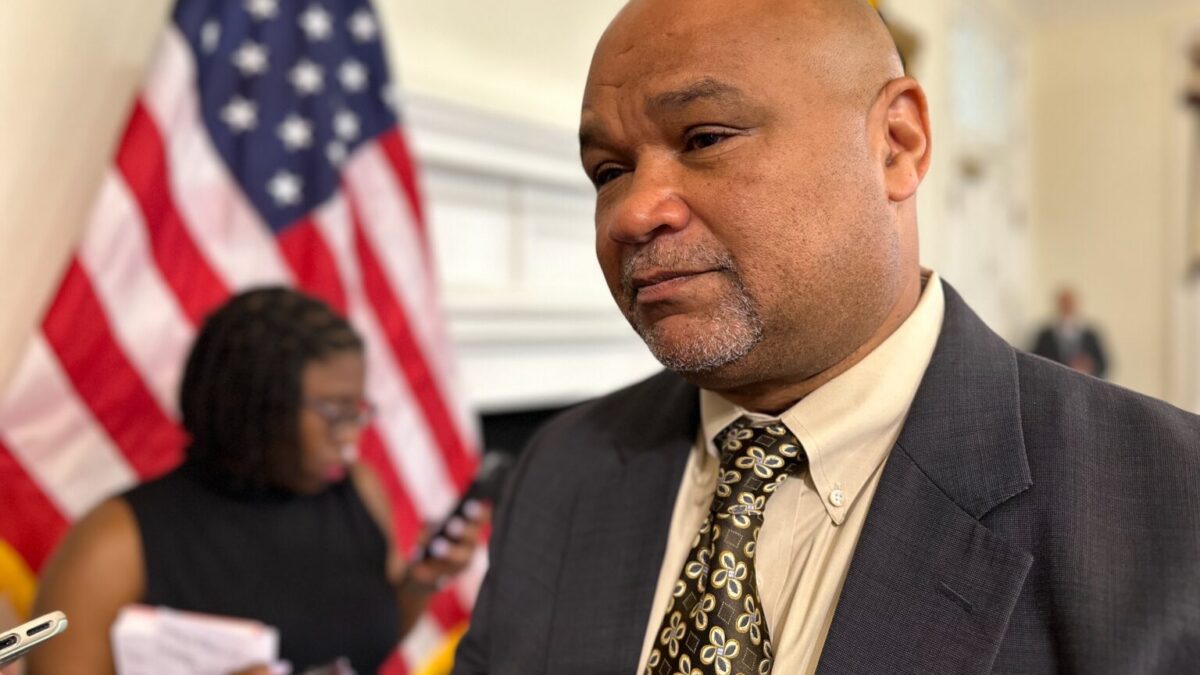
Treasurer Dereck Davis (D) defended the decision to drop Moody's, which he said had a "toxic" relationship with the state. and noted that Maryland still has an AAA bond rating from its remaining rating agencies. (File photo by Bryan P. Sears/Maryland Matters)
MD dumps Moody’s a year after it downgraded state’s bonds
New ratings include lowered outlook on outstanding debt, as state prepares to offer $800 million in bonds next week


 Listen to this article
Key takeaways:
- Maryland replaces Moody’s with Kroll Bond Rating Agency
- Moody’s downgraded Maryland’s bond rating from AAA to Aa1
- Fitch, Standard & Poor’s and KBRA rate Maryland bonds at AAA
- Maryland Treasurer Dereck Davis cites toxic relationship with Moody’s
Maryland has ended a decades-long relationship with one of three major bond rating firms a year after that firm downgraded the state’s credit rating.
The state is scheduled to go to an $800 million bond sale on Wednesday with ratings from Fitch, Standard & Poor’s and a relatively new firm, Kroll Bond Rating Agency, which took the place of longtime rating agency, Moody’s. Maryland parted ways with Moody’s after it downgraded Maryland’s rating last year from AAA, the highest rating, to Aa1, although state officials said the downgrade was not the reason for the split.
All three of the current agencies rated the state’s upcoming bonds at AAA — once again giving the state a triple-triple-A designation that it bragged about for decades — but Standard & Poor’s lowered its outlook on outstanding debt from stable to negative.
The Standard & Poor’s report cites some of the same concerns Moody’s noted a year ago.
Maryland Treasurer Dereck Davis downplayed the decision to drop Moody’s and focused on the state’s still relatively strong ratings from the other firms.
“Fitch and Standard & Poor’s are still two highly recognized rating agencies, and they rated us AAA last year, as well as this year,” Davis said Wednesday. “The takeaway from this is at the end of the day, Maryland was given a AAA bond rating by the three agencies that rated us.
“They gave us that. I don’t want anybody to lose sight of the fact. Even being on a negative credit watch, they still gave us a AAA bond rating,” he said.
Some Republicans expressed skepticism about the decision to hire a new ratings firm after last year.
“They’re sort of picking who gives them good ratings and who doesn’t,” said Del. Jefferson L. Ghrist (R-Upper Shore), a member of the House Appropriations Committee.
And the current three agencies lack the luster of AAA ratings from the previous three, long considered the gold standard of ratings firms.
“Parting ways … I’m not sure I would have done it, but I’m not sure that does any harm either, and I think it is understandable under these circumstances,” said Nancy Kopp, a Montgomery County Democrat who served as state treasurer for nearly two decades.
“I don’t know about ending the relationship with Moody’s, but I do know that there was a feeling that Moody’s no longer understands what makes Maryland truly strong,” Kopp said. “It understands the numbers perfectly well. I mean, they’re a quantitative oriented rating agency, of course, but they don’t have the same fix on why people are investing in Maryland.”
Not a knee-jerk reaction
Since 1993, Maryland counted itself among a handful of states with the highest bond rating from the three major rating firms.
That changed last year in a move that angered some public officials but should have shocked none.
Months earlier, Moody’s issued an unusual interim report that tallied growing concerns about the state’s reliance on federal employment in the face of mounting federal job cuts and program elimination.
Moody’s raised concerns about the state’s “economic and financial underperformance compared to Aaa-rated states, which is expected to continue given the state’s heightened vulnerability to shifting federal policies and employment, and its elevated fixed costs.”
Davis and other state officials attempted to circle the wagons. The message was simple: Maryland pays its bills. Officials told the firms the state has weathered tough fiscal times, pointing to the COVID-19 pandemic and the Great Recession.
But Moody’s issued the downgrade last May, and the streak was over.
Gov. Wes Moore, Senate President Bill Ferguson (D-Baltimore City), House Speaker Adrienne Jones (D-Baltimore County), Comptroller Brook Lierman (D) and Davis pointed fingers to the White House and Republican President Donald Trump.
Later, Davis offered a critique of the rating agency: “To hell with Moody’s.” He hinted that the state could do without them, and said recently that he “was prepared to go with just the two.”
“You don’t have to have three in many states, from what I understand, or a number of states don’t have three,” he said. “They go with the two. So I was prepared to go to two.”
But Davis’ staff found Kroll Bond Rating Agency, KBRA, which the state hired for $75,000, roughly one third of what it paid Moody’s last year.
In January, KBRA published a report giving Maryland a AAA rating, which it reaffirmed last week.
Davis told the House Appropriations Committee in February that his office did not “forum shop” for a better rate.
“We didn’t do that,” he said then. “We just thought we had a better relationship with someone else.”
Aside from Moody’s national presence, the firm is a mainstay among Maryland governments: Of the 20 major Maryland political subdivisions with reported bond ratings, 90% have a rating from Moody’s, and 14 local governments have ratings from all three major firms.
Ending a relationship with a rating agency is a “relatively infrequent occurrence,” according to the Government Finance Officer’s Association.
“In most instances, this decision is driven by a disagreement over an assigned rating opinion,” the association’s website says. ” A decision to terminate a relationship may have serious repercussions and adversely impact an issuer’s credit profile and cost of borrowing. Given the long-term and consequential nature of credit ratings, issuers must proactively manage these risks and their relationship with the credit rating agencies.”
Davis told the Appropriations Committee in February that hiring KBRA “was my choice.”
He said Wednesday that the decision to part ways with Moody’s was not a knee-jerk reaction to the ding on the state’s rating, saying there “was more going on behind the scenes than what people knew, and increasingly it had just become a not positive working relationship.”
“I’m not saying that anybody wasn’t being professional. They gave us — I’m willing to concede they gave us what they thought was appropriate,” Davis said. “I’m not going to question them on that, but the relationship was just toxic. It had reached that point in my personal opinion, and it was time for us to go our separate ways.”
Davis declined to provide specifics, but he told lawmakers in February that Moody’s analysts behaved like “this sort of king or emperor-type things.” And some, he said where not professional.
“Some would say they were nasty … that always got to me,” Davis said at the time. “I’m paying you to be nasty to me … that didn’t go over really well. So, I was like, we don’t need you. There are other people that can do this. To hell with you, and I literally said that.”
A spokesperson for Moody’s did not respond to a request for comment.
Muted fanfare
Maryland continues to get AAA ratings from two of the three top firms, Fitch and Standard and Poor’s.
The rating from Standard & Poor’s included a lowered outlook on the state’s outstanding debt from stable to negative. The downgrade applies to the 15-year bonds issued by the state that have not been repaid.
“Now, I know the thing that stands out is that what they did — the negative watch,” Davis said. “In conversations with them, and basically what that amounts to, is they are concerned with our long-term structural deficit. They want to see the state address it, in their view, in a meaningful way.”
KBRA, founded in 2010 after the 2008 financial crisis, is a relative newcomer. On its website, the firm shows ratings reports for Maryland and two other states.
The firm issued a AAA rating for Delaware, as did Moody’s. Wisconsin also received a AAA rating from KBRA. The three major firms all rated Wisconsin a notch below their respective highest ratings.
Davis said he does not expect investors will perceive the state’s decision to part with Moody’s as petulance because of the downgrade.
“That’ll be backed up Wednesday when we go to bond sale, and we have a robust bidding on it,” David said. “As I like to say, if it don’t make dollars, it don’t make sense, and Maryland, Maryland’s dollars make sense. Our bonds make sense, and we’re going to have a highly sought after bond sale next week. That’s going to speak for itself. Just as when we got downgraded last year, we didn’t see any impact on our bonds. We’re not going to see any impact this year.”
Even with the three top ratings, the fanfare was somewhat muted. In years past, officials would rush to issue press releases and statements highlighting the “triple-AAA rating,” which was seen as an endorsement of the state’s fiscal management.
“Maryland maintains one of the strongest credit ratings in the country. S&P, Fitch, and KBRA all reaffirmed Maryland’s AAA rating — the highest possible rating — and both Fitch and KBRA maintained stable outlooks,” Ammar Moussa, a Moore spokesperson, said Wednesday in a response to a request for comment.
Investors ‘know what they’re investing in’
The state pays the ratings firms for their reviews. Last year, it paid Moody’s $218,000, according to Davis’ office.
The ratings provide a signal to investors about the financial stability of a the government issuing the bonds, and it determines how much interest the government will pay on the money it borrows for projects including buildings, roads and other public amenities.
Higher ratings equal lower interest rates. Taxpayers cover the cost of the principal and interest. The state dedicates its property taxes to bond repayment.
And while the state can again boast a triple-A rating from three firms, the split from Moody’s is attention-grabbing.
For more than a half-century, Moody’s has provided the highest ratings on Maryland’s credit-worthiness. The firm noted the state’s “wealthy and diverse economy,” solid financial planning and that officials had recently addressed budget problems “through a combination of tax increases and restraints on expenditures.”
But those were not enough to offset concerns about looming financial challenges, the report said. Among the reasons cited by Moody’s Analysts were the “state’s heightened vulnerability to shifting federal policies and employment, and its elevated fixed costs.”
But the Moody’s downgrade appeared to have little effect on interest rates in last year’s bond sale.
“We’ve done pretty well in terms of sales,” Kopp said. “I think, to me, that shows the people who are investing in us know what they’re investing in, and think that it basically has not changed significantly.”
Bryan Sears covers the governor and General Assembly, state politics and transportation for Maryland Matters.
Maryland Matters is part of States Newsroom, a network of news bureaus supported by grants and a coalition of donors as a 501(c)(3) public charity. Maryland Matters maintains editorial independence. Contact Editor Steve Crane for questions: [email protected]. Follow Maryland Matters on Facebook and Twitter.