Sign In
 Free Newsletter


Bills stack up on Senate President Bill Ferguson's desk during a busy Friday session on March 20, 2026. (Hannah Gaskill/The Daily Record)
New MD laws: What goes into effect June 1 — or already has?


 Listen to this article
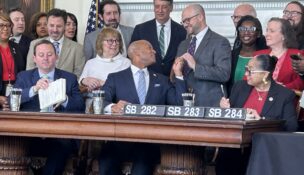
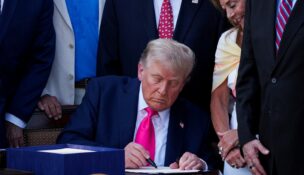
Since the end of the 2026 legislative session, Maryland Gov. Wes Moore has signed 867 bills — some of which have already gone into effect.
The state’s General Assembly passed a series of emergency bills that went into effect as soon as they received the governor’s signature, including the Voting Rights Act of 2026.
Sponsored by Sen. Charles Sydnor III, D-Baltimore County, the Voting Rights Act will allow members of race or language minority communities to pursue lawsuits if they feel that their county or municipality holds elections in a way that they deem impairs their ability to elect a candidate of their choice because their vote has been weakened due to their status as a protected class.
Signed April 28, the law is intended to supplement the federal Voting Rights Act, which was passed in 1965 to end racial discrimination in voting and was weakened last month by a ruling from the U.S. Supreme Court.
Also newly in effect is the Utility Reducing Energy Load Inflation for Everyday Families, or RELIEF, Act, which was signed May 12.
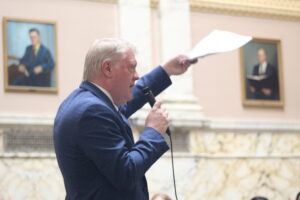
Under the multifaceted law, utility companies like Baltimore Gas and Electric Co. and the Potomac Electric Power Company are prohibited from pursuing forecast-based energy bill increases for one year. During the pause, the Public Service Commission will perform a study to determine if forecasted test years are in the best interest of utility customers.
Additionally, ratepayers are expected to see lower energy bills through a paring down of the Maryland EmPOWER program, which requires utility companies to incentivize their consumers to save power and money through discounted energy audits, weatherization projects and efficient appliances.
Not every bill that will go into effect has received Moore’s signature, though. In Maryland, legislation can be enacted if the governor does not sign or veto it within 30 days of it being presented to him.
Tuesday is the last day for Moore to enact or reject legislation in 2026.
Last week, the governor announced that he would not sign or veto the Community Trust Act, which prohibits state and local correctional facility employees from asking about or investigating an individual’s citizenship, immigration status or place of birth. It additionally bans correctional facilities from holding people at the request of U.S. Immigration and Customs Enforcement or transferring them to one of its facilities unless a valid judicial warrant is presented.
Exceptions in the law allow for communication with ICE if a person is convicted of a felony under state law, if they are convicted of an offense that lands them on Maryland’s sex offense registry, if they are sentenced to a term that would require them to serve a sentence in a state prison or if they sentenced to and served in prison for five years in another state.
The Community Trust Act, which is being challenged in court by a group of local sheriffs, will go into effect Tuesday.
Here are some of the key laws going into effect the day before.
AI in education
Sponsored by Sen. Katie Fry Hester, D-Howard and Montgomery, Senate Bill 720 requires the Maryland Department of Education to issue guidance regarding the use of artificial intelligence in local schools. Schools will have 120 days to adopt policies in alignment with that guidance once it is published, and must designate an AI coordinator and procure the relevant AI tools to adhere to their newly adopted policies.
The State Department of Education must also incorporate AI literacy into its workforce preparation and computer science standards, and provide professional development courses for teachers and school leadership.
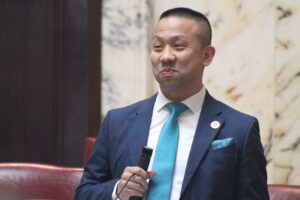
ICE at hospitals
Sponsored by Sen. Clarence Lam, D-Howard, Senate Bill 792 requires hospitals across the state to adopt protocol consistent with policy published by the state attorney general for when ICE enforcement activity occurs at their facilities.
In January 2025, Attorney General Anthony Brown’s office released guidance pertaining to ICE action in healthcare facilities, which includes recording officers’ credentials, contacting legal representation and generally only allowing agents in restricted areas if they have a judicial warrant.
Criminal histories in healthcare
House Bill 1420/Senate Bill 806 will standardize the requirement for criminal history records checks for acupuncturists, dental examiners, dieticians and nutritionists, environmental health specialists, morticians and funeral directors, nurses, optometrists, pharmacists, physical therapists, podiatrists, psychologists and professionals working in residential childcare programs.
Police at polling places
Sponsored by Del. Dana Jones, D-Anne Arundel, as House Bill 1001 and by Sen. Cheryl Kagan, D-Montgomery, as Senate Bill 670, this law will give the Maryland elections administrator, deputy elections administrator and local elections directors the authority to order the arrest of anyone who disturbs the peace at a polling place, violates any article of the state’s election law or interferes with the work of election judges.
Police officers stationed at polling places must obey the orders of the elections administrator, deputy administrator or local election director, and will be protected in making arrests at their order as though they had received a valid arrest warrant.