Sign In
 Free Newsletter

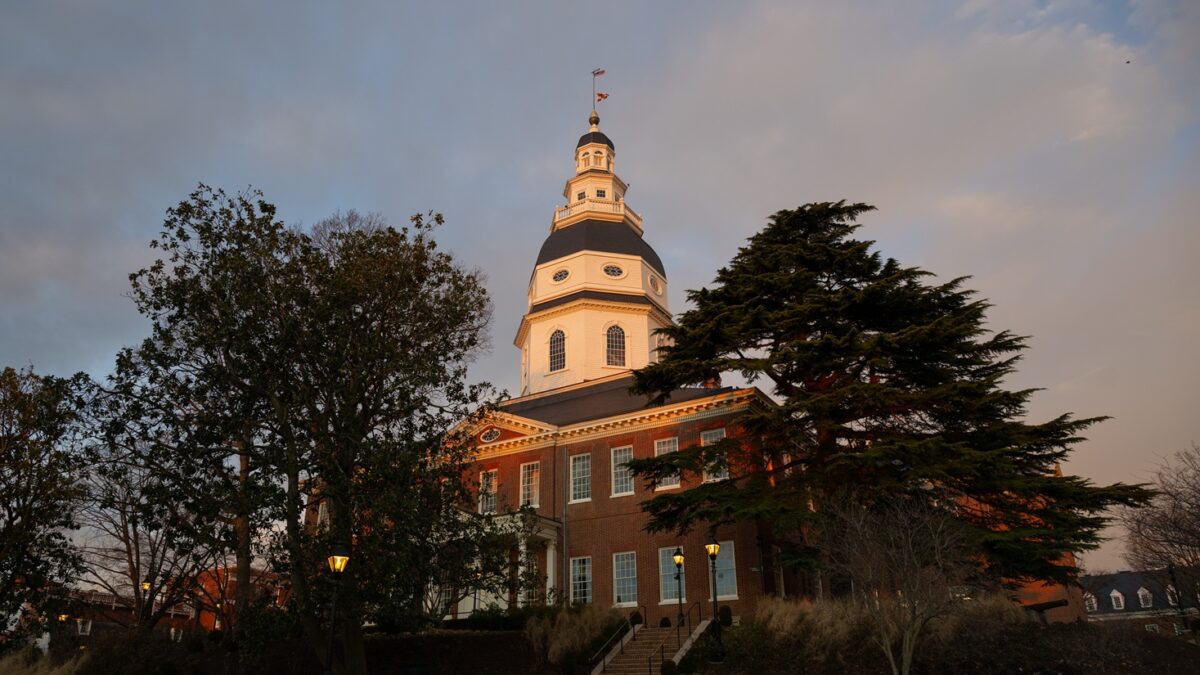
The Maryland State House is shown on the morning of the first day of the 2026 General Assembly, Jan. 14, 2026. (Maximillian Franz/The Daily Record)
MD county leaders look for options as budgets get tighter
While some want flexibility in raising taxes, others want state to stop pushing expenses off on local government


Key takeaways:
- Harford County Treasurer Robert Sandlass warns of income tax volatility
- Talbot County Finance Director Martha Sparks cites state cost shifts
- Maryland faces $3 billion structural budget gap next fiscal year
- Legislative panel explores local taxes on restaurants and land use
County leaders said they need more options to help weather mounting budget pressures driven by reductions in state aid coupled with costs shifted to local governments and mandated education spending.
Those same leaders are understandably edgy as they wait for signs of how state government — the bigger dog on the porch — will resolve its own fiscal crisis. Past solutions have frequently come at the expense of county governments who rely on billions in state aid to balance their books and deliver key services.
“There’s a lot of things that hold down to counties, and unfortunately, counties don’t have anybody else,” said Harford County Treasurer Robert Sandlass. “The feds kick things down to the states. States kick things down to the counties, and then we turn around and there’s nobody to kick it down to.”
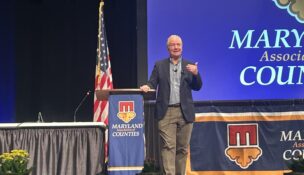
Sandlass, speaking to a packed room of local government leaders attending the Maryland Association of Counties summer convention in Ocean City, warned of an additional concern involving volatile income tax payments to the counties.
“What I’m telling you is that there’s going to be a reckoning next year, probably with your income tax,” he said. “We’ve already been told by the comptroller that we are over-distributing as a whole, and so we’re going to see more of that kind of that volatility.”
All of this comes at a time when the state has pushed down additional costs to the counties and mandated beefed up education spending.
“What we’re struggling with now is a state government that continually pushes down their liabilities and responsibilities to us, and that’s what’s going to break us,” said Talbot County Finance Director Martha Sparks. “Those things that we don’t have any control over: blueprint, additional costs for SDAT [the State Department of Assessments and Taxation], teachers’ pensions. That’s what the state needs to do to give us relief, not other options to raise revenue to pay their bills. ”
At the state level, there is a projected structural budget gap of about $3 billion for the coming fiscal year. Lawmakers and Maryland’s governor will face tough decisions including budget cuts that reduce spending in future years and the potential for tax increases.
One possibility is an increase in income tax, potentially for high income households. Changes to the sales tax might also be discussed.
Maryland has not raised its sales tax since 2008 when it went from 5% to 6%. An increase of a penny could generate an additional $1.2 billion in revenue. Sales taxes are seen as regressive as they hit lower-income families disproportionately harder than higher-income groups.
Another possibility would be to apply the sales tax to services. The legislature could also raise the rate and expand its application.
Local governments have fewer options, relying heavily on property taxes and local income taxes.
A legislative panel is looking at potential revenue sources for local governments including the potential for local taxes on restaurants and changes to land use taxes.
Some have also floated the idea of a local component to the sales tax that would go to jurisdictions.
It’s unclear what recommendations — if any — will come out of that group by the time the General Assembly reconvenes in January. And it may be difficult to get lawmakers to agree to more local taxing authority as it could likely restrict what the state can collect to cover its own budget needs.
Last year, Baltimore Mayor Brandon Scott (D) proposed a 2% increase in the sales tax that would go to the city. The proposal ultimately stalled.
Maryland is one of nine states that does not authorize local governments to levy a sales tax, according to Felix Facchine, chief of staff to Howard County Executive Calvin Ball (D).
“Part of the problem is that Maryland doesn’t actually collect sales tax by point of origin right now,” Facchine said.
The state is projected to collect $6.6 billion in sales taxes in the current fiscal year, according to a projection issued by the Board of Revenue Estimates in March. That panel will update its estimates next month.
The lack of data makes it difficult to determine sales taxes collected in each jurisdiction, Facchine said.
Sandlass said he hopes for a menu of options from which each county can pick and choose.
“What I’m hoping for is that while not all of the solutions that we have are going to be ideal for every county, you know, vacant land, you know, makes a lot more sense in densely urban areas than it does in more rural counties,” Sandlass said. “But I’m hoping that they provide us all with the same toolbox set, so that we, as local leaders, can figure out what works best.”
Bryan Sears covers the governor and General Assembly, state politics and transportation for Maryland Matters.
Maryland Matters is part of States Newsroom, a network of news bureaus supported by grants and a coalition of donors as a 501(c)(3) public charity. Maryland Matters maintains editorial independence. Contact Editor Steve Crane for questions: [email protected]. Follow Maryland Matters on Facebook and Twitter.