Sign In
 Free Newsletter

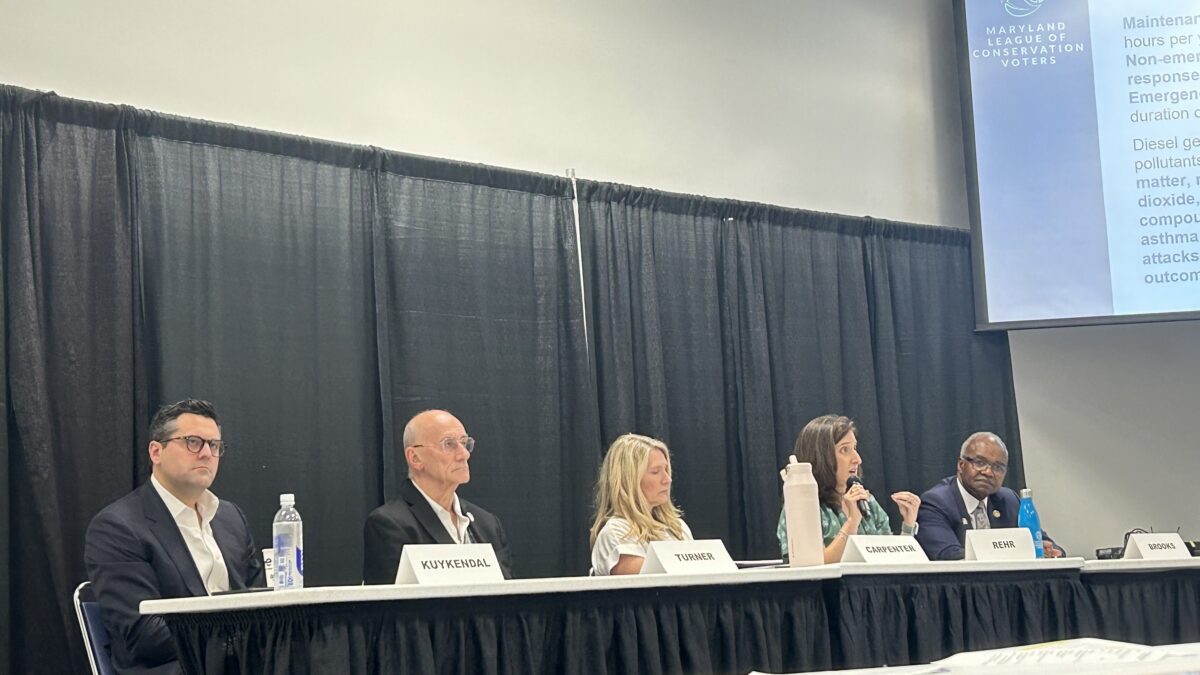
From left: Michael Kuykendall of Cattelus Development Corporation; Loudoun County, Virginia, Board of Supervisors Vice Chair Michael R. Turner; Frederick County Division of Planning and Permitting Director Deborah Carpenter; League of Conservation Voters Director of Climate Policy and Justice Rebecca Rehr; and state Sen. Benjamin Brooks, D-Baltimore County, discuss the costs and benefits of data centers during a panel at the Maryland Association of Counties 2026 summer conference on Aug. 12, 2026. (Hannah Gaskill/The Daily Record)
MD lawmakers mull data center pauses, hear VA’s insights at MACo conference


OCEAN CITY — Some lawmakers at the Maryland Association of Counties conference expressed frustration Wednesday over the encroaching reach of data centers and got some insights from Virginia.
“We are not going to have data centers in College Park, I assure you,” said state Sen. Jim Rosapepe, D-Anne Arundel and Prince Geogre’s, during a Maryland town hall at the Ocean City conference. “We don’t even need to go there.”
Several of Maryland’s jurisdictions have data center moratoriums — Prince George’s, Frederick, Howard, Montgomery and Washington counties all have temporarily pressed pause. Harford County has enacted a full-on ban.
However — regardless of the moratoriums and many Maryland residents’ displeasure of data centers — their growing presence is inevitable.
Michael R. Turner, vice chair of the Loudoun County Board of Supervisors said his jurisdiction in Virginia has over 250 data centers. Turner said that as they were initially popping up, residents were dubious, but he told constituents, “Your taxes are 25% lower than anybody else.”
In recent years, however, Loudoun County residents are less interested in lower taxes, he said.
“Starting about four or five years ago, it got worse, and the answer now is, ‘I don’t care. Raise my taxes. Don’t build any more data centers,’” Turner said.
Data center moratoriums are not legal in Virginia, though policymakers are working toward them, he said.
Turner did say he’s “all in favor” of a moratorium.
“If your ordinance is not up to speed, if you’re not ready, if you don’t know about data centers, have a moratorium, ” he said. “Do your homework and then come out of the moratorium and make your decisions.”
Although data centers aren’t built on the taxpayer’s dime, Del. Linda Foley, D-Montgomery, noted Wednesday that ratepayers foot a lot of the bill for the energy that they consume.
“No one in this room would deny that the utility bills have gone up and that a lot of that we know is attributed to the increase in data centers — not just in Maryland but across the PJM and across the country,” Foley said.
PJM Interconnected is the multistate grid from which Maryland sources energy.
David Kuykendall, executive vice president of Catellus, a mixed-use land development corporation, said the state “took the right step” under the Maryland Reducing Energy Load Inflation for Everyday Families (RELIEF) Act passed during the 2026 regular legislative session.
The Utility RELIEF Act, among many measures, reduces transmission costs and eliminates extra profit incentives for energy companies in an attempt to protect ratepayers. It also requires data centers over 25 megawatts to pay for their own interconnection to the grid.
“I think we have to follow very strict guidelines in terms of how rates are set, and I think that, you know, as this industry evolves and as (the Federal Energy Regulatory Commission) and PJM changes how rate making is done, we will follow those new rules when they’re put in place,” Kuykendall said.