Sign In
 Free Newsletter

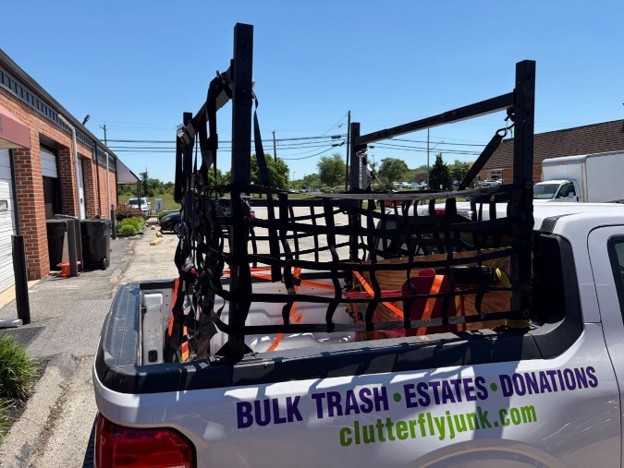
(Photo provided by Aubrey Batten)
Junk-collecting small business adapts Temu rack to double its hauling capacity
A Maryland three-man company adapted a truck rack built for weekend hobbyists and rebuilt it for tough work instead.


A three-person junk-removal company in Maryland doubled how much it can haul in a single trip, by adapting a $150 bed rack built for kayaks and rooftop tents. Aubrey Batten, who owns Clutterfly Junk Removal, a Maryland-based junk removal company serving DC, Anne Arundel, Montgomery, and Prince George’s county, found the rack on Temu and modified it for his crew, in place of $700-to-$800 work-truck versions marketed to off-road hobbyists, the closest thing stores recommended for his pickup truck.
Clutterfly Junk Removal relies heavily on its Ford Maverick, a compact pickup Batten chose over a full-size truck for its fuel economy and its ability to reach tight spaces a bigger vehicle can’t. Companies making aftermarket gear for that truck size build almost exclusively for off-road hobbyists, not people hauling debris for a living. F
He spent weeks searching before he found the rack on Temu. Without it, jobs that should have taken one trip took two, doubling the gas and labor for the same paycheck.
He rebuilt the rack for the job. He pulled one of three overhead bars and remounted it as a side rail, turning the rack into a three-sided cage that made loading and containing loose debris easier from the curb. He swapped the fixed bolts for removable pins so he could still stand tall items like refrigerators and filing cabinets upright in the bed.
He also bought cargo netting separately on Temu, bringing his total spend to under $200. Where the truck used to hold about 13 full trash bags, it now holds 25.
“For $150, I have a better product than what would have cost me $800 or $900 more,” Batten said.
The upgrade changed what Batten can charge and how often he has to go back for a second load. A run that used to bring in $150 now brings in $250, because the truck carries more per trip. Clutterfly Junk Removal is also winning commercial jobs that have tighter schedules, because the crew can clear a site in one pass instead of two.

More ways to make a living
The rack was just the start. Batten now runs a Temu search before most equipment decisions, he said. A wire stripper he found while browsing turned scrap electronics into a small side business: Batten said stripped copper sells for about $20 a pound at the scrapyard, against roughly $4 for unstripped wire. A lever-and-chain fence post puller replaced years of yanking posts out by hand and now rides in the truck for every yard-clearing job. He has also picked up a loading ramp for the warehouse and replacement wheels for hand carts that wear out fast under daily use.
“You’ll see items from Temu all over my shop and warehouse,” Batten said. “I’m always looking for better ways to move or store things we pick up.”
Batten isn’t unusual in feeling the squeeze. NFIB’s Small Business Economic Trends 2026 survey found that 21% of small business owners named inflation as their single most important problem, with rising material and fuel costs among the most common complaints. The average new full-size pickup now sells for nearly $66,000, according to Kelley Blue Book — before a single piece of equipment goes in the bed. Batten’s compact truck starts under $30,000, but the accessory market for these smaller trucks is much smaller for people who want to use them as workhorses. Batten filled that gap for his own truck instead of waiting for someone else to build it.
Batten is hoping to add another truck to his convoy by the end of the year and is already shopping Temu for accessories to upgrade it with to support the business.
“Every little bit of breathing room makes a huge difference for a company this size,” Batten said.
Prices and availability are accurate as of the time of publication and are subject to change without notice. Please check the retailer’s website for the most up-to-date pricing information.