Sign In
Upcoming Event
 Free Newsletter

Newspapers file suit to block Md.’s new online political ads law
Newspapers file suit to block Md.’s new online political ads law


 Listen to this article
Publishers of 10 newspapers and their related websites and the state’s press association are asking a federal judge to strike down a new Maryland law supporters say is meant to limit offshore influence in elections through online advertising.
The lawsuit filed last week in U.S. District Court in Maryland against the Maryland State Board of Elections asks a federal judge to strike down the state’s newly enacted Online Electioneering Transparency and Accountability Act because it violates the First, Fourth and Fourteenth Amendments.
“As a matter of constitutional law, there is a stark difference between requiring speakers to disclose who they are and the source of their funding, and imposing that burden on newspapers and other Internet publishers, especially in the circumstances here,”Seth Berlin, an attorney with Ballard Spahr LLP, wrote in the lawsuit.
The lawsuit was filed on behalf of nearly a dozen news organizations including the Washington Post, Baltimore Sun, Frederick News-Post, Cecil Whig, Easton Star-Democrat and the Maryland-Delaware-DC Press Association. The Daily Record, which is a member of the press association, is not a named plaintiff in the federal lawsuit.
Jared DeMarinis, director of candidacy and campaign finance, declined to comment on the pending litigation.
Berlin, in court filings, writes that Maryland’s new law goes further than similar, less onerous laws, in Washington state and a proposed law in New York, which would expressly exempt newspaper websites.
The law requires websites that accept political advertising to maintain records of the purchases of “campaign material” including advertising, publishing them in a conspicuous place within 48 hours and maintaining other records that must be available to the state board of elections on demand. News websites, for example, would be required to disclose online that an ad had been purchased and provide information on the purchaser, including names and contact information as well as the amount paid.
Additionally, lawyers for the news organizations say the law allows a court to prevent their websites from publishing political ads.
The law also allows the state to fine publishers “without due process of law” and authorizes the board to seize documents owned by the publications.
All purchases are required to be made in U.S. currency.
The law excludes works of journalism — news stories, opinion columns and editorials.
Still, Berlin said, regulations to implement the new law could cause publishers to have second thoughts about ads related to other election-related issues, including ballot questions and sample ballots.
“Such a broad and amorphous definition is likely to chill core political speech about candidates and issues because the online platforms (as well as the speakers themselves) will be uncertain as to whether the speech is included and refrain from speech to steer clear of the statutory restrictions and regulations,” Berlin wrote.
Google has already announced it would not accept political ads in Maryland because of the new law.
“If publisher plaintiffs are forced to make a similar choice, this will work both a financial injury on the publisher plaintiffs and will also substantially curtail the speech available to the citizens of Maryland, as is already the case from the choice Google has made,” wrote Berlin.
The General Assembly passed House Bill 981 and the identical Senate Bill 875 earlier this year, sending it to Gov. Larry Hogan two weeks before the end of session. The timing by the legislature would have allowed the Democratic-controlled legislature to override a veto.
Sponsors of the Maryland’s legislation said they wanted to prevent foreign influence on state elections following allegations of interference by Russian nationals in the 2016 presidential election.
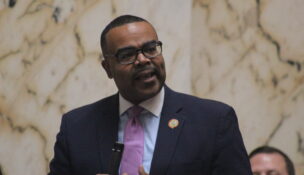
Del. Alonzo Washington, D-Prince George’s and sponsor of the House bill, told a House committee that “it appears that Russia-linked accounts purchased political ads on nearly every major online platform” and noted hundreds of thousands of dollars of ads purchased on social media sites Facebook and Twitter.
“This bill is made to make sure these kinds of acts do not happen here in the state of Maryland,” Washington said in February.
Del. Samuel “Sandy” Rosenberg, D-Baltimore and a co-sponsor of the House bill, described the law as “our first-in-the nation response to the Kremlin’s disruption campaign during the 2016 election.”
Hogan allowed the bill to become law without his signature. In a letter to House Speaker Michael Busch and Senate President Thomas V. Mike Miller Jr., the governor said the goals of the new law were laudable but raised constitutional concerns and the strong likelihood of a legal challenge.