Sign In
Upcoming Event
 Free Newsletter

MD Supreme Court to consider subpoena’s legality in lawyer discipline case
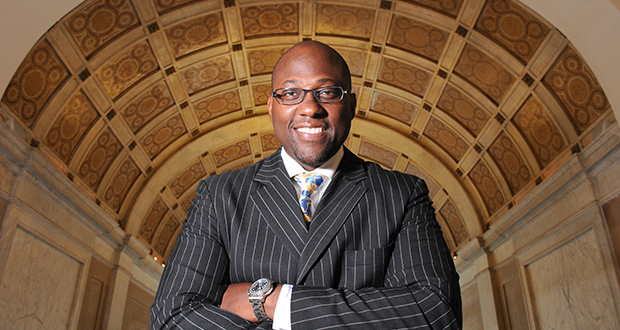
J. Wyndal Gordon, attorney. (Maximilian Franz/ The Daily Record)
MD Supreme Court to consider subpoena’s legality in lawyer discipline case


 Listen to this article
Key takeaways:
- Maryland Supreme Court granted certiorari in a subpoena dispute.
- Baltimore lawyer J. Wyndal Gordon is challenging the investigatory subpoena.
- A circuit judge denied Gordon’s motion to quash the subpoena in February.
Maryland’s highest court will hear oral arguments over a Baltimore lawyer’s attempt to quash an investigatory subpoena from the Attorney Grievance Commission. But first, it must decide on whether it can even hear the appeal.
The Supreme Court of Maryland granted certiorari in the discipline investigation Friday, more than two months after a Baltimore judge denied attorney J. Wyndal Gordon’s motion to quash a subpoena from the state’s bar counsel commanding an examination under oath. The court will first consider whether the trial judge’s February ruling denying Gordon’s motion to quash the subpoena is appealable — and if so, whether it was properly denied.
In a court filing, the commission said its probe was in relation to a complaint of professional misconduct related to rules regarding communication and safekeeping of client property. Gordon and his attorneys said the matter stemmed from a former client’s complaint that Gordon “failed or refused to send her an ’emailed version’ of her personal injury contingency fee retainer agreement.”
Gordon did not return a request for comment on the matter Monday.
The case is captioned as “Unnamed Attorney v. Attorney Grievance Commission,” and Circuit Judge Audrey J.S. Carrión’s ruling February ordered for all papers filed in the court “with respect to the subpoena at issue shall be sealed upon filing and shall be open to inspection only by order of the court.”
However, several filings remained unsealed more than a month later, including exhibits that identified the attorney as Gordon.
Prior to publishing this story, The Daily Record informed Gordon; his attorney, Tiffany Alston; state Bar Counsel Thomas DeGonia II; and Clerk of the Circuit Court Xavier A. Conaway that the documents were open to the public. Alston said she could not disclose the unnamed attorney in the “highly confidential” case. None of the others responded as of Monday afternoon.
The matter involves a long-running investigation initiated due to a former client’s complaint about Gordon, whose attorneys have argued that bar counsel has failed to comply with rules governing the amount of time it takes to conduct disciplinary investigations. The commission, which has not filed a formal petition for disciplinary action against Gordon, argued that it has complied by granted extensions and wrote in court filings that the “unnamed attorney” and his lawyers “have intentionally wasted time and resources throughout this investigation.”
At a 30-minute Zoom interview last year, Gordon’s counsel asked for proof that the Attorney Grievance Commission had approved an extension of the misconduct investigation past the 120-day deadline set by the Maryland Rules. His attorneys wrote that no proof was provided, and the interview was not conducted. The commission wrote that after it sent Gordon its subpoena for a statement under oath, the attorney and his counsel appeared two hours late and refused to answer questions because bar counsel would not provide additional information about the extension.
Gordon and his attorneys argued in court filings that the subpoena commanding his appearance for testimony should be quashed because it was likely outside of the mandatory cutoffs for such investigations. The commission argued that it had the required extensions and that quashing the subpoena is “impermissible” because the power to terminate an investigation is in the hands of the commission — not the subject of the probe.
The state’s supreme court is set to hear oral arguments on the matter this fall, according to court records.
This story has been updated with Alston’s response.