Sign In
Upcoming Event
 Free Newsletter

Gov. Wes Moore signs voting rights, immigration, foster care bills
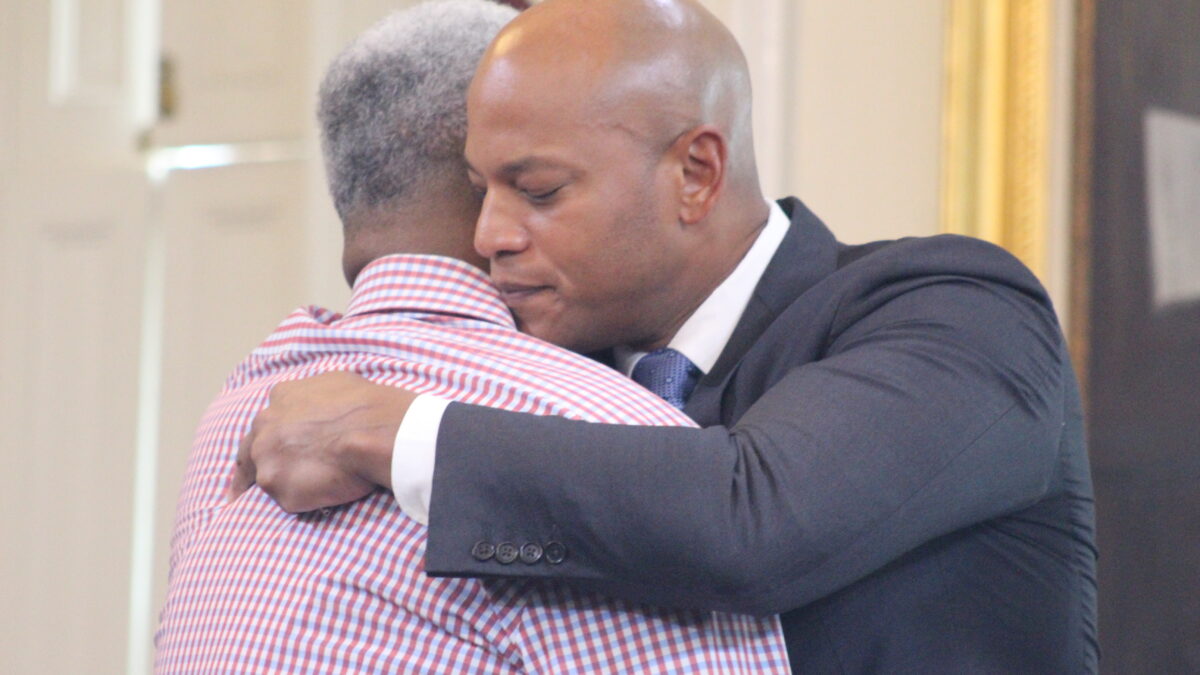
Gov. Wes Moore embraces Michael Ward, the grandfather of Kanaiyah Ward, at an Annapolis bill-signing ceremony on April 28, 2026. (Hannah Gaskill/The Daily Record)
Gov. Wes Moore signs voting rights, immigration, foster care bills


 Listen to this article
Key takeaways:
- Gov. Wes Moore signed nearly 200 bills in Annapolis on Tuesday.
- The Voting Rights Act allows certain minority communities to sue over election impairments.
- A new guardianship assistance program honors foster teen Kanaiyah Ward.
- Maryland is banning dynamic pricing at grocery stores starting Oct, 1.
ANNAPOLIS — Gov. Wes Moore signed dozens of bills Tuesday that are poised to provide increased safeguards for Maryland’s voters, foster children, immigrants and consumers.
“Today, we’re not just signing bills,” House Speaker Joseline Peña-Melnyk said at the Annapolis bill-signing ceremony. “We’re affirming our values about who we are as a state and how we choose to show up for one another.”
Of the nearly 200 bills signed, Moore, Peña-Melnyk and Senate President Bill Ferguson, all Democrats, highlighted the Voting Rights Act, which will allow members of race or language minority communities to bring lawsuits if they feel that their county or municipality has held elections in a way that they feel impairs their ability to elect a candidate of their choice because their vote has been weakened due to their status as a protected class.
The law, which went into effect upon signing, is meant to supplement the federal Voting Rights Act, which was passed in 1965 to bar racial discrimination in voting but could be weakened under President Donald Trump’s administration.
The state bill was passed to Moore’s desk with minutes to spare before the clock struck midnight on the last day of the Maryland General Assembly session, leading to high tensions and yelling in both chambers. The most aggressive arguments were seen in the House of Delegates five minutes before lawmakers adjourned their annual session — something Peña-Melnyk alluded to at least four times before pen hit paper Tuesday.
“As I was up there with five minutes, I thought, ‘I cannot let this die on my watch’ because there was too much at stake,” she said.
The trio also signed legislation to establish a guardianship assistance program and state foster youth ombudsman in honor of Kanaiyah Ward, a teen in the foster care program who died after being placed alone in a Baltimore City hotel last year.
Under the law, guardians of minor children would be eligible for financial assistance from the state if they are legally appointed as a child’s guardian by the courts, that child has been placed in their home by foster care services for at least six months, and the guardian enters into a written voluntary guardianship agreement with their local social services agency prior to their appointment.
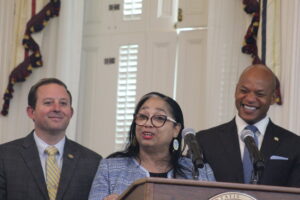
The state foster youth ombudsman established under the law will be appointed by the Department of Human Services secretary and will investigate and address complaints from children placed in out-of-home care.
Ward’s mother and grandfather, Brooke and Michael Ward, were present at the bill-signing. They tearfully joined Moore at the podium before the bill was inked to accept the first ceremonial pens.
“As I’ve said before and I’ll continue to say: Every child in this state deserves to be supported; every child in this state deserves to be safe; every child in this state deserves the same standard of care that any one of us would expect and hope for, for our own children,” the governor said.
Additionally, Moore, Ferguson and Peña-Melnyk signed legislation that builds on the Maryland Values Act of 2025, which mandates that U.S. Immigration and Customs Enforcement agents provide a valid judicial warrant before entering sensitive locations, which include public schools, public libraries and state agency buildings for the purpose of enforcing federal immigration laws.
The 2026 iteration expands the 2025 act to require public school employees to contact their local superintendents if they are aware of immigration enforcement activity at a school facility and adds school bus stops to the state’s list of sensitive locations. Additionally, the law, which went into effect upon signing, bars public school employees from assisting with immigration enforcement.
“Children and their parents should not and cannot have to worry about whether a teacher will report a child or that parent to ICE,” Ferguson said. “Our valued educators cannot and will not be pawns for an organization that has used fear all too often.”
The state’s top policymakers also signed consumer protection legislation to end the practice of dynamic pricing at grocery stores — the first law of its kind to be enacted in the United States.
The Protection from Predatory Pricing Act, which goes into effect Oct. 1, will ban grocery stores and third-party delivery services from using an individual’s personal data to set higher or lower prices when they shop.
“People deserve to know that the price that they pay is not different from a customer that walks in right after them,” Moore said. “People deserve to know that their data will not be used against them to charge them more, and today, Maryland is putting an end to any form of price manipulation.”
Sara Westrick, the advocacy director of the AARP of Maryland, hailed the signing of this legislation as providing “proactive safeguards to make sure pricing is fair.”
“It helps protect consumers, especially those who are older or on fixed incomes, from being taken advantage of in ways they may not realize,” she said in a statement.
Senate Republican leadership, however, was less impressed.
Senate Minority Leader Stephen S. Hershey Jr., R-Upper Eastern Shore, said the policy is “a solution in search of a problem.”
“Being the first in the nation only matters if you’re solving a real problem,” Hershey said in a statement. “In this case, there was no evidence Maryland grocery stores were engaging in this practice, so families shouldn’t expect to see any difference at the checkout line.”
This story has been updated with Westrick’s and Hershey’s statements.