Sign In
 Free Newsletter

Bloomberg gives Hopkins historic $1.8 billion gift for financial aid


 Listen to this article
Michael R. Bloomberg, the billionaire former mayor of New York and a Johns Hopkins University alumnus, gave his alma mater a $1.8 billion gift for student financial aid, the largest-ever contribution to an American university.
Bloomberg, who has previously given significant gifts to the university, said the gift is to be used exclusively for student financial aid in a New York Times op-ed announcing the contribution.
“America is at its best when we reward people based on the quality of their work, not the size of their pocketbook,” Bloomberg wrote. “Denying students entry to a college based on their ability to pay undermines equal opportunity. It perpetuates intergenerational poverty. And it strikes at the heart of the American dream: the idea that every person, from every community, has the chance to rise based on merit.”
With the contribution, Hopkins will become a top-10 institution for financial aid per student. Changes at the university will come as soon as the next school year.
The contribution will make the university permanently need-blind, meaning it will admit students regardless of their ability to pay, starting with the incoming class next fall. The university has need-blind admissions but said that the Bloomberg gift secures their ability to continue to do so.
“Johns Hopkins has many strengths, but it does not have the endowment that many of our peers do,” Ronald J. Daniels, the university’s president said. “As a consequence, it has been a real struggle for us to maintain this commitment to accessibility.”
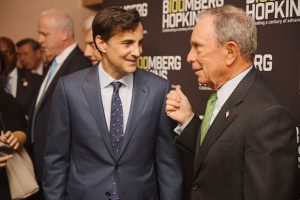
The contribution will be endowed and the funds will be transferred to the university by the end of the year, Daniels said.
The gift will allow the university to focus aid not just on first-time and low-income students, but also middle-income students.
The university will eliminate loans in its financial aid packages, replacing them with scholarships. About 44 percent of the university’s students graduate with some student loan debt, averaging about $24,000.
The university also plans to dramatically increase its recruitment of first-time college students and low-income students. It plans to increase the number of Pell Grant-eligible students to one-fifth of the student body by 2023.
In September, the university’s student body was about 15 percent Pell eligible. The 20 percent goal is a floor, not a ceiling, Daniels said.
“(The gift) just increases significantly the scope for us to recruit students from a broad swath of different backgrounds and increase significantly the socioeconomic diversity of this institution,” he said. “We will now have a much more representative community than we do at present.”
For Bloomberg, giving to the university is not out of the ordinary. In his op-ed, Bloomberg said he began giving to the university when he graduated: A $5 gift that was all he could afford in 1964.
“We need more graduates to direct their alumni giving to financial aid,” Bloomberg wrote. “I’m increasing my personal commitment — the largest donation to a collegiate institution, I’m told. But it’s my hope that others will, too, whether the check is for $5, $50, $50,000 or more.”
Since that $5 graduation gift, Bloomberg has given Hopkins an additional $1.5 billion for facilities, teaching and financial aid. Those past contributions include $300 million for the Bloomberg American Health Initiative, $250 million for the Bloomberg Distinguished Professors program and $219 million for scholarships.
Bloomberg founded his eponymous company in 1981. He served as mayor of New York from 2002-2013. He has affiliated as a Republican, an independent and a Democrat and is reported to be considering a 2020 presidential run as a Democrat.