Sign In
 Free Newsletter

UMBC’s longtime leader Hrabowski to step down next year


 Listen to this article
Dr. Freeman Hrabowski III, the longtime leader of the University of Maryland, Baltimore County, during a period of transformative changes, will retire from his position as president at the end of the current academic year, the university announced Wednesday afternoon.
Hrabowski became president of the university in 1992, focusing on science and technology education with an emphasis on minority participation. Under his leadership, the school has expanded by nearly 4,000 students, doubled the number of degree programs offered and multiplied the amount the school spends yearly on research and development eight times over, from $10 million to over $84 million.
At the time of his retirement, Hrabowski will have been UMBC‘s president for three decades — more than half of the 55-year-old university’s existence.
In a video announcement, he thanked the UMBC community, the University System of Maryland and elected officials who have invested in the university. He celebrated UMBC’s successes and growth over the past three decades, noting that the incoming Class of 2025 is the largest freshman class in UMBC’s history.
“We are determined to continue to seek the truth and to prepare leaders for the next generation. I challenge all of us to take this moment and reflect on all of the brilliance of UMBC, and what we mean to this country, and beyond,” he said. “And as we always say, success is never final, and keep hope alive.”
Following the announcement, Maryland leaders lauded Hrabowski for his success transforming UMBC from a sleepy commuter campus to a well-known breeding ground for science and technology professionals.
“President Freeman Hrabowski has inspired so many with his actions, words, and dedication. His commitment to supporting students from underrepresented groups has transformed higher education not only in Maryland, but around the world. I wish him all the best in retirement,” Gov. Larry Hogan tweeted on Wednesday.
Maryland House Speaker Adrienne Jones, a 1976 UMBC graduate and close friend of Hrabowski, said in a statement that he “has embodied what we want all higher education to be in Maryland: visionary, exciting, cutting-edge, motivating, and life-changing. He has made UMBC into a national leader when many thought it couldn’t be done. He leaves a legacy that many presidents across the country can only hope to achieve.”

Born in Birmingham, Alabama, in 1950, Hrabowski was active in the civil rights movement as a child. He was prominently featured in Spike Lee’s 1997 documentary, “Four Little Girls,” on the racially motivated bombing in 1963 of Birmingham’s Sixteenth Street Baptist Church.
Throughout his tenure at UMBC, Hrabowski, who has a background as a mathematician, has focused on promoting science, technology, engineering and mathematics education, especially for minority students.
In 1988, he developed the Meyerhoff Scholars Program in partnership with philanthropist Robert Meyerhoff. The program, which has graduated 1,400 students since 1993 and has been replicated at other universities, includes students pursuing advanced degrees in the fields of science and engineering and aims to promote the advancement of minority students.
The program has produced a number of notable alumni, including Kizzmekia Corbett, an immunologist and Harvard professor who gained international attention as the force behind the development of Moderna’s coronavirus vaccine. Hrabowski and his wife, Jacqueline, both participated in the Moderna vaccine trial in hopes of encouraging people of color to participate in clinical medical studies.
Although his long-held position as president makes him an almost mythic figure at UMBC, many students know Hrabowski personally. He’s known among the UMBC community for his familiarity with and love of the university’s students, whom he would often greet as he walked through the Catonsville campus.
“I recall on numerous occasions visiting his campus and as I would walk across the campus with him, we would encounter a student here, a student there, a bunch of students here, a bunch of students there, and he knew every name,” recalled Del. Maggie McIntosh, D-Baltimore, chair of the House Appropriations Committee. “He could say hello to every student by their first name on that campus. I was just stunned at his compassion and commitment and his connection to the student body.”
Greg Simmons, the college’s vice president for Institutional Advancement as well as an alum, has been at UMBC since 1993 and has accumulated dozens of stories of Hrabowski’s compassion and care for his students. One that stands was when, during the Sept. 11, 2001 terrorist attacks, Hrabowski left his office to gather with students in front of the University Center, UMBC’s hub of student life at the time, where he worked to answer their questions and assuage their fears.
“He was just being with students. He went where he needed to be,” Simmons recalled. “That was one of those moments when I realized he was uncommon.”
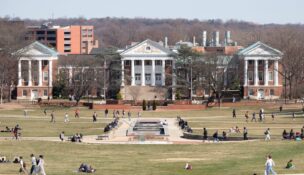
Simmons also noted the physical changes that have come to campus throughout Hrabowski’s time at the helm. Many state-of-the-art buildings have been erected in the past 30 years, including Chesapeake Employers Insurance Arena, a basketball stadium and event space; the Interdisciplinary Life Sciences Building; and the Performing Arts and Humanities Building.
Hrabowski also led the creation of bwtech@UMBC Research and Technology Park, which is home to over 130 companies and organizations that employ nearly 1,900 people.
With Hrabowski as president, UMBC has been routinely ranked among America’s top up-and-coming universities by U.S. News & World Report. Hrabowski himself was named among America’s Best Leaders by U.S. News in 2008 and listed as one of Time magazine’s 10 Best College Presidents in 2009 and one of the Time’s 100 most influential people in 2012.

Beyond his accomplishments at UMBC, Hrabowski has was selected by President Barack Obama to chair the President’s Advisory Commission on Educational Excellence for African Americans in 2012. He serves on a number of boards of organizations in Maryland, including T. Rowe Price and McCormick.
Hrabowski has co-authored four books on Black students’ academic achievements and his experience in high education. Known for his charismatic speeches on campus, he also delivered a TED Talk, “Four Pillars of College Success in Science,” that has been viewed over a million times.
But his legacy also includes a 2018 lawsuit, which listed, among others, both Hrabowski and the university as defendants, and which alleged that the school and police had failed to improperly investigate and prosecute sexual assault claims. The suit was dismissed in 2020.
He graduated from Hampton Institute with “highest honors in mathematics,” according to his official biography. He earned a master’s degree in mathematics and a doctorate in higher education administration and statistics from the University of Illinois at Urbana-Champaign.
Prior to becoming president, he joined the university as vice provost in 1987 before quickly rising in the ranks to the position of executive vice president and then president.
Hrabowski’s last day will be June 22, 2022. The search for a new university president will be led by the USM Board of Regents, beginning will a campus town hall, hosted by USM Chancellor Jay Perman, in September. Perman will also appoint a search committee, including students, faculty, staff, alumni, and university stakeholders, with a member of the Board of Regents as chair.
Though many among the UMBC community — including employees who have never worked under another university president — are sad to see Hrabowski leave, they’re also excited to see who will replace him and how the next president will build upon his accomplishments.
“It will not surprise me if another part of his legacy is inspiring the next leader to come in and continue the work in their own way with this community,” Simmons said.