Sign In
 Free Newsletter


A SpaceX Falcon Heavy rocket carrying the National Oceanic and Atmospheric Administration GOES-U (Geostationary Operational Environmental Satellite U) lifts off from Launch Complex 39A at NASA’s Kennedy Space Center in Florida Tuesday. The GOES-U satellite, built by Bethesda-based global defense technology company Lockheed Martin, is the final satellite in the GOES-R series, which serves a critical role in providing continuous coverage of the Western Hemisphere, including monitoring tropical systems in the eastern Pacific and Atlantic oceans. (Photo courtesy of SpaceX)
Lockheed Martin-built GOES-U weather satellite launched successfully


An advanced weather satellite built by Bethesda-based global defense technology company Lockheed Martin for the National Oceanic and Atmospheric Administration (NOAA) launched Tuesday from NASA’s Kennedy Space Center.
Lifted to space aboard a Space X Falcon Heavy rocket, the GOES-U satellite successfully deployed its large solar array to generate electrical power and has established communications with mission operators.
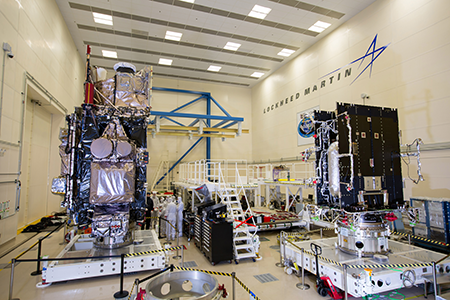
GOES-U is the final satellite in NOAA’s Geostationary Operational Environmental Satellites (GOES) – R series of four satellites. After it reaches geostationary orbit, approximately two weeks after launch, GOES-U will be renamed GOES-19. Once in operations over the East Coast of North America, the satellite be known as GOES East, and will provide advanced weather imagery, atmospheric measurements and real-time mapping of lightning activity, in addition to critical space weather observations.
NOAA’s GOES-R satellites, and soon GOES-U, provide crucial data for weather forecasting, severe storm tracking and climate monitoring. With their advanced instruments and rapid updates, they improve detection of atmospheric phenomena like hurricanes, wildfires and lighting. This real-time data aids the National Weather Service and meteorologist in early warnings, disaster preparedness and resource management, ultimately saving lives and mitigating economic losses.
GOES-U is the final satellite of the GOES-R series which will provide critical weather and climate date into the 2030s. Following GOES-U, Lockheed Martin was selected by NASA to develop the nation’s next generation weather satellite constellation, Geostationary Extended Observations (GeoXO), for NOAA. GeoXO’s new capabilities will deliver more accurate weather forecasting and address emerging environmental issues and challenges. GeoXO, the GOES-R series and the nation’s weather satellites are vital infrastructure for national resilience.
NOAA funds, manages and will operate the GOES-R series satellites. NASA oversees the acquisition and development of the GOES-R spacecraft, instruments and launch vehicles. The program is co-located at NASA’s Goddard Space Flight Center in Greenbelt.