Sign In
 Free Newsletter


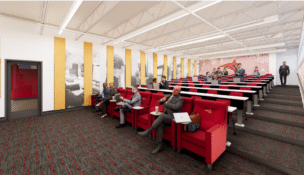
This rendering shows what the planned life sciences center at the North Bethesda Metro Station may look like. (Washington Metropolitan Area Transit Authority)
Metro, Montgomery County plan major life sciences center in North Bethesda


 Listen to this article
Montgomery County and the Washington Metropolitan Area Transit Authority entered a former partnership Monday to create a transit-oriented life sciences center near the North Bethesda Metro Station.
The partnership announced it is looking for a developer to transform 14 acres of land surrounding the North Bethesda Metro into a housing, office, retail and public space for the life sciences industry.
The project will pave the way for a “science-anchored, transit-oriented community” and may be used for medical and bioresearch, health data research, healthcare and manufacturing.
“Today brings all the pieces together,” County Executive Marc Elrich said at a Monday news conference. “We have the opportunity to build the science center that integrates into an area with rich services, housing and a potential for growth, unrivaled by any other station.”
The site is also expected to become the permanent headquarters for the Institute of Health and Computing. The institute was created recently in collaboration between Montgomery County and several University of Maryland entities — including the medical system and both College Park and Baltimore institutions.
This unique partnership will leverage artificial intelligence, machine learning, virtual reality and medicine into a “transformative” model in Maryland’s major life sciences hub, said University of Maryland, College Park President Darryll Pines.
Maryland’s U.S. Sens. Chris Van Hollen and Ben Cardin presented the county with a $5 million check from a federal appropriation Monday to pay for the preliminary engineering of a north entrance to the North Bethesda Metro Station.
The county has already secured $36.6 million in local, state and federal funding to support the project. Montgomery County officials are also seeking a $25 million grant to integrate a new north entrance to the North Bethesda Metro station into a building.
The center, with easy access to transportation, will help connect different aspects of Maryland’s life sciences industry, according to Montgomery County Council President Andrew Friedson. This includes the county’s private bio-health sector and research in higher education institutions.
“We cannot move forward as a region without thinking strategically about the future of Metro, which is both the economic and the transportation hub that connects our entire region together,” Friedson said.
This announcement is the latest development in Montgomery County’s growing life sciences industry, which includes many federal and private organizations.
The National Institutes of Health is headquartered in Bethesda and the Food and Drug Administration is in Silver Spring. The county is also home to the National Cancer Institute and the Universities of Shady Grove.
The number of jobs in Montgomery County’s life science industry grew more than 30% between 2010 and 2018, according to Montgomery County’s planning department. The county now has more than 13,000 people working in private-sector life sciences.
“We’ve got momentum,” the Maryland Commerce Secretary Kevin A. Anderson said. “Supporting development like this is a big part of our efforts to make a balanced economy more equitable, more robust and more competitive.”
After selecting a developer towards the end of 2024, Metro will negotiate an agreement to start on the initiative. Construction could begin as early as two or three years from then, Elrich said.