Sign In
 Free Newsletter

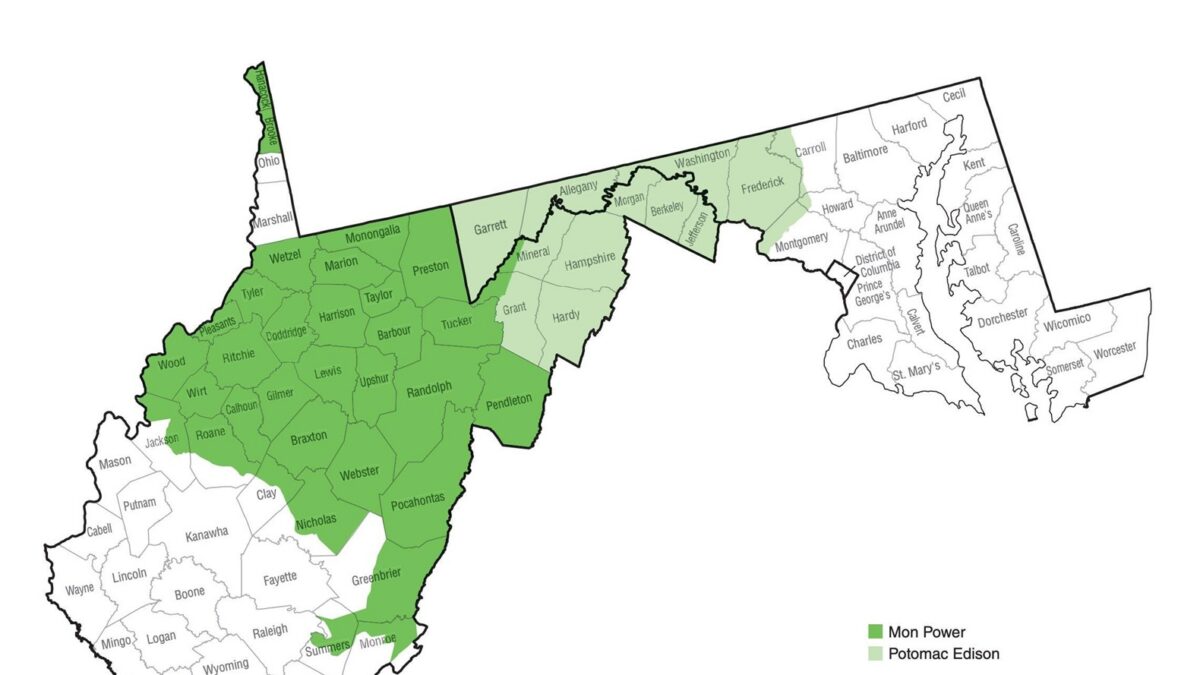
This map from FirstEnergy's website shows Mon Power's and Potomac Edison's service territories in West Virginia and Maryland. (USA TODAY Network via Reuters Connect)
Potomac Edison starts new rate program to encourage off-peak hour use


Key takeaways:
- Potomac Edison offers lower rates for off-peak electricity use
- Program launched April 20 in response to Maryland’s DRIVE Act
- Customers must enroll to receive no-cost new meters
- Target enrollment is 1.2% of eligible residential customers
Potomac Edison has added a new discounted rate option for residential customers who enroll in a program that encourages residents to use electricity during non-peak hours.
The utility proposed the time-of-use rate option in response to Maryland’s DRIVE Act, which was passed by the Maryland General Assembly and signed by Gov. Wes Moore in 2024, FirstEnergy and Potomac Edison spokesperson Will Boye confirmed. Potomac Edison is a subsidiary of FirstEnergy.
Potomac Edison’s new time-of-use rate option offers lower rates for residential customers who use electricity during off-peak hours such as mornings, late evenings and weekends, according to a company release. The new rate launched Monday, April 20.
To take advantage of the time-of-use rate, Potomac Edison customers must enroll so they can get a new meter, at no cost to them, that can track on-peak and off-peak usage, according to the release and Boye.
The new rate would kick in with the next billing cycle.
Customers can enroll by calling 1-800-686-0011.
Potomac Edison customers cannot enroll in the residential time-of-use rate plan and the electric vehicle charger time-of-use rider, the company release states. The latter program, which began in 2023, lets customers enroll to save money by charging their electric vehicles during off-peak hours.
As of April 21, 119 Potomac Edison customers in Washington County had enrolled in the EV time-of-use plan, according to Boye. The total number of customers in that program is 1,695.
Potomac Edison’s Maryland service territory includes Washington, Frederick, Allegany and Garrett counties as well as parts of western Carroll County, northern Montgomery County and northwest Howard County. The company serves about 285,000 customers in those areas.
The City of Hagerstown provides electricity to many city residents, with the city buying its power wholesale.
The Hagerstown Light Department has not explored a time-of-use rate structure, according to an email from Nathan Fridinger, deputy director of electric operations.
How much can residents save with the time-of-use rate?
Through May 31, the on-peak supply and variable distribution charges cost about 16 cents per kilowatt hour, while the off-peak charge is about 9 cents per kilowatt-hour. That is about 44% less.
On June 1, the electric supply charge increases slightly, Boye said in an email. The on-peak charge will cost about 17 cents per kilowatt hour and the off-peak charge will be about 10 cents. The difference between the two remains about 7 cents per kilowatt hour.
Electric supply charges change seasonally.
Boye said the actual savings depend on how much usage is shifed to off-peak hours.
For example, shifting:
- 100 kilowatt hours to off-peak times saves about $7
- 300 kilowatt hours to off-peak times saves about $21
- 500 kilowatt hours to off-peak times saves about $35
Off-peak hours are overnight and early mornings, all day on weekends and daytime hours outside the peak usage window. On-peak hours for weekdays are 4 p.m. to 9 p.m. during Daylight Saving Time and 3 p.m. to 8 p.m. during Eastern Standard Time. The area is currently in Daylight Saving Time.
Some ways Potomac Edison suggests residents can save by using the time-of-use rate is by:
- Running the dishwasher overnight
- Doing laundry early in the morning or on weekends
- Using major appliances outside the weekday peak window
What is Maryland’s DRIVE Act?
The DRIVE Act, which stands for Distributed Renewable Integration and Vehicle Electrification Act, is aimed at preparing the state’s electric grid for increase in demand from electric vehicles (EVs) and other clean energy technologies, according to information from the Maryland Public Service Commission.
The legislation requires investor-owned utilities like FirstEnergy to develop time-of-use rates to encourage consumers to charge their EVs and use electricity for other purposes during off-peak hours, according to the commission.
These companies were to file time-of-use tariffs available for appropriate customer classes, on an opt-in basis, with the Public Service Commission by July 1, 2025. Last October, the commission issued an order directing investor-owned utilities in Maryland “to be more ambitious in implementing elements of the DRIVE Act to accelerate the clean energy transition, strengthen grid resiliency, and reduce consumer costs.”
Potomac Edison told commission officials, at that time, that it would make its time-of-use rate available within 6 months and has done so, according to company and commission officials.
Time-of-use rate plans that are well designed could help mitigate the effects of electrification on the electricity distribution system; reduce GHC emissions during peak hours and encourage adoption of beneficial electrification measures through off-peak cost savings, according to the policy note for the DRIVE Act.
Companies are to submit a reasonable enrollment target for their time-of-use rate programs that they aim to achieve by Jan. 1, 2028, according to the policy note. For Potomac Edison, that target is 1.2% of eligible residential customers, according to an Oct. 21, 2025, Public Service Commission order. That is 3,013 customers, according to Boye.
Potomac Edison had requested using a surcharge for residential customers to cover the costs of implementing the time-of-use program, noting those costs were expected to be around $507,900 over two years, according to the order. About half that cost is due to replacing meters for customers enrolling in the program.
Boye said that surcharge request was not approved. Instead, the company will address recovering those costs in future rate cases. The exception is the electric supply charge, which will be addressed through the normal energy cost adjustment process, he said in an email.
The October order from the Public Service Commission “largely approved” time-of-use rate proposals by companies such as Potomac Edison, with some changes, according to a release from the commission. The directive also “ordered the utilities back to the drawing board on grid services such as virtual power plant and vehicle-to-grid pilot program proposals to align with legislative intent and address material gaps.”
“The Commission, in response to concerns about resource adequacy and increased rates, seeks to adopt policies to incorporate new technologies utilizing the grid,” then-Commission Chair and current Commissioner Frederick H. Hoover said in the October announcement. “By making the grid as efficient as possible, it will lower the overall amount of energy, thus reducing costs to customers. An electric system that incorporates multiple sources of generation, storage and energy management simultaneously is essential to a more efficient and cost-effective grid.”
Reporting by Julie E. Greene, The Herald-Mail / USA TODAY Network via Reuters Connect.