Sign In
Upcoming Event
 Free Newsletter

HBCUs in MD join group teaming up to pursue top research status
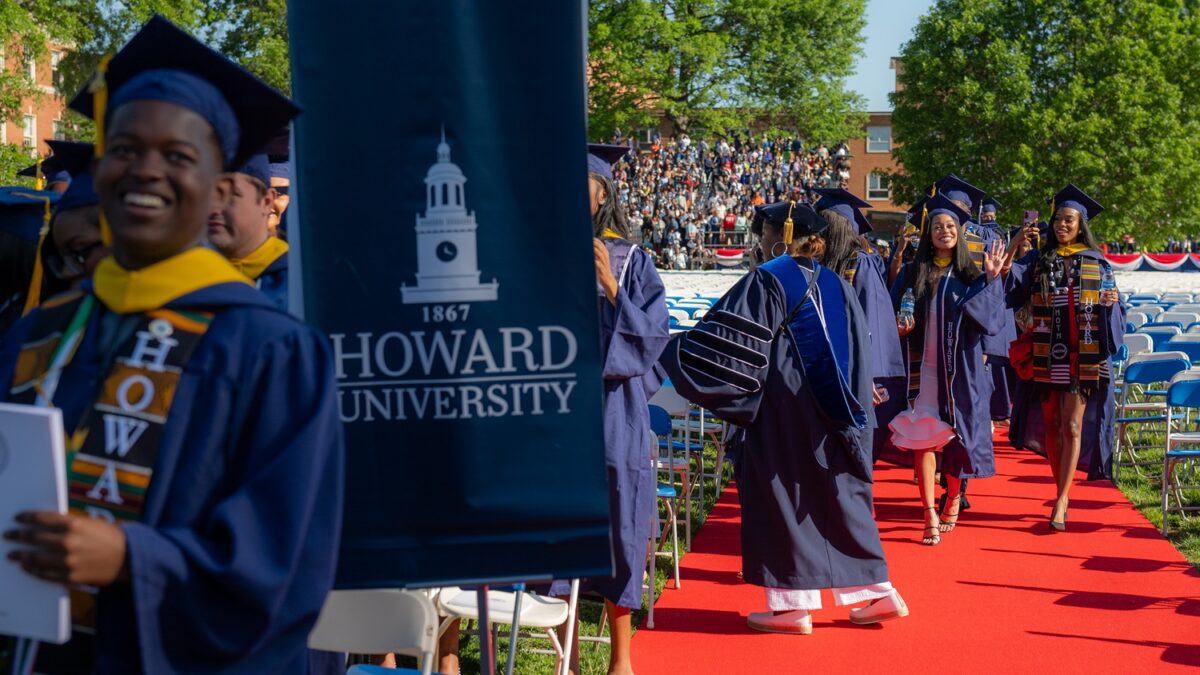
Howard University’s commencement ceremony in May 2025. (Shedrick Pelt/For The Washington Post)
HBCUs in MD join group teaming up to pursue top research status


 Listen to this article
Key takeaways:
- Fifteen HBCUs form Association of HBCU Research Institutions
- Morgan State University and University of Maryland Eastern Shore are part of the association
- Harvard provides $1.05 million grant and technical support
- Coalition aims to reverse discriminatory assumptions about HBCUs
Two historically Black colleges and universities in Maryland are among 15 that have united to pursue the nation’s highest research status in partnership with leading research universities.
The coalition, which includes Morgan State University and University of Maryland Eastern Shore, hopes to upend discriminatory assumptions about what HBCUs can accomplish and reverse some historical trends that have held them back.
The newly announced Association of HBCU Research Institutions (AHRI) aims to help its members reach Research 1 status, a designation that gets more federal funding and makes it easier to recruit top faculty and students. The group will work with the country’s foremost research universities, with space within the Association of American Universities (AAU) headquarters in Washington, and support from Harvard University.
The group plans to hold its first annual symposium on Wednesday.
“We are so thrilled and happy,” said David K. Wilson, the president of Morgan State University. “It’s the first time in the history of American higher education that a group of HBCUs has elevated themselves to the elite ranks of research institutions.”
Only one HBCU, Howard University, has R1 status now. Thirteen HBCUs in the group have R2 status, the next tier down. The R1 designation is granted by the Carnegie Classification of Institutions of Higher Education based on research dollars invested and doctoral degrees conferred.
Recent major gifts – such as $600 million from Bloomberg Philanthropies to four historically Black medical schools, and a total of more than $1 billion from author and philanthropist MacKenzie Scott to individual schools – are helping to propel rapid change. That includes more ability to invest in research.
There were already some existing partnerships between some HBCUs and AAU universities. But Ruth Simmons, the former president of Brown University and Prairie View A&M University, said the effort is important because HBCUs too often work in isolation from dominant research institutions.
She said that when she was at Prairie View, the president of the AAU, Barbara Snyder, contacted her about leading the process of forming a group of top research HBCUs.
Several HBCU presidents helped create the association in 2023, but it had not previously been publicly announced.
Those schools haven’t been part of the broader conversation among leading research universities, Simmons said. “And so what’s so important about this effort is that the AAU has embraced the idea that they should be part of that conversation.”
One reason advocates say it’s important for more HBCUs to gain R1 status is because these schools may be interested in research that is not happening as frequently at other universities, such as research on diseases that disproportionately affect Black people.
“The whole notion that some people in this country are less important than other people has held us hostage for many, many years,” Simmons said.
Universities should embrace the breadth of research important to the country, “and to all groups in the country,” said Simmons, who is now senior adviser to the president on HBCU engagement at Harvard. “Not just to certain elites.”
Harvard is going to help the group with technical and research infrastructure support from Harvard’s Office of the Vice Provost for Research, and a $1.05 million grant over three years. The money comes from the Harvard & the Legacy of Slavery Initiative – created in 2022 after a presidential committee documented the university’s historical ties to the slave trade. The initiative made seven recommendations, including suggesting that Harvard develop enduring partnerships with HBCUs. This joins other ongoing efforts, including research scholarships.
Sara Bleich, the vice provost for special projects who leads the Harvard & the Legacy of Slavery Initiative, said the coalition and its partnership with the AAU can connect researchers with similar interests who might not otherwise meet. She said she hopes Harvard’s involvement sends a signal to other universities and spurs questions about how they can support research at HBCUs, too.
Wayne A.I. Frederick, interim and emeritus president of Howard and the interim president of AHRI, said the HBCUs have a lot of infrastructure needs and are challenged when it comes to recruiting enough faculty to study an issue from multiple perspectives.
But the schools in the coalition have accelerated their research efforts in recent years. Prairie View, for instance, became an R2 in 2022 and this year spent more than $50 million on research, said Tomikia P. LeGrande, its president.
The coalition’s leaders hope the partnership will help research universities collaborate and elevate HBCUs’ contributions nationally. Among the leaders who helped create the association were Simmons, Frederick, Wilson, LeGrande and Harold L. Martin Sr., chancellor emeritus of North Carolina Agricultural and Technical State University. Wilson and LeGrande chair the board.
The HBCUs in the group may prioritize issues and questions that might not surface at other schools. Frederick was drawn to Howard as a student because the university has a Center for Sickle Cell Disease, which addresses an illness more common among Black people. The school’s economics department also studies income inequality, he said, including questioning why Black unemployment is consistently higher than White unemployment.
Simmons said her goal for the coalition and partnership is simple: “Normalcy. Just the idea that we are all, as institutions, as scholars, as researchers, in this together.”
She said she hopes the partnership will send a message that knowledge is not the preserve of a narrow group of people. “It belongs to all of us. And the better we are at collaborating, at sharing information, the more powerful we are in the intellectual product that we produce.”
Susan Svrluga covers national higher education for The Washington Post.