Sign In
 Free Newsletter

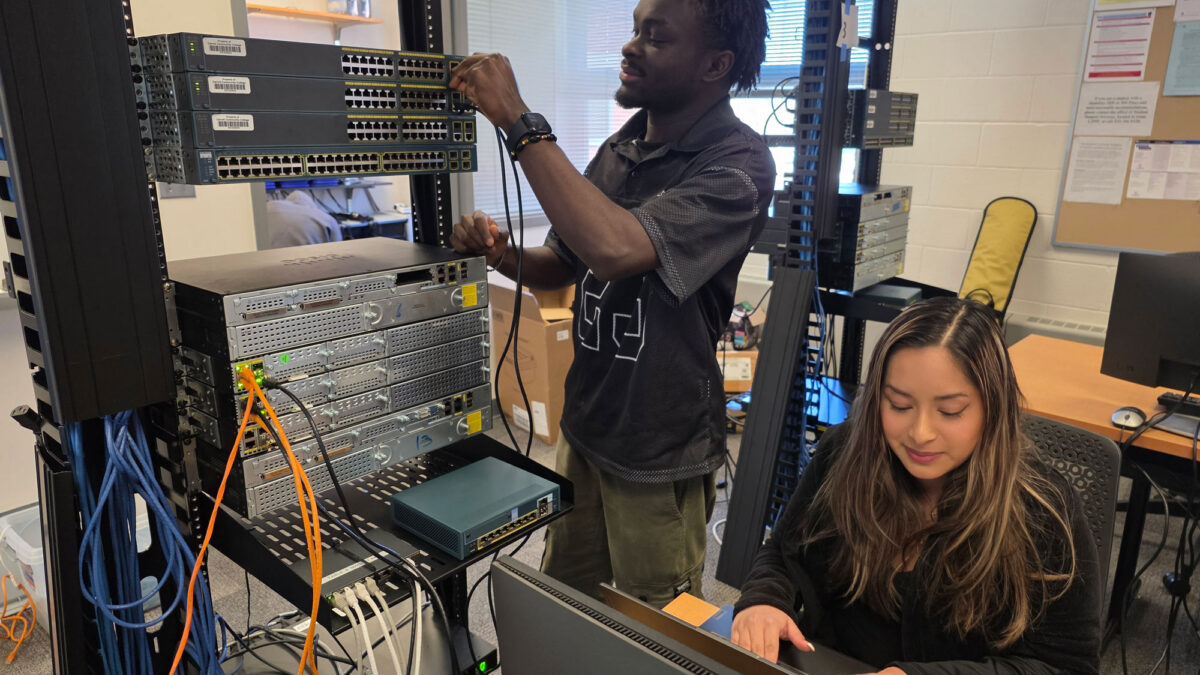
Carroll Community College is the latest institution to participate in a statewide cyber and artificial intelligence program aimed at increasing the labor pool in those fields. (Photo courtesy Carroll Community College)
Carroll Community College launches cyber, AI clinic under MD grant


Key takeaways:
- Carroll Community College will launch a cyber and AI clinic as part of a statewide workforce initiative.
- Carroll partners with Howard and Frederick Community Colleges and Cyber Ready Clinic to expand hands-on cyber training.
Carroll Community College is the latest Maryland institution to participate in a new statewide cyber and artificial intelligence initiative aiming to increase the information technology labor pool, the school announced this month.
As one of three awardees of the Maryland Department of Labor’s grant program, the college will bring cybersecurity training to students and low- or no-cost cyber services to local organizations, in partnership with Howard and Frederick community colleges.
This grant is the result of a partnership between the state’s Talent Innovation Fund and the Cyber Maryland Program, which is providing $1.5 million to train aspiring cyber professionals and $2.5 million for internships and upskilling across the state in life sciences, information technology, aerospace and defense — which Gov. Wes Moore dubbed “lighthouse” industries for their ability to drive growth and decrease Maryland’s reliance on the federal government.
Under the grant, Howard’s Cyber & AI Clinic, operated by the nonprofit Cyber Ready Clinic, is expanding to Carroll and Frederick. Howard is the lead school on the grant and will oversee the regional project.
Over the initial three-year grant period, the schools expect to train 200 interns to develop, implement and manage solutions to real cybersecurity challenges for tax-exempt or 501(c)(3) businesses, nonprofits and community organizations lacking the resources to do the work themselves, whether that’s due to limited IT capacity, constrained budgets or increased exposure to cyber threats.
Working with Cyber Ready, Carroll Community College will identify the potential participants within the county.
Under supervision, the interns will conduct basic cybersecurity risk assessments, support vulnerability scanning and remediation planning, assist with security awareness or cyber hygiene initiatives, and strengthen policies, backups and incident readiness.
According to the U.S. Bureau of Labor Statistics, future opportunities in cybersecurity are excellent, with an expected job growth of 33% through 2033, and a median annual wage for information security analysts of $124,910.
“Carroll was selected because of the strength and maturity of its cybersecurity pathway,” said Kelly Koermer, vice president of workforce, business and community education at Carroll.
The program will be offered once a semester in a combination of synchronous and asynchronous learning, client and mentor meetings and a capstone project focused on remediating a client issue.
After completing the program, interns will take a proficiency test, and once they pass, they’ll receive a Ready5 Verified Practitioner digital badge and a stipend of approximately $500.
As part of the college’s cyber program, Carroll also has on-site access to the BCR Cyber Series 3000 Cyber Range training system. Using this system from the private BCR Cyber, which provides cyber ranges to all 16 of Maryland’s community colleges, Carroll instructors will be able to develop stronger cybersecurity curriculum while students gain experience through realistic, simulated cyberattacks.
“The internship,” said John Bruns, CEO of the Cyber Ready Clinic, “is designed to be accessible to students who are ready to apply technical knowledge in real world environments while continuing to build professional skills required for employment in the cybersecurity field.”
In November, Carroll opened its Cyber Range with a ribbon-cutting ceremony, marking the college’s entry into Maryland’s Cyber Workforce Accelerator program, established in 2024 by the Maryland Association of Community Colleges and BCR Cyber.
Recruiting interns for the Carroll program will focus on current and former Carroll cybersecurity students who’ve completed the Carroll CYBR 122 Network Security course or who have earned the CompTIA Security+ certification.
Each site will manage its own day-to-day operations, including student recruitment and supervision, while aligning with shared standards, training models and reporting requirements. This will “allow each location to respond to local workforce needs while maintaining consistency across the three sites,” said Matt Day, program director of cyber security at the college.
Koermer said in a news release: “This partnership with Howard and Frederick Community Colleges and the Cyber Ready Clinic emphasizes hands-on, real-world learning, giving students practical experience responding to active cybersecurity and AI challenges. Simultaneously, the clinic provides nonprofit and community partners with much-needed technical support and stronger cyber defenses.”
She continued, “As Maryland leads in confronting emerging cyber threats, Carroll Community College is proud to help ensure that no Maryland worker or community organization is left behind in the AI-powered economy.”
The Carroll program should begin operations this fall, with recruitment and onboarding occurring during the summer.
This story has been updated.