Sign In
 Free Newsletter

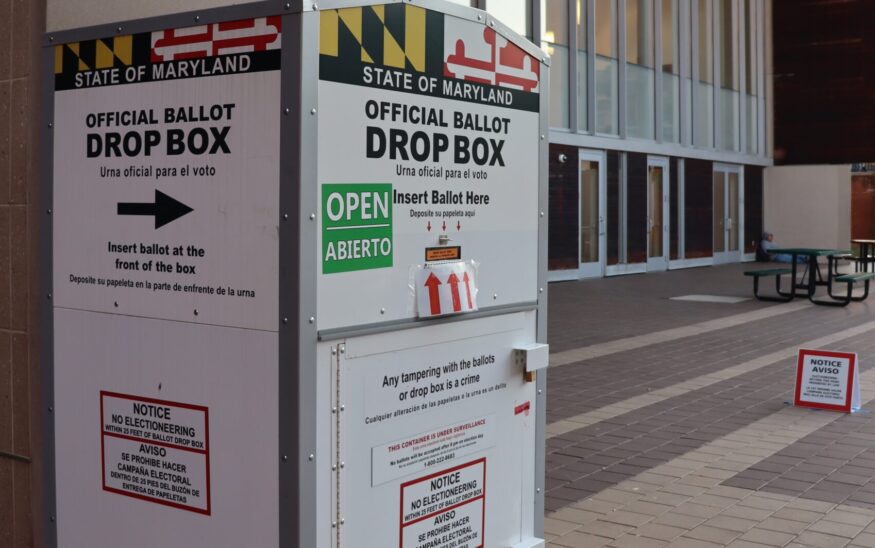
A mail-in ballot drop box outside of the Civic Building in Silver Spring during early voting for the 2024 general election. (Caley Fox Shannon/Capital News Service)
MD elections board approves canvassing protocol following mail-in ballot error


 Listen to this article
Key takeaways:
- Maryland State Board of Elections unanimously approved canvassing instructions
- Taylor Print & Visual Impressions caused mail-in ballot party errors
- Original ballots quarantined and counted only if party affiliation matches
The Maryland State Board of Elections unanimously voted Tuesday to approve official canvassing instructions for the June 23 primary election following the dissemination of replacement ballots after a printing error.
“We heard all the comments here, and we want to make sure that the canvas goes along smoothly and as transparent as possible for this issue with the vendor and the mail-in ballots,” Maryland Elections Administrator Jared DeMarinis said at a virtual meeting of the State Board of Elections.
In mid-May, the Maryland State Board of Elections confirmed that an error on the part of the state’s mail-in ballot vendor, Taylor Print & Visual Impressions Inc., caused some voters to receive the wrong party ballot for the primary election.
During a late May meeting of the State Board of Elections, DeMarinis said that original ballots will be counted if the recipient received the correct party ballot when it was initially sent and is the only ballot returned. They are to be set aside, or quarantined, until after the June 23 primary election when officials will determine if they should be counted.
Melissa Dorsey, the assistant deputy of election policy and operations for the Maryland State Board of Elections, established the official protocol for the 2026 primary election approved Thursday. Those instructions have been sent to local elections boards statewide.
DeMarinis said the newly approved protocol is in alignment with multiple articles under Maryland elections law.
According to a document approved at Tuesday’s meeting, original mail-in ballots have been voided in the state’s voter registration system if a recipient received a replacement ballot, so that it cannot be marked as received when the barcode on the return envelope is scanned to ensure that only one vote is counted. This will allow local elections boards to identify and separate them.
Local boards of elections will have a different record keeping system for the original mail-in ballots that is separate from the state’s voter registration system, and a different method of transferring their results into the election management and results system.
The legal status of the original ballots will be determined during canvassing. Voters can determine that they are using their replacement ballots through a demarcation on their return envelopes that reads “Replacement Ballot Inside.” The envelopes of the original envelopes simply read “Return Envelope.”
Local boards of elections have been instructed to store the original mail-in ballots separately from replacement ballots. Ballots will be stored in a way that elections officials can determine by a person’s name or voter ID.
If returned, original ballots will not be considered for canvass until 10 a.m. on July 6.
“The goal is, from soup to nuts, all of the ballots are living in their very own universe and they don’t ever co-mingle,” Dorsey said.
In the scenario that a voter returned both the original and replacement mail-in ballots, the replacement ballot is the only one that will be counted.
If only the original ballot is returned, canvassers must determine that it coincides with the voter’s party affiliation before. It will be counted, should that be the case. If they voted the wrong party ballot, their selections in nonpartisan races will be duplicated on a new ballot and will be counted. If there are no nonpartisan races on the ballot, those ballots will be thrown out.
In Maryland, the only nonpartisan races are for membership of boards of education.
Should voters return their original ballots and also vote with a provisional ballot, the provisional ballot will be counted. If a replacement ballot is returned and a voter still chooses to vote provisionally at a polling location, the first legally sufficient ballot is the one that will be counted.
At the previous meeting of the board, DeMarinis said 447,000 mail-in ballots had been requested when the printing error was recognized. Taylor Print & Visual Impressions was unable to identify voters who received incorrect ballots, leading the State Board of Elections to issue new mail-in ballots to all who had requested them.
The replacement ballots were paid for by Taylor Print & Visual Impressions, and DeMarinis said that Maryland’s mail-in ballot director was on site while they were reprinted and packaged.
Voters who plan to submit their ballots before Election Day can submit their replacement ballots at drop boxes, early voting centers, local boards of elections or through the mail as long as they are postmarked by June 23. Mail-in ballots can also be submitted at polling places on Election Day.
Early voting begins Thursday and runs through June 18. Maryland’s primary election will be held June 23.