Sign In
 Free Newsletter

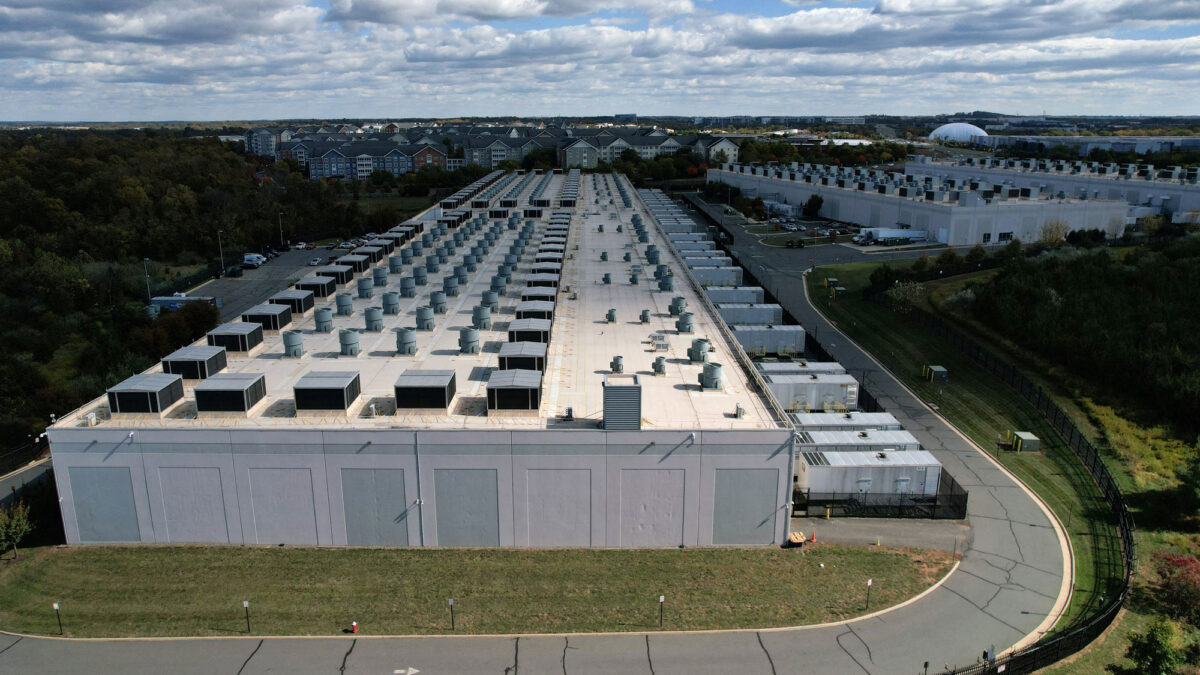
An aerial view of an Amazon Web Services Data Center known as US East 1 in Ashburn, Virginia, October 20, 2025. (REUTERS/Jonathan Ernst/File Photo)
Maryland’s new energy law intertwines with data center boom


Key takeaways:
- Maryland Utility RELIEF Act passed in 2026 session
- Data centers must pay for infrastructure upgrades
- Harford County is first in Maryland to ban data centers
- Maryland Tech Council CEO Kelly Schulz supports fair cost sharing
The passing of the Utility RELIEF (Reducing Energy Load Inflation for Everyday Families) Act during Maryland’s 2026 legislative session means some financial respite in today’s inflationary climate is, hopefully, on the way for its residents and businesses.
The new law addresses such topics as rate hike protections, streamlining permitting for renewables and creating a temporary freeze on EMPOWER surcharges on bills.
But there’s another area that’s looming large over the state, as well as the world: The rise of data centers and the need for more to rise. The new law also calls for the centers, which are notorious for massive energy consumption and criticized for various climate concerns, to upgrade their own infrastructure to avoid overburdening Maryland’s already overburdened grid.
RELATED: Utility rate-setting is ‘Catch-22,’ MD lawmakers, advocates say
The issue of data centers is one that many communities around the country. Last week, Harford County Executive Bob Cassilly signed a bill that bans data centers in the county. It is the first county in Maryland to take that step.
The Utility RELIEF Act also holds other provisions, most notably making Maryland among the first states in the nation to require large load customers, like data centers, to pay for infrastructure upgrades needed to connect to the electric grid and the first to require registration with its Public Service Commission for these customers, “ensuring that these costs are not borne by ratepayers,” said Maryland Tech Council CEO Kelly Schulz.
‘Fair share’
Maryland’s electricity prices are driven “by a wide range of factors, most notably that the state imports 60% of its power, which increases transmission costs,” said Schulz.
“Further,” she said, a new Energy + Environmental Economics study states that, “in wholesale markets such as PJM, capacity price volatility has also been driven by market design and supply-side factors, including power plant retirements, reduced accreditation of fossil resources, higher reliability targets, planning/forecasting gaps, regulatory lag, permitting barriers and interconnection backlogs.”
RELATED: Piedmont power line sparks preliminary eminent domain questions
As data centers in Maryland “invest their fair share for the electricity they use and the infrastructure that delivers it, Maryland ratepayers will benefit,” Schulz said. “Data centers invest heavily to modernize the substations, poles and wires that make up the electric grid we all depend on.”
Research from EEE indicates that “a single 100 MW data center yields more than $3 million in surplus value that utilities can use to reduce costs for other customers,” she said. “Many electricity providers across the U.S. have recently lowered ratepayer costs, stating that the reductions were made possible by data center power agreements.”
One such example is that of New Orleans-based Entergy, which announced $5 billion in savings for 2.3 million customers in Arkansas, Louisiana, Mississippi and Texas, which was borne of data center agreements earlier this year.
Getting registered
Among the many observers hoping that the aforementioned occurs in Maryland is Owen Rouse. Rouse, a senior vice president with Baltimore-based MacKenzie Commercial Real Estate Services, said he’s “curious to know how 200 data centers in Loudoun County, Virginia, alone, in a state that imports about 30% of its electricity (ranking it second in the nation, according to the U.S Energy Information Administration), are not overburdening its energy infrastructure.”
His point is, Virginia and Maryland (40%, also according to the EIA) import a considerable amount of electricity, “but our bills are higher in Maryland. Virginia has 609 data centers across the state and we have 53 (according to Data Center Map), but our bills are at 20 cents per kWh hour and Virginia’s hover around 16 cents per kWh,” he said, “despite having so many data centers.
“But our rates in Maryland have risen,” he said. “Why?”
RELATED: 100% clean electricity by 2035: Can MD meet climate goals?
Sen. Katie Fry Hester (D-9), who authored the data center amendment to House Bill 1532, said Maryland’s new law and its registry are intended to answer such questions “and give Maryland policymakers, utilities and grid operators a more accurate picture of future electricity demand.
“Today, billion-dollar decisions about generation, transmission and grid infrastructure are being made without a clear understanding of which projects are likely to move forward and which are simply holding a place in the queue,” Fry Hester said. “A data center registry will improve the forecasts that drive energy planning and capacity procurement, helping us make smarter investments and better protect ratepayers from unnecessary costs.”
She said the legislation is also designed to encourage the types of projects that provide the greatest benefit to Maryland’s electric system.
“By creating clean capacity tiers, we can reward projects that bring new clean generation online, participate in demand response and help manage peak demand,” Fry Hester said. “Our goal is to attract the kinds of projects that strengthen grid reliability, support affordability, and create long-term value for Maryland residents.”
Among the firms trying to bring more balance to the industry is Rockville-based X-Energy, which designs advanced, small modular nuclear reactors (or SMRs) and manufactures proprietary nuclear fuel that is billed as safe, zero-carbon and highly reliable. Company representatives declined to offer comment for this article.
Nationwide issue
What’s happening in Maryland with the new law requiring data centers to pay higher rates, enter into long term contracts to recoup costs, or directly pay for the needed infrastructure is “part of a broader policy trend sweeping the U.S., with federal legislation now also pending, to make data centers pay their fair share,” said Chris Lloyd, senior vice president, infrastructure and economic development, in the Richmond, Virginia, office of McGuire Woods Consulting.
Just how data centers will bring their own power “will be particular to each case and could mean additional generation via nuclear, offshore wind, solar or natural gas,” said Mike McHale, business manager for the International Brotherhood of Electrical Workers Local Union 24, in Frederick, Baltimore and the Eastern Shore. “For instance, we already need more offshore wind due to demand and the jobs it creates.”
McHale feels the new law didn’t receive enough tweaking, notably regarding renewing Maryland’s Renewable Portfolio Standards.
“With the renewable energy goals, credits needed to be updated and incentives were not addressed during the recent General Assembly,” he said. It’s about large load users “bringing their own power, but it didn’t really define what that means.”
He added that getting the legislation passed “was one thing, but the execution by the administration is crucial. In theory, enough was done, but people have to follow through. That’s what matters. Done correctly, it could be a game-changer for the state.”
McHale also pointed out that at any rate, the state needs to take advantage of this vast opportunity, even if some people object to the size and decibel level of, and a perceived lack of jobs created by, large data centers, which can generally be run by about two dozen people and up to 100, depending on their size.
So the workforce is expanding accordingly. “I have 700 apprentices in our program now, but there were 350 less than three years ago,” he said. “IBEW Local 24 had 1,820 members five years ago; today, it’s 3,300 ― with 800 working on data centers in Maryland. They’re earning solid middle-class wages.
“And bear in mind that these places need to be upgraded every few years, which once again creates jobs,” McHale said. “If the counties in Maryland are interested, they can locate brownfield or former industrial sites, similar to Quantum Frederick, and build data centers there.”
Various factors
What the Utility RELIEF Act does, in essence, is offer a clearer view to the future in this wildly expanding industry. Rhyan Lake, a spokesperson for Gov. Wes Moore, said requiring data centers to cover the cost of their energy infrastructure upgrades, creating a separate rate class for data centers and mandating data centers to register with PSC “brings transparency in the process, while holding data centers accountable for their own costs.
“No state can control the wholesale cost of energy or the reliability of our regional grid,” said Lake, “but Gov. Moore has taken action to provide more relief for Maryland families and aggressively pushed for action from regional operator PJM to hold them accountable.”
She added that Moore “has aggressively pursued reforms at PJM to ensure data centers pay for new generation or transmission infrastructure. This PJM level advocacy is meant to partner with the state level work to cover these data center costs from every possible angle.”
Schulz concurred concerning the value in taking a broad approach. “Lowering electricity rates in Maryland requires solutions for a broad set of long-standing factors,” she said, “including power plant retirements, interconnection backlogs and regulatory lag.
“Sound planning for data center investment in Maryland will help modernize our electric grid,” she said, “while strengthening our economy and communities.”