Sign In
 Free Newsletter


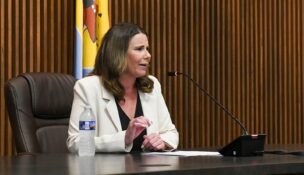
Maryland Attorney General Anthony Brown speaks on May 15, 2024. (The Daily Record/Jack Hogan)
MD, states sue Trump administration over anti-DEI terms in federal contracts


 Listen to this article
Key takeaways:
- Maryland co-leads coalition of 19 states and Washington, D.C.
- Lawsuit challenges Trump executive order on DEI contract terms and claims federal agencies violated Administrative Procedure Act
- Case filed in U.S. District Court for the District of Maryland
Maryland co-led a coalition of Democratic state officials in filing a lawsuit Wednesday claiming federal agencies have flouted the law by hastily implementing President Donald Trump’s executive order that seeks to eliminate diversity, equity and inclusion initiatives by federal contractors including many state agencies.
The lawsuit in Baltimore federal court by the attorneys general of 19 states and Washington, D.C., claims that more than two dozen federal agencies are adding new terms to federal contracts barring “any racially discriminatory DEI activities” without notice or explaining exactly what is prohibited.
Trump directed agencies to adopt those new terms in a March executive order, part of his broader efforts to eradicate DEI initiatives.
“These new contract terms were imposed without public input, without clear guidance, and without explanation of how they differ from anti-discrimination laws that have been on the books for decades,” Maryland Attorney General Anthony Brown said in a news release. “These poorly defined mandates cause confusion for contractors like Maryland’s State agencies and universities. We’re filing this lawsuit to restore the proper standards and process that contractors deserve and the law requires.”
Groups representing university faculty and minority business owners filed a lawsuit in the same court in April claiming Trump’s order violates contractors’ free-speech rights under the First Amendment of the U.S. Constitution. They have moved for a preliminary injunction that would block Trump’s order pending the outcome of the case.
Massachusetts Attorney General Andrea Joy Campbell in a statement said that the Trump administration was ignoring its obligations under federal law to make headlines about eliminating diversity efforts.
“This is yet another example of haphazard actions designed to confuse and intimidate rather than provide clear guidance to people and businesses — in this case federal contractors,” Campbell said. She was joined in the lawsuit by her counterparts in California, Illinois and New Jersey, among other states.
The White House and the U.S. Department of Justice did not immediately respond to requests for comment.
The lawsuit says state agencies regularly contract with the federal government and the states involved in the case collectively hold billions of dollars in existing contracts. Trump’s order could affect up to 640,000 contracts and subcontracts with over 34,000 unique contractors nationwide, according to federal estimates cited by Campbell’s office.
The state officials allege that the federal agencies implementing Trump’s order have violated the federal Administrative Procedure Act by acting in an arbitrary and capricious manner and failing to seek public comment before adding language from Trump’s order to federal contracts, and are seeking to block them from imposing the new contract terms.
Civil rights advocates say DEI practices help address historic inequities for marginalized groups like women, LGBTQ people and racial and ethnic minorities. Trump and many conservatives argue that DEI is discriminatory against groups like white people and men and impedes merit-based decision-making.
Trump since last year has issued a series of orders aimed at eliminating DEI programs from the federal government, higher education, government contractors and grant recipients. He also repealed an executive order issued by Democratic former President Lyndon Johnson in 1965 requiring federal contractors to take affirmative action to hire minorities and women.
The case is Maryland v. Hegseth, U.S. District Court for the District of Maryland, No. 1:26-cv-02322.
For the states: James Luh of the Maryland Attorney General’s Office; Alexis Piazza of the California Attorney General’s Office; Paul Berks of the Illinois Attorney General’s Office; and others.
For the federal government: not yet available.
Reporting by Daniel Wiessner in Albany, New York.