Sign In
 Free Newsletter

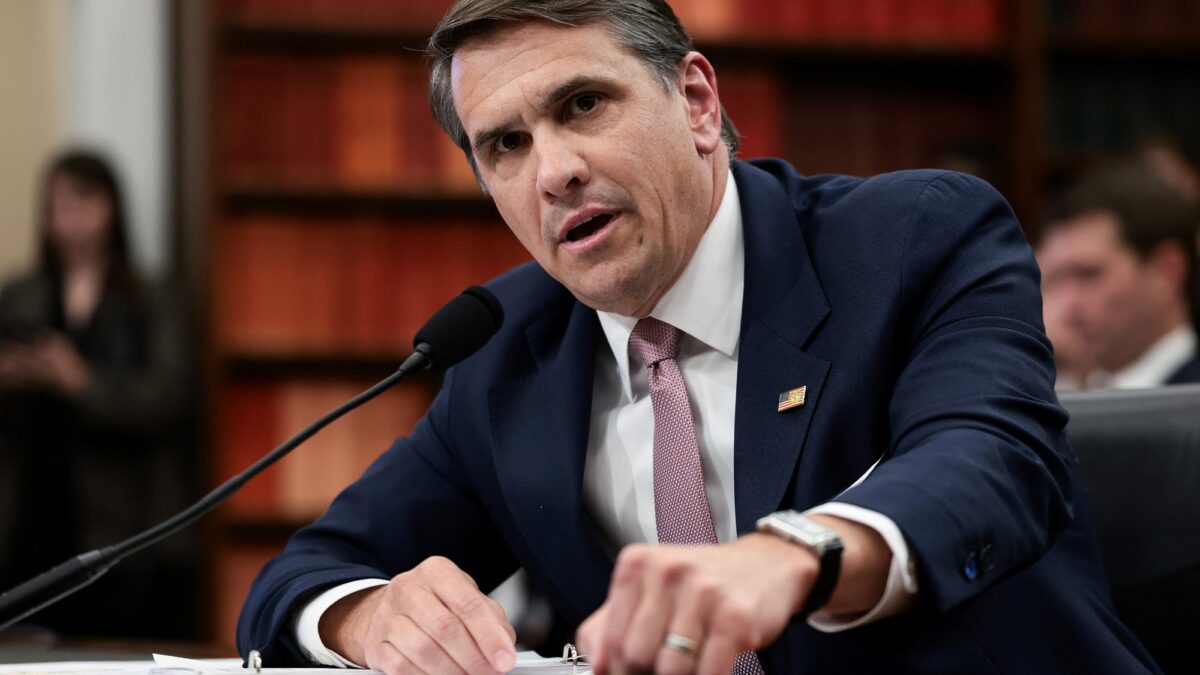
Acting U.S. Attorney General Todd Blanche responds to U.S. Rep. Madeleine Dean's (D-PA) question during his testimony before a House Appropriations Commerce, Justice, Science, and Related Agencies Subcommittee oversight hearing on the Department of Justice, on Capitol Hill, in Washington, D.C., on June 2, 2026. (REUTERS/Evelyn Hockstein)
Federal judge warns Justice Department not to revive payout fund


Key takeaways:
- Judge Richard J. Leon denies temporary restraining order
- Acting Attorney General Todd Blanche says fund plans scrapped
- CREW challenges Justice Department‘s position on fund status
A federal judge in Washington, D.C., on Wednesday declined to bar the Trump administration from pursuing its $1.8 billion payout fund for those who claim they were improperly investigated by the government, saying top Justice Department officials have stated in public comments and court filings that the fund is dead.
But even as he denied the request for a temporary restraining order, U.S. District Judge Richard J. Leon warned the Justice Department not to revive the fund.
“Don’t play ‘possum with this court,” Leon said at a hearing in D.C. federal court.
Leon said he would rule at a later date on a request for a preliminary injunction in the same case, which was filed by the group Citizens for Responsibility and Ethics in Washington (CREW).
But the judge said the case appeared to be moot because acting attorney general Todd Blanche testified to Congress last week that the plans for the $1.8 billion fund had been scrapped, and Justice Department officials then repeated that in court filings.
Plans for the “Anti-Weaponization Fund” generated bipartisan backlash in Congress and at least five federal lawsuits after Blanche announced it last month. It proved to be short-lived.
At a congressional hearing last week, Blanche said the fund would not be established.
That change of position came after another federal judge, Leonie M. Brinkema, ordered Trump administration officials not to proceed with the fund until at least Friday, when she is scheduled to hold a hearing in Alexandria, Virginia, federal court.
Republicans, who control the Senate, had also expressed misgivings about potentially using taxpayer dollars to enrich the Jan. 6, 2021, rioters who received pardons from President Donald Trump or had their sentences commuted.
CREW attorney Nikhel Sus argued at Wednesday’s hearing that Blanche’s statements and the Justice Department’s court filings could be temporary and unreliable. The Justice Department has not rescinded Blanche’s May 18 memo establishing the fund, Sus said, and Trump in public comments declined to echo Blanche’s statements that the plans had been scrapped.
Plaintiffs in the Virginia case made similar arguments in a court filing in that matter Wednesday, urging Brinkema to not just take the department at its word.
Leon said Trump could be making statements for a political benefit. But Justice Department lawyers, he added, could face judicial sanctions for making misrepresentations in court filings.
“The fact of the matter is, no members have been appointed to the fund … [and] no money has been transferred,” Andrew Block, a Justice Department lawyer, argued at the hearing Wednesday. CREW did not have legal standing to sue because the case was moot and their injuries were all speculative, he said.
Block added that he and Associate Attorney General Stanley Woodward, the No. 3 official in the department, had both signed their names to court filings saying the fund was dead.
“Our briefs are assurances in writing,” he said. “And those submissions are court documents.”
Trump this week formally nominated Blanche for a full term as attorney general. Questions about his role in the creation of the fund are likely to come up in what is expected to be a contentious and uncertain confirmation battle in the Senate.
Salvador Rizzo covers the D.C. federal court and U.S. attorney’s office for The Washington Post.
Jeremy Roebuck contributed to this report.